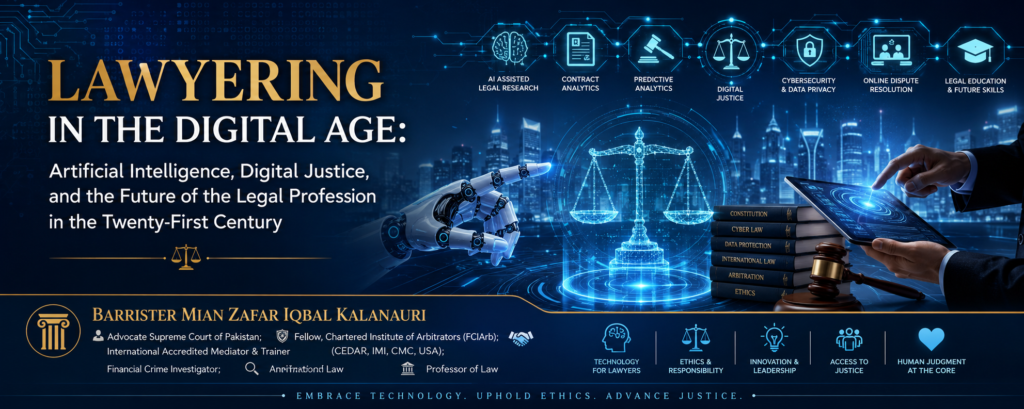
Lawyering in the Digital Age: Artificial Intelligence, Digital Justice, and the Future of the Legal Profession in the Twenty-First Century
Barrister Mian Zafar Iqbal Kalanauri
Advocate Supreme Court of Pakistan, Fellow Chartered Institute of Arbitrators (FCIArb),International Accredited Mediator & Trainer(CEDAR, IMI, CMC, USA), Financial Crime Investigator , Professor of Law
Abstract
The legal profession is undergoing the most profound transformation since the emergence of the modern nation-state. Artificial intelligence (AI), machine learning, blockchain, generative AI, big data analytics, cloud computing, digital evidence, and online dispute resolution are redefining not only how lawyers work but also the institutional architecture of justice itself. Traditional legal practice, which historically relied upon doctrinal knowledge, manual research, paper-based evidence, and adversarial courtroom advocacy, is increasingly giving way to technology-enabled legal services characterised by automation, predictive analytics, intelligent document review, virtual hearings, and AI-assisted decision support.
This article critically examines the evolving relationship between law, technology, and professional responsibility in the twenty-first century. It argues that contemporary debates framed around whether AI will replace lawyers fundamentally misconceive the nature of legal practice. While artificial intelligence is capable of automating numerous cognitive and administrative functions traditionally performed by lawyers, it remains incapable of replicating the normative judgment, ethical reasoning, professional accountability, emotional intelligence, and contextual decision-making that constitute the essence of legal professionalism.
Drawing upon comparative developments in the United Kingdom, the United States, the European Union, Singapore, Estonia, and Pakistan, this article explores the implications of AI for legal ethics, digital evidence, cybersecurity, legal education, alternative dispute resolution, judicial administration, and access to justice. It examines emerging regulatory responses to generative AI, including evolving professional duties of technological competence and the challenges posed by algorithmic bias, deepfakes, confidentiality, explainability, and accountability.
The article advances an original normative model-the Future Lawyer Competency Framework (FLCF)-which identifies seven interdependent competencies required for twenty-first-century legal practice: legal expertise, technological competence, ethical judgment, digital evidence literacy, human-centered advocacy, global legal awareness, and lifelong professional learning. It argues that the future of legal practice depends not upon competition between lawyers and artificial intelligence but upon the intelligent integration of technological innovation with enduring principles of justice, professional ethics, and the rule of law.
Ultimately, the article contends that although artificial intelligence will fundamentally transform legal services, the legitimacy of justice will continue to depend upon human judgment. The lawyer of the future must therefore evolve from a traditional legal technician into a technologically competent, ethically grounded, globally informed, and human-centered professional capable of leading legal institutions through an era of unprecedented technological change.
Keywords
Artificial Intelligence; Legal Profession; Legal Ethics; Digital Justice; Digital Evidence; Online Dispute Resolution; Legal Education; Law and Technology; Cybersecurity; Professional Responsibility; Access to Justice; Future Lawyer; Generative AI; Legal Innovation.
I. Introduction
The legal profession stands at a transformative moment in its history. Few periods have witnessed changes of comparable magnitude to those currently reshaping legal institutions worldwide. Artificial intelligence (AI), generative large language models (LLMs), blockchain technologies, cloud computing, algorithmic decision-making, digital identity systems, and advanced data analytics are redefining both the substance of legal practice and the institutional processes through which justice is administered. The cumulative effect of these technologies extends well beyond incremental improvements in efficiency; rather, they challenge long-standing assumptions concerning legal reasoning, professional expertise, judicial administration, evidentiary reliability, and access to justice.
Historically, legal practice has adapted to successive waves of technological innovation. The introduction of the printing press transformed legal scholarship by facilitating the widespread dissemination of statutes, judicial decisions, and legal treatises. The industrial revolution generated entirely new areas of commercial regulation, labour law, and administrative governance. The digital revolution of the late twentieth century introduced electronic databases, computer-assisted legal research, electronic discovery, online legal information systems, and virtual communication technologies. Each technological transformation altered legal practice without fundamentally displacing the lawyer’s central role as interpreter, advocate, counsellor, and guardian of justice.
The contemporary AI revolution differs in one important respect. Previous technological developments largely enhanced lawyers’ capacity to perform existing tasks more efficiently. By contrast, modern artificial intelligence increasingly performs cognitive functions previously regarded as uniquely human. Generative AI systems can draft legal memoranda, summarise judicial opinions, analyse contractual provisions, identify litigation risks, predict legal outcomes, generate legal arguments, translate multilingual documents, and assist in regulatory compliance with remarkable speed and sophistication. Consequently, questions that were once confined to speculative academic debate have become pressing practical concerns for courts, regulators, law firms, universities, and professional associations.
The widespread availability of advanced generative AI platforms has accelerated these developments dramatically. Legal professionals now routinely employ AI-assisted tools for document review, due diligence, contract analytics, litigation support, and legal research. Courts in multiple jurisdictions have begun issuing practice directions governing the responsible use of generative AI in litigation, while law societies and bar associations increasingly recognise technological competence as an essential component of professional responsibility. Simultaneously, universities confront the challenge of preparing future lawyers for a profession in which technological literacy is no longer optional but indispensable.
These developments have generated a rapidly expanding body of academic literature. Much of the existing scholarship focuses on whether artificial intelligence will replace lawyers or transform particular segments of legal practice. Such discussions, although valuable, frequently oversimplify the nature of legal professionalism by equating legal work with information processing. Legal practice involves considerably more than the application of legal rules to factual scenarios. Lawyers exercise professional judgment under conditions of uncertainty; evaluate competing normative considerations; reconcile legal doctrine with commercial realities; negotiate settlements; counsel vulnerable clients; safeguard constitutional rights; and maintain public confidence in the administration of justice. These responsibilities require forms of reasoning, ethical deliberation, and interpersonal engagement that extend beyond computational efficiency.
Accordingly, the principal question confronting the legal profession is not whether artificial intelligence can perform discrete legal tasks more rapidly than human practitioners. Rather, it is whether legal institutions can successfully integrate increasingly sophisticated technological systems while preserving the normative foundations upon which the legitimacy of law depends. Efficiency, although desirable, cannot substitute for fairness. Predictive accuracy cannot replace judicial independence. Automated decision-making cannot displace procedural justice. Nor can algorithmic optimisation replace the ethical accountability that remains central to professional legal practice.
This article argues that the emerging relationship between artificial intelligence and legal practice should be understood as one of augmentation rather than substitution. Properly designed and responsibly governed AI systems possess enormous potential to improve legal research, increase efficiency, reduce transaction costs, expand access to justice, and assist judicial administration. Nevertheless, these benefits are accompanied by substantial risks relating to algorithmic bias, opacity, confidentiality, cybersecurity, misinformation, evidentiary authenticity, regulatory accountability, and professional negligence. The challenge facing contemporary legal systems is therefore neither technological enthusiasm nor technological resistance, but principled technological governance.
To address these issues, this article develops a comprehensive analytical framework for understanding the future of legal professionalism in an era increasingly characterised by intelligent technologies. It first examines the technological forces driving contemporary transformation within legal practice before considering the implications of artificial intelligence for legal ethics, digital evidence, cybersecurity, judicial administration, and alternative dispute resolution. Comparative analysis is undertaken across selected jurisdictions, including the United Kingdom, the United States, the European Union, Singapore, Estonia, and Pakistan, in order to identify emerging regulatory trends and institutional responses. Building upon this comparative analysis, the article proposes the Future Lawyer Competency Framework (FLCF) as a normative model for twenty-first-century legal education and professional development.
The central thesis advanced throughout this article is that artificial intelligence will undoubtedly transform the practice of law; however, it will not eliminate the lawyer’s indispensable constitutional and societal function. The future lawyer will not compete against artificial intelligence but will instead distinguish themselves through those uniquely human attributes that technology cannot replicate: ethical judgment, contextual reasoning, professional responsibility, emotional intelligence, leadership, and an unwavering commitment to justice. The continued legitimacy of legal institutions will therefore depend not upon technological capability alone, but upon the capacity of lawyers to integrate innovation with the enduring values of the rule of law.
II. The Fourth Industrial Revolution and the Transformation of the Legal Profession
A. From the Information Age to the Intelligence Age
The history of the legal profession has always been intertwined with technological development. Every major technological revolution has altered the mechanisms through which law is created, communicated, interpreted, and enforced. Yet few transformations rival the breadth and intensity of the Fourth Industrial Revolution, a phenomenon characterised by the convergence of artificial intelligence, robotics, cloud computing, blockchain, biotechnology, quantum computing, advanced telecommunications, and pervasive digital connectivity.
Unlike previous industrial revolutions, which primarily automated physical labour or facilitated information exchange, the Fourth Industrial Revolution increasingly automates aspects of human cognition. This distinction has profound implications for legal practice because the legal profession has historically been founded upon specialised intellectual labour. Legal research, statutory interpretation, contract drafting, evidentiary analysis, due diligence, legal prediction, regulatory compliance, and legal writing have traditionally constituted core functions requiring highly trained professional judgment.
Artificial intelligence now performs many of these activities with unprecedented speed and sophistication. Contemporary generative AI systems can synthesise vast quantities of legal information within seconds, identify relevant authorities across multiple jurisdictions, produce first-draft legal memoranda, compare contractual provisions, detect inconsistencies within complex documentation, and generate structured legal analyses that previously required extensive human effort.
This transition marks a movement beyond the Information Age into what may appropriately be described as the Intelligence Age, in which computational systems increasingly assist, augment, and in certain circumstances automate cognitive aspects of professional work. For the legal profession, the implications extend far beyond technological efficiency. They require a fundamental reconsideration of professional identity, legal education, institutional design, ethical regulation, and the continuing role of human judgment within increasingly technology-enabled systems of justice.
III. Artificial Intelligence and the New Lawyer: Redefining Legal Practice in the Twenty-First Century
A. The Emergence of Artificial Intelligence as a Legal Actor
Artificial intelligence has evolved from a peripheral technological innovation into a central feature of contemporary legal practice. Unlike earlier legal technologies, which merely digitised existing workflows, modern AI systems increasingly participate in legal reasoning itself. Large Language Models (LLMs), natural language processing systems, machine learning algorithms, and predictive analytics now perform tasks that were traditionally regarded as requiring professional legal expertise. These include legal research, statutory interpretation, contract drafting, litigation prediction, regulatory compliance, due diligence, document review, legal translation, and increasingly sophisticated client interaction.
The emergence of generative AI marks a decisive departure from earlier generations of legal technology. Electronic databases such as Westlaw and LexisNexis fundamentally altered legal research by improving access to legal information, yet they continued to rely upon lawyers to formulate legal analysis. Contemporary AI systems, by contrast, actively generate legal reasoning, draft persuasive submissions, identify legal authorities, synthesise complex regulatory frameworks, and formulate legal arguments with minimal human intervention. Consequently, AI no longer functions merely as a repository of legal information but increasingly operates as an active participant within legal decision-support systems.
This transition raises fundamental jurisprudential questions concerning the nature of legal expertise itself. If legal reasoning can increasingly be replicated through computational models trained upon enormous corpora of judicial decisions, legislation, academic commentary, and transactional documents, what remains uniquely human within legal practice? More importantly, which aspects of legal professionalism should remain exclusively human regardless of future technological capability?
These questions extend beyond technological capability into the normative foundations of law. Legal systems derive legitimacy not solely from technical accuracy but from procedural fairness, transparency, accountability, and public confidence. The increasing integration of AI into legal services therefore requires careful examination of both its transformative potential and its institutional limits.
B. From Information Processing to Professional Judgment
Legal practice has historically been misunderstood as principally an exercise in information retrieval. This misconception has contributed significantly to predictions that artificial intelligence will ultimately replace lawyers. Such predictions rest upon the assumption that legal work consists primarily of identifying relevant legal authorities and applying established legal rules to factual circumstances. Although these functions undoubtedly constitute important components of legal practice, they represent only part of a considerably broader professional enterprise.
The practice of law requires the continuous exercise of judgment under conditions of uncertainty. Lawyers advise clients whose objectives may conflict with legal obligations, commercial realities, ethical considerations, or public policy. They negotiate settlements in circumstances where legal outcomes remain uncertain. They evaluate witness credibility, anticipate judicial reasoning, reconcile conflicting precedents, manage reputational risks, and frequently counsel clients against legally permissible but ethically undesirable courses of action.
These dimensions of legal practice require forms of contextual reasoning that remain resistant to computational automation. While AI systems excel at identifying patterns within historical data, legal judgment frequently concerns novel factual scenarios, competing normative values, and evolving social expectations. Human lawyers routinely confront situations in which multiple legally plausible outcomes exist simultaneously. Selecting among them requires ethical reasoning, professional discretion, and contextual sensitivity rather than merely statistical optimisation.
This distinction between information processing and professional judgment represents one of the defining characteristics of contemporary legal practice. Artificial intelligence may substantially reduce the time required to locate relevant authorities or prepare initial drafts of legal documents; however, responsibility for legal advice continues to rest with human practitioners who remain accountable to clients, courts, regulators, and society.
C. The Evolution of Legal Service Delivery
The traditional model of legal service delivery has undergone significant structural transformation during the past two decades. Historically, legal services were organised around labour-intensive professional processes in which junior lawyers undertook extensive manual research, document review, due diligence, and drafting before senior practitioners exercised supervisory judgment. Technological innovation increasingly disrupts this hierarchical model.
Contemporary law firms increasingly employ AI-assisted document review, automated contract analysis, intelligent litigation management platforms, predictive legal analytics, and generative drafting tools. Routine commercial transactions that once required substantial human labour may now be completed with significantly greater efficiency through AI-assisted workflows. Contract lifecycle management systems automatically identify inconsistent clauses, regulatory compliance software continuously monitors legislative developments, while intelligent document review platforms rapidly analyse millions of electronic documents during complex litigation.
Consequently, the economic foundations of legal practice are evolving. Traditional billing models based upon time expenditure increasingly confront technological efficiencies that substantially reduce the hours required to complete routine legal tasks. Clients increasingly expect legal advisers not merely to provide legal expertise but also to employ technological tools capable of delivering more efficient, transparent, and cost-effective services. This shift has encouraged law firms to reconsider organisational structures, professional roles, pricing strategies, and recruitment priorities.
Importantly, technological transformation does not necessarily diminish demand for lawyers. Rather, it alters the distribution of professional activity. Routine legal work becomes increasingly automated, while complex advisory, strategic, regulatory, constitutional, and dispute resolution functions assume greater importance. Lawyers therefore transition from information processors towards strategic advisers, risk managers, negotiators, and institutional leaders.
D. Artificial Intelligence and the Changing Economics of Legal Practice
The economic implications of artificial intelligence extend beyond individual law firms to the broader legal services market. Historically, access to sophisticated legal advice has often been constrained by cost, geographical location, and professional scarcity. AI-assisted legal technologies possess considerable potential to democratise access to legal information by reducing transaction costs, improving legal research capabilities, and increasing the efficiency of legal service delivery.
For individual practitioners and small law firms, generative AI offers unprecedented opportunities to compete with substantially larger organisations. Sophisticated legal research, document drafting, contract analytics, and regulatory monitoring—once requiring extensive institutional resources—are increasingly available through affordable AI-assisted platforms. Consequently, technological innovation may reduce structural inequalities within legal service markets while simultaneously encouraging greater competition based upon expertise rather than organisational size alone.
Nevertheless, these developments also create new forms of inequality. Large multinational firms possess substantially greater resources to acquire proprietary AI systems, invest in cybersecurity infrastructure, develop internal knowledge management systems, and recruit multidisciplinary teams comprising lawyers, software engineers, data scientists, and cybersecurity specialists. Smaller practices may therefore encounter significant challenges in maintaining technological competitiveness without corresponding institutional investment.
Regulatory authorities consequently confront an emerging policy dilemma. Artificial intelligence possesses significant potential to enhance access to justice by reducing costs and increasing legal accessibility. Simultaneously, unequal technological capability may exacerbate disparities between well-resourced legal institutions and smaller practitioners. Effective regulatory frameworks must therefore balance innovation with equitable access while preserving professional independence and public confidence.
E. Artificial Intelligence as Augmentation Rather Than Substitution
Public discourse concerning AI frequently frames technological development as a contest between human professionals and intelligent machines. Such narratives oversimplify both technological capability and professional reality. Contemporary evidence suggests that artificial intelligence functions most effectively when deployed as an augmentative rather than substitutive technology.
The concept of augmentation recognises that human and artificial intelligence possess complementary strengths. AI systems demonstrate exceptional capabilities in information retrieval, pattern recognition, language generation, statistical analysis, and large-scale document processing. Human professionals contribute ethical reasoning, contextual understanding, emotional intelligence, creativity, interpersonal communication, and professional accountability. Effective legal practice increasingly depends upon integrating these complementary capabilities rather than privileging one at the expense of the other.
This collaborative model has important implications for legal education and professional regulation. Lawyers must develop sufficient technological literacy to supervise AI outputs critically, recognise algorithmic limitations, verify legal authorities, identify hallucinations, protect client confidentiality, and exercise independent professional judgment. Technological competence therefore becomes an extension of professional competence rather than an optional supplementary skill.
The lawyer of the future will not be defined by resistance to technological innovation but by the ability to integrate advanced technological tools with enduring principles of justice, professional ethics, and constitutional governance.
F. The Future Lawyer Competency Framework (FLCF): A Normative Model
Existing scholarship has extensively examined the technological disruption of legal services. Comparatively less attention has been devoted to identifying the competencies that future lawyers should possess within technology-enabled legal systems. To address this gap, this article proposes the Future Lawyer Competency Framework (FLCF) as a normative model for legal education, professional regulation, and continuing legal development.
The framework identifies seven mutually reinforcing competencies:
- Legal Expertise – mastery of substantive and procedural law, legal reasoning, statutory interpretation, and doctrinal analysis.
- Technological Competence – understanding AI, legal technology, cybersecurity, digital platforms, data governance, and emerging digital infrastructures.
- Ethical Judgment – independent professional reasoning, integrity, confidentiality, accountability, and responsible AI supervision.
- Digital Evidence Literacy – competence in electronic evidence, metadata, blockchain verification, digital forensics, AI-generated content, and evidentiary authentication.
- Human-Centered Advocacy – empathy, negotiation, mediation, client counselling, communication, and persuasive advocacy.
- Global and Comparative Legal Awareness – understanding transnational regulation, comparative legal systems, international dispute resolution, and cross-border legal practice.
- Lifelong Professional Learning – continuous adaptation to technological innovation through research, interdisciplinary collaboration, and ongoing professional education.
Unlike traditional competency models that focus primarily upon doctrinal expertise, the FLCF recognises that twenty-first-century legal professionalism requires integration of technological capability with ethical responsibility and human judgment. The framework therefore provides both a conceptual contribution to legal scholarship and a practical roadmap for law schools, bar regulators, judicial academies, and legal employers.
IV. Artificial Intelligence, Professional Ethics, and the Regulatory Future of Legal Practice
A. Introduction
Technological innovation has consistently challenged established conceptions of legal professionalism. From the introduction of electronic legal databases to the emergence of electronic discovery and virtual hearings, each successive technological advancement has required the legal profession to reconsider the relationship between professional competence and technological capability. Artificial intelligence presents perhaps the most significant challenge yet encountered because it directly intersects with those professional functions that historically defined legal expertise itself.
Unlike earlier technological innovations, contemporary AI systems increasingly participate in activities that require legal reasoning, document generation, factual synthesis, predictive analysis, and strategic decision support. Consequently, the integration of AI into legal practice raises fundamental questions concerning professional responsibility, regulatory oversight, client protection, and the continuing legitimacy of legal institutions. These questions cannot be answered solely through technological assessment. They require careful analysis of professional ethics, legal accountability, and the constitutional role of lawyers within democratic societies.
This section argues that artificial intelligence should be understood neither as an autonomous legal actor nor merely as an advanced research tool. Rather, AI functions as a professional instrument whose legitimacy depends entirely upon the ethical judgment and continuing responsibility of the lawyer supervising its use. Accordingly, the emergence of AI requires an expansion—not a diminution—of professional obligations.
B. The Duty of Technological Competence
Professional competence has traditionally been understood as requiring adequate knowledge of substantive law, procedural rules, legal research, advocacy, and client representation. The digital transformation of legal practice increasingly requires a broader understanding of competence that encompasses technological literacy.
Several professional regulators have already recognised this evolution. The duty of competence now extends beyond legal knowledge to include an understanding of the benefits, limitations, and risks associated with technologies employed in legal practice. This development reflects an important conceptual shift. Lawyers are no longer expected merely to understand the law; they must also understand the technological environment within which legal services are delivered.
Technological competence should not be interpreted as requiring lawyers to become software engineers or computer scientists. Rather, it requires sufficient understanding to exercise informed professional judgment. Lawyers must appreciate how AI systems generate outputs, recognise their limitations, evaluate reliability, verify legal authorities, supervise automated drafting, identify hallucinations, and protect confidential client information. Failure to understand these issues increasingly constitutes a professional risk rather than a mere technological deficiency.
The emergence of AI therefore transforms technological literacy from an optional professional advantage into an essential component of competent legal practice.
C. Artificial Intelligence and the Duty of Independent Professional Judgment
Perhaps the most fundamental principle governing legal ethics is the lawyer’s duty to exercise independent professional judgment.
This principle distinguishes legal advice from automated information retrieval. Clients do not retain lawyers merely to identify legal authorities. They seek professional judgment concerning uncertain legal, commercial, ethical, and strategic questions.
Artificial intelligence may recommend multiple legal strategies based upon statistical analysis or historical patterns. Nevertheless, responsibility for selecting an appropriate course of action remains exclusively human. Professional judgment requires consideration of matters that frequently lie beyond algorithmic analysis, including client objectives, commercial realities, litigation risk, judicial temperament, public policy, reputational considerations, constitutional values, and ethical implications.
Overreliance upon AI-generated recommendations risks creating what behavioral scientists describe as automation bias—the tendency of human decision-makers to accept computer-generated outputs without sufficient independent verification. Within legal practice, such reliance may undermine professional independence and expose clients to significant legal risk.
The ethical lawyer therefore treats AI as an advisory instrument rather than a substitute for legal judgment. Professional responsibility cannot be delegated to algorithms. It remains inseparable from the lawyer’s own independent reasoning.
D. Confidentiality, Privilege, and Data Governance
Few professional obligations occupy a more central position within legal ethics than the duty of confidentiality. Public confidence in legal institutions depends upon clients’ ability to disclose sensitive information secure in the knowledge that their communications will remain protected.
The increasing use of cloud-based AI systems complicates this traditional obligation. Many generative AI platforms process user inputs through remote computing infrastructure that may involve third-party data processing, cross-border data transfers, machine learning optimisation, or cloud storage arrangements. These technological processes raise complex questions concerning legal professional privilege, confidentiality, cybersecurity, and regulatory compliance.
Lawyers must therefore exercise careful judgment before uploading confidential client information into external AI platforms. Issues requiring consideration include:
- the provider’s data retention policies;
- encryption standards;
- jurisdictional location of servers;
- contractual confidentiality protections;
- applicable data protection legislation;
- cybersecurity certification;
- and whether client data may be incorporated into future model training.
Professional regulators increasingly emphasise that confidentiality obligations apply equally within digital environments. The mere convenience of AI-assisted drafting cannot justify compromising privileged communications or confidential legal advice.
Accordingly, responsible AI governance within legal practice requires both technological safeguards and informed professional oversight.
E. Hallucinations and the Duty of Verification
One of the most widely discussed limitations of contemporary generative AI concerns the phenomenon commonly described as hallucination. Hallucinations occur when AI systems confidently generate inaccurate, fabricated, or non-existent legal authorities, factual assertions, statutory provisions, or judicial decisions.
From an ethical perspective, hallucinations present challenges considerably more serious than ordinary factual error. Because generative AI frequently produces linguistically persuasive and internally coherent outputs, inaccurate information may appear entirely credible unless independently verified.
Recent litigation in several jurisdictions has demonstrated the professional consequences of relying uncritically upon AI-generated legal citations. Courts have sanctioned practitioners who submitted legal authorities that did not exist or whose contents had been inaccurately represented. Such cases illustrate a broader principle. Artificial intelligence does not alter the lawyer’s duty of candour toward the court.
Every legal authority generated through AI must therefore be independently verified against authoritative legal sources before being relied upon in litigation, legal opinions, contractual drafting, or academic scholarship.
Verification remains a non-delegable professional obligation.
F. Algorithmic Bias and Equality Before the Law
Artificial intelligence systems derive predictive capability from historical datasets. Consequently, AI outputs inevitably reflect characteristics present within underlying training data.
This creates significant concerns regarding algorithmic bias.
Historical legal datasets frequently incorporate systemic inequalities relating to race, gender, socioeconomic status, disability, geography, policing practices, sentencing patterns, and institutional decision-making. Machine learning systems trained upon such datasets may inadvertently reproduce or amplify existing inequalities unless carefully designed, audited, and supervised.
The implications extend beyond technical accuracy.
Equality before the law constitutes a constitutional principle within democratic legal systems. If AI-assisted legal technologies systematically disadvantage particular individuals or communities, legal institutions risk undermining public confidence in procedural fairness.
Lawyers therefore bear an ethical responsibility not merely to employ AI efficiently but also to interrogate its fairness. Professional competence increasingly includes recognising circumstances in which algorithmic outputs require careful scrutiny due to potential bias or discriminatory effects.
AI should assist legal decision-making.
It must never become an unquestioned source of legal authority.
G. Explainability, Transparency, and Accountability
Traditional legal reasoning possesses an important characteristic often absent from sophisticated AI systems.
It is explainable.
Judges explain judgments.
Lawyers explain legal advice.
Arbitrators explain awards.
Administrative authorities explain decisions.
This culture of reasoned justification lies at the heart of the rule of law.
Many advanced AI models, however, function as highly complex statistical systems whose internal reasoning processes remain partially opaque. This phenomenon—often described as the “black box problem”—raises profound jurisprudential questions concerning accountability and procedural fairness.
If an AI system recommends litigation strategy, predicts judicial outcomes, or assists administrative decision-making, affected individuals may legitimately ask:
- Why was this conclusion reached?
- Which factors influenced the outcome?
- Can the reasoning be independently scrutinised?
- Who bears responsibility if the recommendation proves incorrect?
These questions cannot be answered solely through technical explanation. They concern the legitimacy of legal authority itself.
Accordingly, future AI governance should incorporate principles of transparency, explainability, contestability, and meaningful human oversight.
H. Toward an Ethical Framework for AI-Assisted Lawyering
The preceding analysis suggests that existing professional duties remain fundamentally applicable within technology-enabled legal practice. Nevertheless, their practical content requires reinterpretation.
This article therefore proposes five guiding principles for ethical AI-assisted lawyering:
- Human Primacy – final legal responsibility must always remain with the lawyer.
- Independent Verification – all AI-generated legal authorities and factual assertions must be verified through authoritative sources.
- Confidentiality by Design – AI should never compromise client privilege or confidential communications.
- Transparency and Explainability – lawyers should understand sufficiently how AI-generated recommendations are produced to evaluate their reliability.
- Continuous Professional Development – technological competence should become an integral component of continuing legal education and professional regulation.
Together, these principles provide the ethical foundation upon which responsible AI integration may occur without undermining the constitutional values that legal institutions exist to protect.
Concluding Observations
Artificial intelligence represents neither an existential threat to legal professionalism nor a technological panacea capable of resolving every institutional challenge confronting justice systems. Its significance lies instead in its capacity to redefine the practical conditions under which lawyers exercise professional judgment.
The ethical question is therefore not whether lawyers should use artificial intelligence.
The real question is whether lawyers can use artificial intelligence while remaining faithful to the enduring principles of independence, integrity, competence, confidentiality, accountability, and justice.
The answer will determine not only the future of legal practice but also the future legitimacy of the rule of law itself.
V. Digital Evidence, Artificial Intelligence, and the Future Courtroom: Reimagining Evidentiary Law in the Digital Age
A. Introduction
The digital transformation of society has fundamentally altered the nature of evidence presented before contemporary courts and arbitral tribunals. Whereas twentieth-century litigation relied predominantly upon paper documents, handwritten correspondence, physical exhibits, eyewitness testimony, and tangible objects, twenty-first-century disputes increasingly revolve around electronically stored information (ESI), cloud-based communications, social media content, blockchain transactions, digital identities, surveillance technologies, biometric authentication, and AI-generated material. Consequently, evidentiary law has entered an era in which questions of authenticity, reliability, integrity, and admissibility are becoming substantially more complex than at any previous stage in legal history.
The significance of this transformation extends beyond procedural reform. Evidence constitutes the epistemological foundation of adjudication. Courts derive legitimacy from their ability to determine disputed facts through reliable evidentiary processes. As digital technologies increasingly mediate human interaction, judicial institutions must develop methodologies capable of distinguishing authentic digital evidence from technologically sophisticated fabrications. The rise of generative artificial intelligence, deepfake technologies, synthetic media, algorithmically manipulated documents, and automated data generation therefore challenges long-established assumptions concerning the nature of proof itself.
This section argues that evidentiary law is undergoing a paradigmatic transformation comparable to the historical transition from oral testimony to documentary evidence. Future legal systems will increasingly depend upon technological literacy, digital forensic methodologies, cryptographic verification, and interdisciplinary cooperation between lawyers, judges, investigators, computer scientists, and forensic experts. The lawyer of the future must therefore possess not only doctrinal knowledge of evidentiary rules but also a sophisticated understanding of digital technologies capable of generating, preserving, manipulating, authenticating, and challenging electronic evidence.
B. The Digital Transformation of Evidence
Historically, evidentiary systems developed within environments dominated by physical documentation. The authenticity of documentary evidence depended principally upon handwriting, signatures, seals, paper characteristics, witness testimony, and physical possession. Courts evaluated documentary reliability through direct examination of tangible objects capable of visual inspection.
The digital environment fundamentally alters these assumptions. Modern communications rarely exist in fixed physical form. Emails, encrypted messaging applications, cloud storage systems, collaborative digital workspaces, blockchain ledgers, digital contracts, biometric identifiers, and Internet-of-Things (IoT) devices continuously generate electronic records without corresponding physical manifestations. Unlike traditional documentary evidence, digital information may be duplicated perfectly, altered invisibly, transmitted instantaneously across jurisdictions, and stored simultaneously in multiple locations.
These characteristics produce significant evidentiary challenges. Digital evidence often appears identical regardless of whether it has been modified, fabricated, or manipulated. Conventional visual inspection therefore becomes insufficient. Courts increasingly depend upon metadata analysis, cryptographic verification, digital forensic examination, chain of custody documentation, system logs, server records, network analysis, and expert testimony to determine authenticity.
The transformation of evidence from physical objects to digital information thus requires a corresponding transformation in evidentiary methodology. Legal practitioners who remain unfamiliar with these developments risk substantial professional disadvantage.
C. Artificial Intelligence and Synthetic Evidence
Among the most significant challenges confronting modern evidentiary law is the emergence of synthetic evidence generated through artificial intelligence. Contemporary generative AI systems possess the capability to produce highly convincing text, images, audio recordings, video material, voice simulations, contractual documentation, signatures, and other forms of synthetic content that may be virtually indistinguishable from authentic material.
Deepfake technologies illustrate this challenge particularly clearly. Through advanced neural networks, AI systems can generate realistic audiovisual representations depicting individuals saying or doing things that never occurred. Such material may possess extraordinary persuasive force despite being entirely fabricated.
From an evidentiary perspective, synthetic media presents at least four distinct challenges.
First, courts must determine whether contested digital material is authentic or AI-generated.
Secondly, legal systems must establish appropriate evidentiary standards governing the admission of synthetic media.
Thirdly, lawyers require sufficient technological understanding to identify circumstances requiring forensic verification.
Finally, judges must avoid assuming either that all digital evidence is inherently reliable or that all AI-generated material is necessarily unreliable.
Neither assumption accurately reflects technological reality.
Rather, evidentiary reliability increasingly depends upon robust authentication procedures supported by expert forensic analysis.
D. Metadata: The Hidden Architecture of Digital Evidence
Perhaps no concept is more important to modern evidentiary practice than metadata. Frequently described as “data about data,” metadata records the contextual information associated with electronic documents, communications, photographs, videos, databases, and digital transactions.
Metadata may reveal:
- the creator of a document;
- the date and time of creation;
- subsequent modifications;
- user access histories;
- device identifiers;
- geographical location;
- software utilised;
- transmission pathways;
- system logs; and
- cryptographic integrity information.
Although ordinarily invisible during routine use, metadata frequently becomes decisive during litigation. Seemingly authentic documents may reveal extensive post-creation alterations. Emails may disclose transmission through unexpected servers. Photographs may identify geographical locations inconsistent with witness testimony. Electronic contracts may demonstrate modifications occurring after execution.
Modern evidentiary practice therefore increasingly requires legal practitioners to understand not merely documentary content but also the technological architecture underlying digital information.
E. Blockchain and Evidentiary Authentication
Blockchain technology introduces an innovative mechanism for enhancing evidentiary integrity through decentralised cryptographic verification. Unlike conventional databases maintained by central authorities, blockchain systems distribute identical transactional records across multiple interconnected nodes, rendering unauthorised alteration substantially more difficult.
For evidentiary purposes, blockchain offers several potential advantages.
First, immutable timestamping may assist in establishing chronological authenticity.
Secondly, cryptographic hashing facilitates verification that digital files remain unaltered following registration.
Thirdly, decentralised storage reduces dependence upon single institutional custodians.
Fourthly, transparent transaction histories may strengthen evidentiary reliability.
Nevertheless, blockchain should not be regarded as infallible proof of factual accuracy. Blockchain verifies transactional integrity rather than substantive truth. False information recorded immutably remains false. Consequently, blockchain authentication complements rather than replaces traditional evidentiary analysis.
Future evidentiary doctrine should therefore distinguish carefully between integrity of record and truth of content, recognising that technological immutability cannot substitute for judicial fact-finding.
F. Digital Forensics and the Modern Trial
The increasing complexity of digital evidence has elevated digital forensic science from a specialised investigative discipline to a central component of contemporary litigation.
Digital forensic experts now examine:
- mobile telephones;
- computers;
- cloud storage;
- encrypted communications;
- deleted files;
- blockchain transactions;
- malware;
- network intrusions;
- surveillance systems;
- digital photographs;
- CCTV recordings;
- cryptocurrency wallets; and
- Internet-of-Things devices.
The objective extends beyond technical recovery of information. Digital forensics seeks to establish authenticity, chronology, integrity, attribution, and reliability while maintaining rigorous evidentiary chain of custody.
Lawyers need not acquire technical expertise equivalent to forensic scientists. However, competent legal representation increasingly requires sufficient forensic literacy to instruct experts appropriately, evaluate technical reports critically, formulate effective cross-examination, and present complex technological evidence coherently before courts and arbitral tribunals.
The future advocate must therefore become technologically conversant without ceasing to be legally analytical.
G. Chain of Custody in Digital Environments
Traditional chain of custody principles were developed primarily for physical evidence. Courts required demonstrable continuity of possession from collection to courtroom presentation in order to minimise risks of tampering or contamination.
Digital evidence complicates this model. Electronic information may be copied perfectly without altering original data. Multiple identical versions may exist simultaneously across geographically dispersed servers. Cloud storage frequently involves distributed infrastructures extending across several jurisdictions.
Consequently, contemporary chain of custody documentation increasingly incorporates:
- forensic imaging procedures;
- cryptographic hash verification;
- audit logs;
- access control records;
- digital preservation protocols;
- system authentication histories; and
- forensic acquisition methodologies.
These procedures seek to ensure that electronic evidence presented before courts corresponds precisely with material originally acquired during investigation.
H. Comparative Developments
Comparative legal systems increasingly recognise the necessity of adapting evidentiary doctrine to digital realities. Common law jurisdictions have expanded rules governing electronic evidence, while civil law systems increasingly integrate digital authentication mechanisms within procedural legislation. International arbitration has likewise witnessed significant evolution through the adoption of protocols addressing electronic disclosure, virtual hearings, cybersecurity, and remote witness testimony.
Although doctrinal approaches differ, several common trends emerge:
- growing judicial reliance upon digital forensic expertise;
- increasing procedural recognition of electronic evidence;
- greater emphasis upon cybersecurity and preservation obligations;
- expanded use of remote hearings;
- enhanced scrutiny of AI-generated material; and
- recognition that technological competence forms an essential component of contemporary legal professionalism.
These converging developments suggest the gradual emergence of transnational evidentiary principles governing digital litigation.
I. Pakistan and the Digital Evidentiary Transition
Pakistan, like many developing jurisdictions, stands at an important transitional stage. The increasing prevalence of digital communications, electronic banking, mobile devices, online commerce, social media, and cybercrime has substantially expanded the role of electronic evidence within both civil and criminal proceedings.
Future reform should extend beyond legislative recognition of electronic evidence. Judicial capacity-building, forensic infrastructure, continuing professional education, technological investment, cybersecurity protocols, and specialised evidentiary guidelines remain equally essential.
The digital transformation of justice cannot succeed solely through statutory amendment.
It requires institutional transformation.
J. Conclusion
Digital evidence has fundamentally altered the epistemology of judicial proof. Courts increasingly determine factual disputes within technologically mediated environments where authenticity depends upon forensic verification rather than visual inspection alone.
Artificial intelligence simultaneously enhances and complicates this process. While AI facilitates sophisticated evidentiary analysis, it also generates increasingly convincing synthetic evidence capable of undermining public confidence in digital authenticity.
The future courtroom will therefore depend upon an unprecedented partnership between legal doctrine, technological expertise, and judicial oversight. Lawyers who combine doctrinal excellence with digital literacy will possess significant professional advantages, while legal systems that successfully integrate technological innovation with procedural fairness will strengthen rather than diminish the rule of law.
Ultimately, the challenge confronting modern evidentiary law is not technological complexity itself but ensuring that technological advancement continues to serve justice rather than obscure it.
VI. Cybersecurity, Data Protection, and the Lawyer’s Duty of Digital Competence
A. Introduction
The digitalisation of legal practice has fundamentally altered the nature of professional responsibility. Traditionally, lawyers discharged their duty of confidentiality by safeguarding physical files, securing client correspondence, and preventing unauthorised disclosure of privileged information. The transition to digital legal practice has significantly expanded these obligations. Contemporary lawyers increasingly operate within interconnected technological environments characterised by cloud computing, remote access, mobile devices, artificial intelligence, encrypted communications, electronic document management systems, and cross-border data transfers. These developments expose legal professionals to cybersecurity risks that extend far beyond traditional conceptions of professional negligence.
Cybersecurity has therefore emerged not merely as an information technology concern but as an essential component of legal ethics and professional responsibility. Law firms now constitute attractive targets for cybercriminals because they routinely possess commercially valuable information relating to mergers and acquisitions, financial transactions, intellectual property, government investigations, criminal litigation, arbitration proceedings, and confidential corporate strategy. A successful cyberattack may compromise not only individual clients but also judicial proceedings, commercial markets, national security interests, and public confidence in legal institutions.
This section argues that digital competence should be recognised as a core professional obligation equivalent in importance to legal competence itself. Lawyers who fail to understand fundamental principles of cybersecurity, digital risk management, and responsible technological governance expose clients to risks incompatible with contemporary standards of professional care.
B. Law Firms as High-Value Cybersecurity Targets
The legal profession occupies a uniquely sensitive position within modern information ecosystems. Unlike many commercial organisations that possess only sector-specific information, law firms routinely hold confidential data across multiple industries and jurisdictions. Client files frequently contain commercially sensitive contracts, regulatory investigations, privileged legal advice, financial records, merger documentation, trade secrets, proprietary technologies, witness statements, litigation strategies, medical information, and personally identifiable data.
This concentration of valuable information has transformed law firms into increasingly attractive targets for cybercriminal organisations, ransomware groups, industrial espionage networks, and state-sponsored threat actors. Cyberattacks directed against legal professionals no longer seek merely financial gain; they frequently pursue strategic intelligence, competitive advantage, political influence, or disruption of judicial processes.
Recent incidents affecting prominent international law firms demonstrate that sophisticated legal expertise alone provides little protection against cyber threats. Vulnerabilities frequently arise through seemingly routine professional activities, including phishing emails, compromised passwords, insecure cloud storage, inadequate access controls, unencrypted communications, or improperly configured remote access systems.
The legal profession must therefore recognise cybersecurity not as an external technical issue delegated exclusively to information technology departments but as an intrinsic element of competent legal practice.
C. Confidentiality in the Era of Artificial Intelligence
Confidentiality constitutes one of the oldest and most fundamental principles governing legal practice. The fiduciary relationship between lawyer and client depends upon confidence that sensitive communications will remain protected from unauthorised disclosure.
Artificial intelligence introduces novel complexities into this relationship. Many generative AI platforms operate through cloud-based infrastructures involving external service providers, distributed computing environments, continuous software updates, and data processing mechanisms that may extend across multiple jurisdictions. Consequently, lawyers employing publicly accessible AI systems must consider whether confidential client information remains adequately protected throughout the technological lifecycle.
Professional responsibility now requires careful evaluation of issues including:
- contractual arrangements governing AI service providers;
- data retention and deletion policies;
- encryption standards;
- server locations;
- cross-border data transfers;
- access controls;
- model training practices;
- audit mechanisms; and
- compliance with applicable data protection legislation.
The convenience of AI-assisted drafting or research cannot justify compromising legal professional privilege. Where uncertainty exists concerning confidentiality protections, lawyers should refrain from entering client-identifiable information into external AI platforms or should employ secure enterprise systems specifically designed for professional legal practice.
The ethical obligation of confidentiality remains unchanged.
Its technological application has become substantially more complex.
D. Ransomware and Professional Negligence
Among the most significant contemporary cybersecurity threats confronting legal practice is ransomware. Modern ransomware attacks typically encrypt organisational data before demanding payment for decryption while simultaneously threatening public disclosure of confidential information.
For legal professionals, the consequences extend beyond operational disruption. Loss of privileged client communications, litigation strategies, evidentiary material, or commercially sensitive documentation may irreparably prejudice client interests. Regulatory obligations relating to breach notification, data protection compliance, contractual liability, and professional indemnity further complicate organisational responses.
These developments invite reconsideration of professional negligence within digital environments. Historically, negligence focused upon inadequate legal advice, missed limitation periods, procedural error, or defective drafting. Contemporary professional standards increasingly encompass failure to implement reasonable cybersecurity safeguards where foreseeable digital risks exist.
Professional competence therefore requires preventative organisational measures including:
- regular security assessments;
- encrypted storage;
- multi-factor authentication;
- secure backup procedures;
- incident response planning;
- employee awareness training;
- vendor due diligence;
- and periodic technological review.
Cybersecurity is no longer merely reactive.
It is preventative professional governance.
E. Data Protection and Cross-Border Legal Practice
Globalisation has significantly increased cross-border legal practice. International arbitration, multinational corporate transactions, transnational litigation, cloud computing, and remote legal services routinely involve the transfer of personal and commercial data across multiple jurisdictions.
These developments create complex regulatory challenges. Different jurisdictions adopt differing approaches to data protection, privacy, cybersecurity, governmental access, lawful interception, and international data transfer mechanisms. Lawyers engaged in cross-border practice must therefore understand not merely domestic confidentiality obligations but also international regulatory frameworks governing personal data.
Increasingly, professional responsibility requires appreciation of questions including:
- jurisdictional applicability of privacy legislation;
- contractual safeguards for international transfers;
- lawful processing requirements;
- data minimisation principles;
- retention obligations;
- client consent;
- and digital sovereignty.
The convergence of legal ethics and data governance represents one of the defining features of contemporary legal practice.
F. Artificial Intelligence Governance and Institutional Responsibility
The growing integration of AI within legal practice raises broader institutional questions extending beyond individual professional conduct. Law firms, courts, arbitral institutions, universities, bar councils, and regulatory authorities increasingly require comprehensive AI governance frameworks capable of ensuring responsible technological adoption.
Effective governance should address:
- acceptable organisational uses of AI;
- mandatory human oversight;
- verification protocols;
- confidentiality protections;
- algorithmic auditing;
- cybersecurity standards;
- procurement procedures;
- documentation requirements;
- continuing professional education; and
- institutional accountability.
AI governance should therefore be understood as an organisational analogue to professional ethics. Individual integrity remains essential, but institutional systems significantly influence professional behaviour. Responsible governance reduces systemic risk while encouraging consistent technological practice across legal institutions.
G. Toward a Doctrine of Digital Competence
This article proposes recognition of a broader normative principle: the Doctrine of Digital Competence.
Traditionally, professional competence has required lawyers to possess adequate knowledge of substantive law, procedural rules, advocacy, drafting, and legal ethics. Contemporary technological transformation necessitates expansion of this conception.
The proposed doctrine rests upon six interrelated obligations:
- Technological Literacy – understanding technologies routinely employed within legal practice.
- Cybersecurity Awareness – recognising digital threats and implementing reasonable protective measures.
- AI Supervision – exercising independent professional judgment over AI-generated outputs.
- Data Governance – protecting confidential information throughout digital processing.
- Continuous Learning – maintaining technological competence through ongoing professional education.
- Institutional Responsibility – contributing to organisational governance frameworks supporting responsible technological practice.
Digital competence should therefore become an express component of professional regulation, continuing legal education, judicial training, and university legal curricula.
H. Digital Competence as a Human Rights Issue
The consequences of inadequate digital competence extend beyond professional negligence. Increasingly, technological failures may affect fundamental rights including access to justice, privacy, equality before the law, procedural fairness, and effective legal representation.
Where lawyers fail to understand technological evidence, cybersecurity risks, algorithmic bias, or digital disclosure obligations, clients may experience tangible injustice irrespective of the substantive merits of their legal claims.
Digital competence should therefore be viewed not merely as a professional expectation but as a constitutional necessity supporting the effective administration of justice.
I. Recommendations for Professional Regulators
Professional regulators should consider adopting the following reforms:
- Recognise technological competence as an explicit ethical obligation.
- Require mandatory continuing education concerning AI and cybersecurity.
- Develop guidance governing confidential use of generative AI.
- Establish minimum cybersecurity expectations for legal practice.
- Encourage interdisciplinary collaboration between lawyers, technologists, and cybersecurity specialists.
- Develop AI governance principles applicable to courts, law firms, and arbitral institutions.
These reforms would strengthen both professional standards and public confidence.
J. Conclusion
The digital transformation of legal practice requires a corresponding transformation of professional responsibility. Cybersecurity, data governance, artificial intelligence, and technological competence are no longer peripheral concerns but central components of ethical legal practice.
The future lawyer must therefore possess not only legal knowledge but also the capacity to supervise intelligent technologies responsibly, protect confidential information, understand digital risk, and maintain professional independence within increasingly automated legal environments.
Digital competence is not an optional technological skill.
It is rapidly becoming an indispensable ethical obligation.
VII. Reimagining Legal Education for the Twenty-First Century: Preparing the Future Lawyer
A. Introduction
Legal education has historically served as the principal gateway to the legal profession. For centuries, law schools have sought to cultivate analytical reasoning, doctrinal knowledge, advocacy, and professional ethics through a curriculum largely centered upon judicial precedent, statutory interpretation, legal writing, and adversarial reasoning. While these foundations remain indispensable, the accelerating pace of technological transformation raises an important question: Does contemporary legal education adequately prepare graduates for the profession they will actually enter rather than the profession that previously existed?
This question has acquired renewed urgency following the rapid emergence of generative artificial intelligence, legal analytics, blockchain technologies, cybersecurity, online dispute resolution, and digital evidence. Increasingly, employers seek graduates capable not only of interpreting legal doctrine but also of navigating technologically sophisticated legal environments characterised by multidisciplinary collaboration, digital workflows, algorithmic decision-support systems, and globally interconnected legal services.
The traditional law school curriculum was designed for an analogue legal profession. The contemporary profession, however, has become increasingly digital, data-driven, international, and interdisciplinary. Consequently, incremental curricular reform is unlikely to prove sufficient. What is required is a comprehensive reimagining of legal education itself.
This section argues that future legal education should move beyond doctrinal instruction towards a competency-based model integrating legal knowledge with technological literacy, ethical reasoning, interdisciplinary collaboration, innovation, and lifelong learning. To facilitate this transition, the article proposes a new pedagogical framework—the Future-Ready Legal Education Model (FRLEM)—designed specifically for twenty-first-century legal practice.
B. The Limitations of the Traditional Curriculum
Most law schools throughout the world continue to organise legal education around doctrinal subjects including constitutional law, contract, tort, criminal law, property, evidence, civil procedure, and jurisprudence. These subjects remain foundational and should not be displaced. Nevertheless, contemporary professional practice increasingly demands competencies extending well beyond traditional doctrinal mastery.
Graduates entering modern legal practice encounter issues involving:
- Artificial intelligence governance;
- digital evidence;
- cybersecurity;
- data protection;
- blockchain transactions;
- algorithmic accountability;
- smart contracts;
- cross-border digital commerce;
- online dispute resolution;
- electronic discovery;
- virtual advocacy;
- legal technology procurement;
- AI-assisted legal drafting; and
- multidisciplinary project management.
Yet many law schools continue to devote minimal curricular attention to these subjects.
This disparity between legal education and professional reality produces what may be described as a competency gap. Graduates possess strong theoretical knowledge but frequently lack familiarity with the technological, commercial, and interdisciplinary environments within which contemporary legal practice increasingly operates.
The objective should not be to diminish doctrinal education but to complement it with competencies necessary for emerging professional contexts.
C. Beyond Memorisation: Teaching Lawyers How to Think
Traditional legal education has often rewarded memorisation of legal principles, statutory provisions, and judicial authorities. Artificial intelligence fundamentally changes the educational value of memorisation.
Information has become abundant.
Judgment remains scarce.
Generative AI systems can retrieve legal authorities within seconds. Consequently, future legal education should increasingly emphasise those capacities least susceptible to automation.
These include:
- critical reasoning;
- ethical analysis;
- comparative evaluation;
- strategic judgment;
- negotiation;
- creativity;
- problem-solving;
- institutional analysis;
- persuasive communication;
- and leadership.
Law schools should therefore encourage students not merely to identify legal rules but to evaluate competing policy considerations, critique judicial reasoning, analyse technological implications, and formulate innovative legal solutions to complex societal problems.
The lawyer of the future will distinguish themselves not by remembering more information than artificial intelligence but by thinking more critically than artificial intelligence.
D. Artificial Intelligence as an Educational Partner
The emergence of generative AI presents educational institutions with a significant dilemma. Some universities initially responded by prohibiting AI use within assessment. Others embraced unrestricted technological adoption. Neither extreme adequately reflects the realities of professional practice.
Future lawyers will inevitably work alongside intelligent technologies. Accordingly, legal education should prepare students to employ AI responsibly rather than attempting to exclude it entirely.
Artificial intelligence can significantly enhance learning by assisting students with:
- preliminary legal research;
- comparative analysis;
- legislative summaries;
- drafting exercises;
- language translation;
- conceptual explanation;
- moot court preparation;
- and academic organisation.
However, AI should not replace independent reasoning. Students must remain responsible for verifying authorities, evaluating legal arguments, identifying inaccuracies, and exercising independent judgment.
Legal education should therefore focus upon AI supervision rather than AI avoidance.
The central educational question should become:
“How can students use artificial intelligence responsibly while strengthening rather than diminishing their own intellectual development?”
E. Clinical Legal Education in the Digital Era
Clinical legal education has long sought to bridge the gap between classroom instruction and professional practice through experiential learning. Digital transformation presents significant opportunities to expand this pedagogical model.
Future legal clinics should increasingly incorporate:
- digital evidence analysis;
- online mediation;
- virtual client interviewing;
- AI-assisted legal research;
- cybersecurity risk assessment;
- technology law;
- consumer protection within digital markets;
- privacy compliance;
- and online dispute resolution.
Students should participate in simulated multidisciplinary environments involving collaboration with computer scientists, cybersecurity specialists, psychologists, business professionals, and digital forensic experts.
Such experiences better reflect contemporary legal practice than traditional classroom instruction alone.
F. Interdisciplinary Legal Education
Law increasingly intersects with disciplines previously regarded as external to legal education.
Modern lawyers routinely engage with:
- economics;
- finance;
- computer science;
- psychology;
- behavioral economics;
- engineering;
- public policy;
- international relations;
- cybersecurity;
- and data science.
Consequently, legal education should encourage interdisciplinary learning rather than professional isolation.
The objective is not to transform lawyers into engineers or computer scientists.
Rather, lawyers should acquire sufficient interdisciplinary understanding to communicate effectively with technical experts, evaluate technological evidence, supervise multidisciplinary projects, and advise clients operating within technologically sophisticated industries.
G. The Future-Ready Legal Education Model (FRLEM)
Building upon the Future Lawyer Competency Framework proposed earlier, this article advances a complementary pedagogical model-the Future-Ready Legal Education Model (FRLEM).
The model consists of eight integrated pillars:
Pillar One: Doctrinal Excellence
Strong foundations in substantive and procedural law remain indispensable.
Technology supplements legal knowledge; it cannot replace it.
Pillar Two: Technological Literacy
Students should understand:
- artificial intelligence;
- legal technology;
- cybersecurity;
- blockchain;
- digital evidence;
- cloud computing;
- and emerging technological developments affecting legal practice.
Pillar Three: Ethical Leadership
Professional responsibility should remain central throughout legal education.
Technological capability without ethical judgment risks undermining public confidence in justice.
Pillar Four: Experiential Learning
Clinical programmes, moot courts, negotiation exercises, mediation simulations, arbitration competitions, virtual hearings, and practical drafting should become integral components of legal education.
Pillar Five: Research and Innovation
Students should produce publishable research, engage in interdisciplinary inquiry, and critically evaluate technological developments affecting legal systems.
Pillar Six: Global Competence
Comparative law, international dispute resolution, transnational regulation, international commercial arbitration, and cross-border legal practice should receive significantly greater emphasis.
Pillar Seven: Professional Wellbeing
Legal education should address resilience, stress management, professional identity, leadership, emotional intelligence, and ethical decision-making.
Preparing competent lawyers requires preparing healthy professionals.
Pillar Eight: Lifelong Learning
Graduation should be understood not as completion of legal education but as entry into continuous professional development.
The legal profession will increasingly require ongoing adaptation throughout professional life.
H. Comparative Perspectives
Several jurisdictions have already initiated significant reforms.
Leading universities in the United Kingdom increasingly integrate legal technology, innovation, and AI governance into postgraduate programmes.
American law schools have expanded courses addressing legal analytics, cybersecurity, technology law, and digital privacy.
Singapore has adopted particularly forward-looking initiatives combining legal education with legal innovation, computational thinking, and dispute resolution technology.
Estonia demonstrates how broader digital governance strategies influence legal education by familiarising future lawyers with highly digitised public institutions.
Pakistan has begun important conversations concerning legal education reform. However, more comprehensive integration of digital justice, legal technology, artificial intelligence, cybersecurity, ADR, and comparative legal innovation remains necessary if graduates are to compete effectively within increasingly global legal markets.
I. Recommendations
Law schools should consider the following reforms:
- Introduce compulsory courses on AI and Legal Technology.
- Integrate digital evidence and cybersecurity into procedural law curricula.
- Expand ADR and Online Dispute Resolution training.
- Develop interdisciplinary programmes with computer science faculties.
- Encourage publication-oriented legal research.
- Establish legal innovation laboratories.
- Modernise assessment through problem-based learning.
- Strengthen clinical legal education.
- Promote international academic collaboration.
- Introduce continuous technological competence requirements for graduates.
These reforms would significantly improve alignment between legal education and contemporary professional practice.
J. Conclusion
The future of legal education cannot be secured through minor curricular adjustment alone. Artificial intelligence, digital justice, and technological transformation require a more fundamental reconsideration of what it means to educate a lawyer.
Law schools must continue teaching legal doctrine while simultaneously cultivating technological literacy, ethical leadership, interdisciplinary understanding, practical competence, and lifelong intellectual curiosity.
The lawyer graduating in 2035 will confront legal problems that many universities have not yet begun to teach.
Legal education must therefore anticipate the future rather than merely respond to the past.
The institutions that successfully embrace this transformation will educate not only competent lawyers but also the leaders who will shape the future administration of justice.
VIII. Comparative Perspectives on Artificial Intelligence and the Transformation of the Legal Profession
A. Introduction
The regulation of artificial intelligence within legal systems has emerged as one of the defining challenges of twenty-first-century governance. Although technological innovation is global, regulatory responses remain diverse. Different jurisdictions have adopted varying approaches reflecting constitutional traditions, economic priorities, technological capacity, institutional maturity, and conceptions of the relationship between innovation and regulation. Consequently, comparative analysis provides valuable insights into emerging international best practices while revealing the complexities of regulating AI within legal institutions.
No single jurisdiction has yet developed a comprehensive model capable of addressing every legal challenge associated with artificial intelligence. Instead, contemporary regulatory frameworks reveal a gradual convergence around several common principles, including human oversight, transparency, accountability, cybersecurity, technological competence, protection of fundamental rights, and responsible innovation. These principles increasingly influence judicial administration, professional regulation, legal education, and legal service delivery across diverse legal systems.
This section examines developments within selected jurisdictions, namely the United Kingdom, the United States, the European Union, Singapore, Estonia, the United Arab Emirates, India, and Pakistan. While each jurisdiction demonstrates distinctive regulatory characteristics, together they illustrate the gradual emergence of a global normative framework governing AI-assisted legal practice.
B. United Kingdom: Principles-Based Regulation and Professional Responsibility
The United Kingdom has adopted a relatively flexible, principles-based approach towards AI governance. Rather than enacting a single comprehensive AI statute, the UK Government has emphasised adaptive regulation through existing sectoral regulators supported by cross-cutting principles including safety, transparency, fairness, accountability, contestability, and appropriate governance.
Within the legal profession, technological competence increasingly forms part of professional expectations. Courts have demonstrated growing willingness to utilise digital case management, electronic filing systems, virtual hearings, and technology-assisted review during complex litigation. Simultaneously, legal regulators have begun issuing guidance concerning the responsible use of generative AI, emphasising continuing duties relating to competence, confidentiality, supervision, and verification.
The United Kingdom also remains internationally influential through its leadership in legal technology, online dispute resolution, and commercial arbitration. London’s legal services market has become a significant testing ground for AI-assisted legal research, document automation, and predictive analytics.
The principal lesson emerging from the British experience is that technological innovation need not require entirely new professional ethics. Existing ethical principles remain applicable but require reinterpretation within technologically sophisticated environments.
C. United States: Innovation Driven by Market Competition
The United States has witnessed perhaps the most rapid integration of artificial intelligence into commercial legal practice. Large law firms increasingly employ AI-assisted contract review, predictive litigation analytics, legal research platforms, document automation, and due diligence technologies. Legal technology companies continue to develop increasingly sophisticated applications supporting commercial transactions, regulatory compliance, intellectual property management, and litigation strategy.
American legal scholarship has also significantly influenced global debates concerning computational law, legal informatics, algorithmic governance, and AI-assisted judicial decision-making. Universities have established specialised centres examining the intersection between law, technology, ethics, and public policy.
Nevertheless, rapid innovation has exposed important ethical challenges. Several courts have sanctioned practitioners who relied upon fabricated AI-generated authorities, illustrating the continuing importance of independent professional verification. These incidents demonstrate that technological capability cannot substitute for professional responsibility.
The American experience therefore highlights both the extraordinary potential of AI-assisted legal services and the necessity of robust ethical supervision.
D. European Union: Rights-Based Artificial Intelligence Regulation
The European Union has adopted perhaps the most comprehensive legislative approach through the EU Artificial Intelligence Act, establishing a risk-based regulatory framework governing AI systems according to their potential impact upon fundamental rights, public safety, and democratic governance.
The European model reflects a constitutional commitment to human dignity, transparency, accountability, non-discrimination, and effective legal remedies. High-risk AI systems remain subject to stringent obligations concerning documentation, human oversight, risk management, accuracy, cybersecurity, and conformity assessment.
Although the legislation extends beyond legal services, its broader implications for the legal profession are substantial. Lawyers increasingly advise clients concerning regulatory compliance, AI procurement, liability, contractual allocation of technological risk, and governance frameworks.
The European approach illustrates how AI regulation may integrate technological innovation with constitutional values rather than treating innovation and rights protection as competing objectives.
E. Singapore: Legal Innovation Through Institutional Modernisation
Singapore has emerged as one of the world’s leading jurisdictions in legal innovation. Rather than viewing technology as an external challenge, Singapore has systematically incorporated digital transformation into judicial administration, legal education, arbitration, mediation, and commercial regulation.
The Singapore judiciary has invested extensively in electronic litigation platforms, digital case management, online hearings, and technology-enabled dispute resolution. International arbitration institutions operating within Singapore similarly employ sophisticated digital systems supporting cross-border proceedings.
Legal education has likewise evolved through increased emphasis upon legal technology, interdisciplinary learning, and innovation. Singapore’s experience demonstrates that successful digital transformation depends not merely upon technological investment but upon coordinated institutional reform involving universities, courts, regulators, and professional bodies.
F. Estonia: Digital Governance as a Legal Ecosystem
Estonia provides one of the most advanced examples of comprehensive digital governance. Public administration, judicial services, taxation, corporate registration, digital identity, healthcare, and public records operate within an integrated digital infrastructure supported by secure electronic identification and interoperable governmental systems.
Although Estonia’s population is comparatively small, its experience demonstrates that technological transformation should be understood as an institutional ecosystem rather than a collection of isolated digital projects.
For lawyers, digital governance substantially alters professional practice. Electronic transactions become routine. Administrative procedures accelerate. Documentary authenticity increasingly relies upon secure digital identity systems. Citizens interact with government through digital platforms rather than traditional bureaucratic processes.
Estonia therefore illustrates the broader institutional conditions supporting digital justice beyond courtroom technology alone.
G. United Arab Emirates: Artificial Intelligence and Smart Justice
The United Arab Emirates has adopted an ambitious national strategy promoting artificial intelligence across governmental administration, commercial regulation, judicial services, and digital governance. Courts increasingly employ advanced digital infrastructure supporting electronic filing, virtual hearings, intelligent case management, and technology-enabled dispute resolution.
International financial centres operating within the UAE, including specialised commercial jurisdictions, have further encouraged technological innovation through sophisticated arbitration, digital commercial services, and internationally oriented legal regulation.
The UAE experience demonstrates how emerging jurisdictions may employ technological innovation strategically to strengthen commercial competitiveness and international legal services.
H. India: Scale, Digital Inclusion, and Judicial Modernisation
India presents distinctive challenges arising from population size, judicial backlog, linguistic diversity, and unequal technological access. Nevertheless, significant progress has occurred through e-Courts initiatives, digitisation of judicial records, virtual hearings, electronic filing, and increasing judicial engagement with legal technology.
Indian legal scholarship has contributed extensively to debates concerning AI ethics, constitutional rights, privacy, algorithmic accountability, and digital governance. The Indian experience illustrates both the opportunities and complexities associated with technological reform within large, diverse legal systems characterised by substantial institutional variation.
I. Pakistan: Emerging Opportunities and Structural Challenges
Pakistan stands at an important moment in its digital legal development. Increasing internet penetration, electronic commerce, mobile banking, digital financial services, cybersecurity regulation, and growing judicial digitisation provide important foundations for future reform. Simultaneously, Pakistani courts increasingly encounter electronic evidence, cybercrime, digital transactions, and technology-related disputes.
However, institutional challenges remain significant. Legal education continues to focus predominantly upon traditional doctrinal instruction, with comparatively limited integration of artificial intelligence, digital evidence, cybersecurity, legal analytics, and interdisciplinary technological competence. Continuing professional development similarly requires expansion to address emerging technological realities.
The judiciary has initiated encouraging digital reforms in certain areas, including electronic case management, online access to judgments, and technological modernisation. Nevertheless, sustained investment in judicial infrastructure, forensic capability, legal technology, cybersecurity, and specialised professional education remains necessary.
Pakistan possesses considerable opportunity to benefit from comparative experience while avoiding difficulties encountered elsewhere. Rather than merely importing technological solutions, reform should remain guided by constitutional values, procedural fairness, judicial independence, and equitable access to justice.
J. Comparative Lessons
Despite significant jurisdictional diversity, several common themes emerge from comparative analysis.
First, no jurisdiction regards artificial intelligence as replacing lawyers. Rather, AI is increasingly understood as augmenting professional capability while preserving human responsibility.
Secondly, technological competence has become an emerging component of professional regulation across multiple jurisdictions.
Thirdly, legal education increasingly incorporates technology, innovation, interdisciplinary learning, and digital skills.
Fourthly, cybersecurity, confidentiality, and AI governance have become central institutional priorities.
Finally, jurisdictions achieving the greatest success approach digital transformation holistically rather than treating technology as a purely technical issue. Sustainable reform integrates legislation, judicial administration, legal education, professional regulation, institutional governance, and technological infrastructure within a coherent policy framework.
K. Comparative Evaluation Through the Digital Justice Readiness Index (DJRI)
Building upon the Future Lawyer Competency Framework and the Future-Ready Legal Education Model, this article proposes a third original analytical contribution: the Digital Justice Readiness Index (DJRI).
The DJRI provides a conceptual framework for evaluating the preparedness of legal systems to operate effectively within AI-enabled environments. It assesses jurisdictions across six dimensions:
- Digital Judicial Infrastructure – electronic filing, case management, virtual hearings, and digital court administration.
- AI Governance and Regulation – legislative frameworks, regulatory oversight, transparency, accountability, and human oversight.
- Professional Competence – technological literacy requirements, continuing legal education, ethical guidance, and AI supervision.
- Legal Education – integration of AI, digital evidence, cybersecurity, legal technology, and interdisciplinary learning into university curricula.
- Cybersecurity and Data Governance – institutional resilience, confidentiality protections, digital preservation, and data governance standards.
- Access to Digital Justice – technological accessibility, affordability, digital inclusion, public legal information, and equitable access.
The DJRI is not intended as a ranking instrument but as a diagnostic framework enabling policymakers, universities, bar councils, judicial academies, and governments to identify strengths, institutional gaps, and future reform priorities.
L. Conclusion
Comparative analysis demonstrates that the future of legal practice will not be determined solely by technological innovation. Rather, it will depend upon how effectively legal institutions integrate technological capability with enduring principles of justice, accountability, human rights, and professional ethics.
Although jurisdictions differ considerably in regulatory strategy, they increasingly converge around a common understanding: artificial intelligence should strengthen, rather than replace, the human foundations of legal practice.
For Pakistan and similarly situated jurisdictions, comparative experience offers both cautionary lessons and valuable opportunities. By investing simultaneously in legal education, institutional capacity, ethical governance, cybersecurity, judicial modernisation, and technological competence, legal systems can embrace innovation without compromising the rule of law.
IX. The Future Lawyer: A Normative Framework for Law, Justice, and Professional Identity
A. Introduction
The preceding sections have demonstrated that the legal profession is experiencing structural transformation unprecedented in modern legal history. Artificial intelligence, digital evidence, cybersecurity, legal analytics, online dispute resolution, blockchain technologies, and digital governance are reshaping the institutional architecture within which legal services are delivered. Yet technological change alone does not determine the future of legal practice. The defining question concerns the identity of the lawyer within increasingly intelligent legal systems.
Throughout legal history, professional identity has evolved in response to changing political, economic, and technological conditions. The nineteenth-century lawyer was principally a courtroom advocate. The twentieth-century lawyer became a specialist, adviser, and commercial counsellor. The twenty-first-century lawyer must become something more: a technologically competent, ethically grounded, globally aware, interdisciplinary professional capable of integrating innovation with justice.
This section develops a normative framework for understanding the future lawyer. It synthesises the three original models advanced throughout this article—the Future Lawyer Competency Framework (FLCF), the Future-Ready Legal Education Model (FRLEM), and the Digital Justice Readiness Index (DJRI)—into a unified vision of professional identity. It argues that the future of legal practice depends not upon technological superiority but upon preserving those distinctly human qualities that give law its legitimacy.
B. The Lawyer as an Architect of Trust
The defining characteristic of legal professionalism has never been the possession of information. Information has always been available through statutes, judgments, textbooks, and legal databases. What distinguishes the lawyer is the ability to transform legal knowledge into trusted professional judgment.
Artificial intelligence dramatically increases access to legal information. It does not automatically increase trust.
Clients retain lawyers because they seek more than answers to legal questions. They seek judgment under uncertainty, strategic advice, ethical guidance, emotional reassurance, negotiation, advocacy, and representation before institutions exercising public authority.
Trust therefore remains the legal profession’s most valuable asset.
Professional trust rests upon four interdependent pillars:
- competence;
- integrity;
- independence; and
- accountability.
Artificial intelligence may enhance competence.
Only human professionals can sustain integrity, independence, and accountability.
Consequently, the future lawyer should be understood not as a competitor to artificial intelligence but as an architect of trust within increasingly digital societies.
C. Human Judgment as the Constitutional Core of Justice
Modern legal systems increasingly employ algorithmic tools to assist administrative decision-making, risk assessment, legal research, document review, sentencing analysis, regulatory compliance, and judicial administration. These developments invite an important constitutional question:
Which aspects of legal decision-making should remain exclusively human?
This article argues that human judgment constitutes the constitutional core of justice.
Certain professional functions involve normative evaluation rather than computational optimisation. These include:
- balancing competing constitutional rights;
- determining proportionality;
- assessing witness credibility;
- interpreting legislative purpose;
- evaluating equitable considerations;
- exercising judicial discretion;
- protecting vulnerable individuals;
- and safeguarding procedural fairness.
Such decisions require contextual reasoning informed by legal principle, ethical reflection, institutional legitimacy, and democratic accountability.
Artificial intelligence may assist these processes.
It should not replace them.
Maintaining meaningful human control over legally significant decisions therefore represents an essential constitutional safeguard rather than a temporary technological limitation.
D. From Legal Technician to Justice Professional
The transformation of legal practice requires corresponding transformation of professional identity.
Traditional legal education often portrayed lawyers primarily as legal technicians possessing specialised doctrinal knowledge. Contemporary legal practice increasingly demands broader capabilities extending beyond technical legal expertise.
The future lawyer must simultaneously function as:
- legal adviser;
- strategist;
- negotiator;
- mediator;
- arbitrator;
- technology supervisor;
- cybersecurity-aware professional;
- ethical decision-maker;
- interdisciplinary collaborator;
- policy adviser; and
- institutional leader.
Professional excellence therefore depends upon integration rather than specialisation alone.
The lawyer of the future should be educated not merely to understand legal doctrine but to strengthen legal institutions.
E. Reaffirming the Rule of Law in the Age of Artificial Intelligence
Rapid technological innovation occasionally encourages narratives suggesting that algorithms may eventually replace significant aspects of legal reasoning. Such narratives underestimate the constitutional significance of the rule of law.
The rule of law is not simply an efficient mechanism for resolving disputes.
It is a normative commitment to legality, equality, transparency, accountability, procedural fairness, and respect for human dignity.
Artificial intelligence may improve efficiency.
Efficiency alone cannot legitimate governmental authority.
Legal legitimacy continues to depend upon public confidence that legal decisions remain:
- reasoned;
- transparent;
- reviewable;
- contestable;
- and ultimately attributable to accountable human institutions.
Technological innovation should therefore reinforce rather than weaken constitutional governance.
F. A Roadmap for Institutional Reform
The analysis undertaken throughout this article suggests that effective digital transformation requires coordinated institutional reform rather than isolated technological initiatives.
Accordingly, this article proposes a five-level roadmap.
1. Universities
Law schools should:
- integrate AI, digital evidence, cybersecurity, legal technology, and interdisciplinary learning into core curricula;
- strengthen clinical legal education;
- encourage empirical and comparative legal research;
- develop legal innovation laboratories;
- and promote publication-oriented scholarship.
2. Bar Councils and Professional Bodies
Professional regulators should:
- recognise technological competence as an ethical obligation;
- issue guidance governing responsible AI use;
- mandate continuing education in legal technology;
- develop cybersecurity standards;
- and encourage interdisciplinary professional development.
3. The Judiciary
Judicial institutions should:
- modernise digital infrastructure;
- strengthen judicial education concerning AI and digital evidence;
- adopt transparent AI governance policies;
- encourage technology-assisted case management;
- while preserving meaningful human adjudication.
4. Governments
Governments should:
- enact balanced AI governance frameworks;
- strengthen cybersecurity legislation;
- invest in digital justice infrastructure;
- support legal innovation;
- and promote international cooperation regarding cross-border technological regulation.
5. International Organisations
International organisations should encourage:
- harmonisation of AI governance principles;
- cooperation concerning digital evidence;
- judicial capacity building;
- technological assistance for developing jurisdictions;
- and comparative research supporting responsible global legal innovation.
G. The Integrated Future Lawyer Model
The three conceptual frameworks proposed in this article may be understood collectively as the Integrated Future Lawyer Model (IFLM).
The model consists of three mutually reinforcing dimensions.
Professional Competence
Governed by the Future Lawyer Competency Framework (FLCF).
Focus:
- knowledge;
- ethics;
- technology;
- advocacy;
- leadership.
Educational Transformation
Governed by the Future-Ready Legal Education Model (FRLEM).
Focus:
- curriculum;
- pedagogy;
- interdisciplinarity;
- innovation;
- lifelong learning.
Institutional Capacity
Evaluated through the Digital Justice Readiness Index (DJRI).
Focus:
- courts;
- regulation;
- infrastructure;
- cybersecurity;
- access to justice.
Together these frameworks provide a comprehensive roadmap for preparing legal systems for the age of artificial intelligence.
H. Implications for Pakistan
For Pakistan, the transition towards AI-enabled legal practice presents both challenges and opportunities.
The country possesses a vibrant legal profession, an active judiciary, growing digital connectivity, expanding fintech markets, and increasing public demand for accessible justice. At the same time, institutional constraints—including uneven technological infrastructure, resource limitations, curriculum gaps, and disparities in digital literacy—require sustained attention.
A coherent national strategy should therefore prioritise:
- modernisation of legal education;
- investment in judicial technology;
- specialised training in digital evidence and cybersecurity;
- AI governance frameworks aligned with constitutional values;
- and expansion of online dispute resolution mechanisms to improve access to justice.
Rather than replicating foreign regulatory models, Pakistan should develop a context-sensitive framework that reflects its constitutional traditions, legal culture, and developmental priorities while remaining informed by comparative best practices.
I. Conclusion
Artificial intelligence represents one of the most significant technological developments in the history of legal practice. Its capacity to automate legal research, enhance document analysis, improve access to information, strengthen regulatory compliance, and increase institutional efficiency is undeniable.
Nevertheless, the future of justice will never be determined by technological capability alone.
The enduring legitimacy of legal systems depends upon principles that remain fundamentally human: integrity, independence, accountability, empathy, procedural fairness, and the capacity to exercise judgment under conditions of uncertainty.
Accordingly, the central argument advanced throughout this article is not that lawyers should resist artificial intelligence, nor that they should embrace technological innovation uncritically. Rather, lawyers must cultivate the wisdom to integrate intelligent technologies responsibly while preserving the constitutional values that distinguish law from mere administration.
The future lawyer will therefore not be defined by the ability to outperform artificial intelligence in information processing. Instead, future professional excellence will be measured by the capacity to combine technological competence with ethical leadership, interdisciplinary understanding, human-centered advocacy, and unwavering commitment to the rule of law.
Artificial intelligence may reshape the practice of law.
Only principled lawyers can preserve the legitimacy of justice.
X. Final Conclusion
The legal profession stands at one of the most consequential moments in its history. From the invention of the printing press to the emergence of digital databases, every technological revolution has reshaped the practice of law. Yet none has challenged the very nature of legal reasoning, professional judgment, and the administration of justice as profoundly as artificial intelligence. The legal profession is no longer witnessing incremental technological change; it is participating in a transformation that will redefine the delivery of legal services, the organisation of courts, the education of lawyers, and the meaning of professional responsibility for generations to come.
This article has argued that contemporary debates framed around the question of whether artificial intelligence will replace lawyers fundamentally misunderstand the nature of legal practice. Lawyers do far more than retrieve information or draft documents. They interpret human conflict through the lens of law, exercise judgment where certainty is impossible, defend constitutional liberties, protect the vulnerable, negotiate peace where litigation threatens destruction, and uphold public confidence in the rule of law. These responsibilities cannot be reduced to computational efficiency or delegated to algorithms, regardless of their sophistication.
Artificial intelligence undoubtedly possesses extraordinary capacity to enhance legal research, automate routine processes, improve document review, strengthen regulatory compliance, increase access to justice, and support judicial administration. Properly governed, it offers unprecedented opportunities to democratise legal knowledge, reduce costs, and improve the efficiency of legal institutions. Yet technological capability alone can never provide legitimacy. Justice derives its authority not merely from accurate outcomes but from transparent procedures, ethical accountability, human dignity, and the confidence of society that legal decisions are made fairly, independently, and responsibly.
The central thesis advanced throughout this article is therefore one of augmentation rather than substitution. The future belongs neither to lawyers who reject technology nor to those who surrender professional judgment to machines. It belongs to lawyers who can combine technological competence with ethical wisdom, doctrinal excellence with digital literacy, and innovation with an unwavering commitment to justice.
To support this transition, this article has proposed four original conceptual contributions:
- the Future Lawyer Competency Framework (FLCF), defining the competencies required of the twenty-first-century legal professional;
- the Future-Ready Legal Education Model (FRLEM), reimagining legal education for the digital age;
- the Digital Justice Readiness Index (DJRI), providing a comparative framework for evaluating institutional preparedness; and
- the Doctrine of Digital Competence, recognising technological literacy as an essential dimension of professional responsibility.
Collectively, these models offer a practical roadmap for universities, bar councils, judiciaries, governments, arbitral institutions, and policymakers seeking to modernise legal systems without compromising constitutional values or the rule of law.
For jurisdictions such as Pakistan, the challenge is particularly significant. The rapid expansion of digital commerce, electronic governance, online dispute resolution, cybersecurity threats, and artificial intelligence demands legal institutions capable of responding proactively rather than reactively. Investment in legal education, judicial training, digital infrastructure, cybersecurity, and ethical AI governance is no longer a matter of technological advancement alone-it is an investment in the future of justice itself.
Ultimately, the defining question is not whether artificial intelligence will become more powerful. It unquestionably will. The defining question is whether the legal profession will demonstrate the wisdom, integrity, and courage to ensure that technological innovation remains subordinate to the enduring ideals of justice.
History has repeatedly shown that civilisation is sustained not by the sophistication of its tools but by the principles governing their use. Artificial intelligence may transform the mechanics of legal practice, but it cannot replace conscience, moral courage, compassion, integrity, or the human capacity to distinguish justice from mere efficiency.
The lawyer of the future will therefore not be remembered for mastering technology alone. They will be remembered for ensuring that, in an age increasingly shaped by algorithms, the law remains profoundly and irreducibly human.
“Technology can accelerate justice, but it can never define it. The true measure of a legal system is not the intelligence of its machines, but the integrity of the people entrusted to use them. The future of law belongs not to artificial intelligence alone, but to lawyers whose wisdom, courage, and humanity ensure that every technological advance remains faithful to the timeless ideals of justice, dignity, and the rule of law.”
— Barrister Mian Zafar Iqbal Kalanauri
REFERENCES
- Tomorrow’s Lawyers, Richard Susskind (Oxford University Press 2017).
- Online Courts and the Future of Justice, Richard Susskind (Oxford University Press 2019).
- The Future of the Professions, Richard Susskind and Daniel Susskind (Oxford University Press 2015).
- Weapons of Math Destruction, Cathy O’Neil (Crown 2016).
- The Black Box Society, Frank Pasquale (Harvard University Press 2015).
- Law for Computer Scientists and Other Folk, Mireille Hildebrandt (Oxford University Press 2020).
- The Age of AI, Henry Kissinger, Eric Schmidt and Daniel Huttenlocher (John Murray 2021).