
LAW IN THE AGE OF ALGORITHMS
Cybercrime, Artificial Intelligence & The Future of Justice in Pakistan Barrister Mian Zafar Iqbal KalanauriAdvocate Supreme Court of Pakistan, Barrister Lincoln’s Inn, FCIArbInternational Mediator, White-Collar Crime Investigator Abstract The transformation of crime in the digital age has outpaced the evolution of legal frameworks across jurisdictions. In Pakistan, the Prevention of Electronic Crimes Act, 2016 (PECA) […]
Fundamental Rights and Principles of Policy under the Constitution of Pakistan (1973):
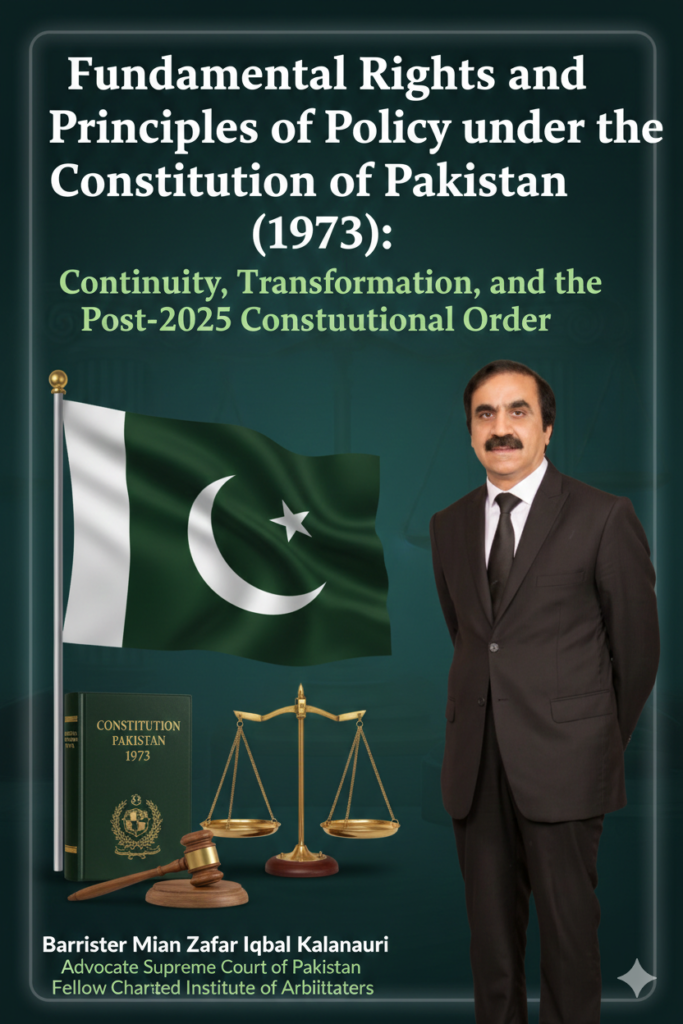
Continuity, Transformation, and the Post-2025 Constitutional Order Barrister Mian Zafar Iqbal KalanauriAdvocate Supreme Court of PakistanFellow Chartered Institute of Arbitrators Abstract The Constitution of the Islamic Republic of Pakistan, 1973, embodies a distinctive dual architecture in Part II: Fundamental Rights (Articles 8–28), which are judicially enforceable, and Principles of Policy (Articles 29–40), which articulate the […]
THE FAMINE OF TRUTH IN PAKISTAN
پاکستان میں سچ کا قحط ہے A Civilizational and Moral Inquiry Abstract Truth is not merely a personal virtue; it is the moral backbone of civilizations. Across religions, philosophies, histories, and literatures, truth has been revered as the condition of freedom and the measure of human dignity. When truth becomes dangerous and silence becomes safe, […]
Misyar and Mutʿah Marriages: Doctrinal Foundations, Contemporary Practice, and Ethical Controversies
Abstract Marriage (Nikah) in Islamic law is conceived not merely as a lawful avenue for intimacy but as a moral covenant oriented toward tranquility (sukūn), affection (mawaddah), mercy (raḥmah), and social stability. Yet contemporary Muslim societies increasingly encounter alternative marital forms, most notably Mutʿah (temporary marriage) and Misyar (a reduced-rights permanent marriage) that depart from […]
Ethical Prosperity and the Architecture of Welfare
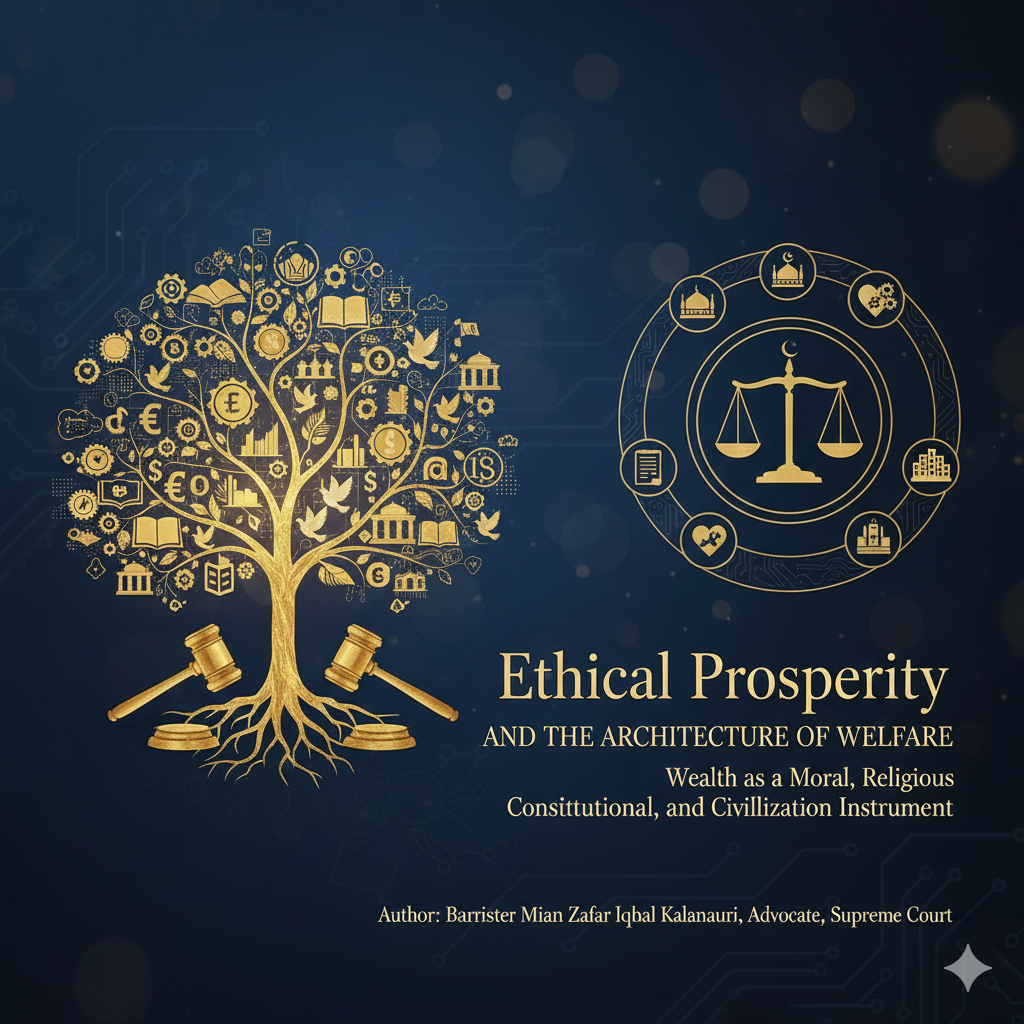
Wealth as a Moral, Religious, Constitutional, and Civilizational Instrument Abstract This article advances a normative and comparative theory of Ethical Prosperity, arguing that wealth-when ethically accumulated and responsibly deployed-is not a moral vice but a structural prerequisite for welfare, reform, and social justice. Drawing upon classical philosophy, Islamic jurisprudence, religious ethics, literary realism, political theory, […]

Abstract This article examines the evolving role of Alternative Dispute Resolution (ADR) as a structural and philosophical transformation of justice systems. It argues that adjudication alone is no longer sufficient to address contemporary disputes marked by complexity, delay, cost, and social fragmentation. Drawing upon constitutional principles of Pakistan, judicial precedents, and comparative experiences from the […]
Haq (2025): When Cinema Reclaims the Constitutional Soul of Shah Bano By Barrister Mian Zafar Iqbal Kalanauri

In an age when cinema often chooses comfort over confrontation, Haq arrives not as entertainment but as an intervention. It does not merely narrate a legal dispute; it resurrects a constitutional moment that India once struggled to face-and, for a time, chose to bury. Anchored in the moral universe of the Shah Bano case (1985), […]
Off-Loading Passengers Despite Valid Visas in Pakistan: The 2025 Controversy, Legal Authority, and Constitutitutional Limits
Barrister Mian Zafar Iqbal KalanauriAdvocate Supreme Court of Pakistan, FCIArb, Accredited Mediator & Master Trainer Abstract In 2025, Pakistan witnessed a sharp rise in complaints and media reports that passengers-particularly overseas workers and students-were being off-loaded at airports despite holding valid visas, tickets, and, in the case of workers, protection/emigration documentation. The phenomenon generated public […]
Empowering Women in Pakistan’s Legal Profession: Barriers, Harassment Trends, Structural Lacunae, and Pathways for Reform

ByBarrister Mian Zafar Iqbal KalanauriAdvocate Supreme Court of Pakistan, FCIArb , Mediator & Legal Reforms Specialist Abstract Despite unprecedented growth in women’s participation in legal education across Pakistan, their presence and empowerment in the legal profession remain disproportionately low. This article synthesizes original qualitative research on female lawyers’ lived experiences with updated national statistics on […]
Guarding the Realm in an Age of Legal Fracture: A Scholarly Analysis of Professor Dr. Mohamed Abdel Wahab’s Alexander Lecture
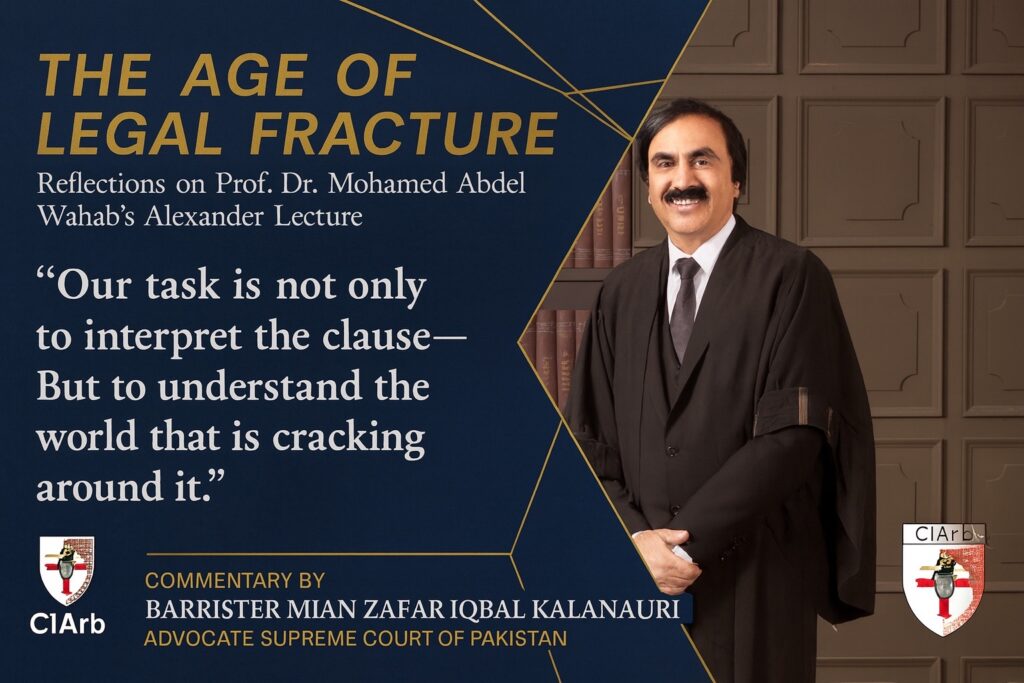
Abstract This paper provides a scholarly analysis of Professor Dr. Mohamed Abdel Wahab’s Alexander Lecture, examining the concept of ‘legal fracture’ and its implications for international arbitration. The analysis explores geopolitical, technological, and normative fragmentation and proposes a recalibrated role for arbitration as a stabilizing structure in an increasingly fractured global legal environment. Keywords Legal […]