
Bridging Global Dispute Resolution with Legal Innovation

Zafar Iqbal Kalanauri
Advocate Supreme Court Pakistan, Arbitrator Fellow CIArb, Mediator CEDAR,IMI,CMC,U.S.A. , Master Trainer Mediation CEDAR , Legal Educator, Reformist of Judicial System and Legal education, White collar Crime Investigator
Preface
In an interconnected world where global commerce transcends borders, the demand for a coherent, efficient, and predictable dispute resolution framework has never been more urgent. International Commercial Arbitration (ICA) has emerged not merely as an alternative but as a preferred and essential mechanism for resolving cross-border commercial conflicts.
This book is the culmination of over three decades of practical and policy-level experience-in arbitral tribunals, courtrooms, legislative drafting committees, and training programs for judges, advocates, and ADR professionals. It reflects a unique convergence of legal practice, academic depth, reformist vision, and commitment to shaping the next generation of arbitration leaders.
With an expansive yet practical approach, this work explores everything from the recognition and enforcement of arbitral awards under the New York Convention to the evolving legal terrain of smart contract disputes and the role of artificial intelligence in arbitration. It dissects institutional rules (ICC, LCIA, SIAC, UNCITRAL), examines arbitrability challenges, outlines effective advocacy techniques, and provides valuable guidance for those beginning their careers as arbitrators.
More than a legal textbook, this book is a strategic roadmap-bridging policy, practice, and progressive developments in ICA. It is designed to serve practitioners, law students, judges, ADR experts, and policymakers who seek to understand, apply, and shape arbitration in the digital age.
General Warning: Intellectual Property Protection:
All rights reserved. No part of this publication may be copied, reproduced, distributed, stored in a retrieval system, or transmitted in any form or by any means-electronic, mechanical, photocopying, recording, or otherwise—without the prior written permission of the author. The contents of this book, including but not limited to the original analysis, commentary, case summaries, institutional comparisons, and all forms of text and structure, are the intellectual property of Mian Zafar Iqbal Kalanauri. Any unauthorized use or reproduction, including in derivative works, research, educational material, or legal practice, is strictly prohibited and may result in legal action. This book is protected under applicable intellectual property laws both nationally and internationally.
Executive Summary
This book provides a wide-ranging and structured exploration of International Commercial Arbitration (ICA), focusing on its foundational principles, procedural frameworks, technological innovations, and jurisdiction-specific developments.
Key contributions of the book include:
- Institutional Analysis: Detailed examination of leading arbitral institutions (ICC, LCIA, SIAC, UNCITRAL), comparing their procedural rules, global relevance, and practical implications.
- Legal Instruments: Comprehensive review of the UNCITRAL Model Law and the New York Convention, focusing on harmonization efforts and cross-border enforcement strategies.
- Technological Integration: Insight into the arbitration of smart contract disputes, the impact of artificial intelligence, and the future of digital ADR mechanisms.
- National Focus-Pakistan: A pioneering look at the evolution of arbitration law and practice in Pakistan, including case law, the Arbitration Bill 2024, and enforcement practices in Pakistani courts.
- Professional Development: Practical steps for aspiring arbitrators, from credential building to gaining appointments and navigating challenges in early practice.
- Current Challenges and Reforms: Discussion on arbitrability, cost-efficiency, oral hearings, written advocacy, tribunal diversity, and party-arbitrator dynamics.
This work stands at the intersection of commercial need, legal clarity, and institutional evolution offering actionable insights for arbitration practitioners and policymakers committed to modernizing dispute resolution in the 21st century.
Author Introduction: Mian Zafar Iqbal Kalanauri
Barrister-at-Law, Advocate Supreme Court, Fellow of the Chartered Institute of Arbitrators (FCIArb), and an accredited Mediator , Master Trainer (CEDR, IMI, ICC), Mr. Zafar Kalanauri is a leading figure in international arbitration, mediation, and commercial dispute resolution in Pakistan.
A senior partner at Zafar Kalanauri & Associates, he brings over three decades of experience in representing clients in complex disputes across borders. His contributions span law reform, ADR curriculum development, judicial training, mediation training and policy consultation for the World Bank, ADB, EU, and judicial bodies of Pakistan.
Mr. Kalanauri is a prolific author, speaker, and educator with 300+ publications and affiliations with institutions in the UK, USA, Singapore, and France. His vision is rooted in modernizing legal systems, empowering new arbitrators, mediators, legal practitioners and ensuring accessible dispute resolution for all.
INDEX
| Chapter No. | Topic | Pages |
| 1. | International Commercial Arbitration: Recognition and Enforcement-Strengthening Enforcement of International Arbitration Agreements and Foreign Award
Examines recognition mechanisms across jurisdictions, refusal grounds, court enforcement procedures, and practical tips for successful award enforcement. |
1–10 |
| 2. | Role of International Arbitration in Business Dispute Resolution
Explores how ICA serves as a neutral, enforceable, and cost- efficient mechanism for resolving global trade conflicts, comparing it with litigation and other ADR models. |
11–16 |
| 3. | The Role of International Arbitration in Resolving Cross- Border Smart
Contract Disputes: Opportunities and Challenges. |
17–20 |
| 4. | Rules Established and used for International Commercial Arbitration
Legal Framework: UNCITRAL Model Law & New York Convention Key Institutions & Rules (ICC, LCIA, SIAC, etc.) Detailed overview of major arbitral institutions and their rules, focusing on procedural differences, global adoption, and institution-specific strengths. Breaks down the legal instruments shaping ICA: adoption of the UNCITRAL Model Law, provisions of the New York Convention, and how they harmonize international enforcement. |
21–32 |
| 5. | Corporate Arbitration: An Evolving Mechanism of Dispute
Resolution in Modern Business Law |
33–35 |
| 6. | Securing Your First Arbitral Appointment and Starting Out as an Arbitrator: A Step-by-Step Approach.
Starting a Career in International Arbitration Step-by-step guidance on becoming an arbitrator-from education and credentials to networking, mentorship, panel appointments, and career-building strategies. |
36–45 |
| 7. | The Concept of Arbitrability in International and Domestic Arbitration: A Legal Analysis
Challenges in International Arbitration Critically analyzes existing challenges including cost barriers, procedural delays, enforcement inconsistencies, diversity gaps, and ethical concerns. |
46–49 |
| 8. | The Party-Arbitrator Relation: Foundations, Challenges, and
Evolving Norms |
50–52 |
| 9. | The Practice Related to Oral Hearings in International
Commercial Arbitration: A Comprehensive Legal Analysis |
53–54 |
| 10. | Effective and Persuasive Written Advocacy in International
Commercial |
55–67 |
| 11. | Navigating a tense meeting as arbitrator during arbitration.
How can you assert your perspective without creating conflict? |
68 |
| 12. | The Concept of Arbitrability in International and Domestic Arbitration: A Legal Analysis | 69-72 |
| 13. | Preparation and Conduct of Arbitration Hearings: A Brief
Overview |
73-77 |
| 14. | Impact of Artificial Intelligence, its Potential Benefits on Legal Sector and in International Arbitration
The Party-Arbitrator Relation: Foundations, Challenges, and Evolving Norms |
78-83 |
| 15. | Artificial Intelligence in the realm of International
Arbitration |
84-87 |
| 16. | Arbitration Procedure and Arbitration Awards in Pakistan | 88-110 |
| 17. | Enforcement of Foreign Arbitral Awards in Pakistan
Recognition and Enforcement of Foreign Arbitral Awards |
111-117 |
| 18. | Pakistan Courts approach towards out of Court settlement through the Alternate Dispute Resolution (the “ADR”)
A deep dive into Pakistan’s arbitration evolution, including legislation, judicial attitude, enforcement trends, and recent reforms like the 2024 Arbitration Bill. |
118-133 |
| 19. | Recent Developments in International Commercial Arbitration in Pakistan (2023-2024): Case Law Analysis and
Emerging Trends |
134-145 |
International Commercial Arbitration: Recognition and Enforcement- Strengthening Enforcement of International Arbitration Agreements and Foreign Award
Introduction
The period following the Second World War witnessed a significant increase in international contractual relationships. Moreover, globalization and advancements in information technology have transformed the world into a small, interconnected “village” that fosters extensive multinational interactions. The growing prevalence of international transactions between parties from various countries, each governed by different legal systems, has highlighted the need for a suitable mechanism to manage disputes arising from these relationships. Key considerations, such as the applicable laws, procedural rules, decision-making processes, and enforcement of outcomes, are critical.
In this context, international commercial arbitration has emerged as the most preferred mechanism for resolving issues related to cross-border commercial transactions. It is widely recognized for offering practical solutions to these challenges. Importantly, international commercial arbitration owes much of its popularity to the global acceptance and enforcement of arbitral awards.
However, practice reveals that an increasing number of arbitral awards encounter obstacles during the recognition and enforcement phases. Arbitration’s effectiveness is significantly diminished if its final product, the arbitral award, cannot be promptly recognized and enforced with minimal procedural hurdles. To address this issue, international efforts have been directed toward enhancing the recognition and enforcement of arbitral awards. These initiatives have led to the creation of several international treaties designed to unify and harmonize the rules governing this process.
Enforcing international commercial arbitral awards across jurisdictions involves navigating a framework that includes both international treaties and national laws. The most significant instrument governing this process is the 1958 New York Convention on the Recognition and Enforcement of Foreign Arbitral Awards (commonly referred to as the New York Convention), which has been ratified by over 170 countries is universally regarded as the most important treaty in this domain. It is complemented by the UNCITRAL Model Law (1985), which, together with the NYC, provides a robust international legal framework for the recognition and enforcement of foreign arbitral awards. offer a solid foundation for the reciprocal enforcement of arbitration agreements and awards among signatory states. These frameworks simplify the enforcement process, ensuring that arbitral decisions carry significant weight globally.
Arbitration has become a cornerstone of international trade, providing a preferred mechanism for resolving disputes between parties across jurisdictions. In today’s interconnected global economy, where trade and investments transcend borders, the importance of arbitration as an alternative dispute resolution method is immense. Countries that prioritize the enforcement of arbitration agreements and awards signal their commitment to an efficient dispute resolution
system. Such efforts foster a business-friendly environment, encouraging international trade and economic growth.
The effective enforcement of international arbitration agreements and foreign arbitral awards is crucial for fostering trust and confidence among parties, ensuring the resolution of disputes, and facilitating seamless cross-border business activities. Furthermore, it promotes the harmonization of international legal standards, contributing to a stable and predictable environment for global trade.
This article undertakes an in-depth evaluation of the NYC and the Model Law provisions concerning the recognition and enforcement of foreign arbitral awards. It critically examines the practical application of these instruments within the realm of international commercial arbitration. Furthermore, it identifies the challenges that hinder the recognition and enforcement of arbitral awards and proposes practical solutions to address these issues. Particular attention is given to the recognition and enforcement of foreign arbitral awards to provide comprehensive insights into this crucial area of international law.
The New York Convention
The New York Convention provides the foundation for recognizing and enforcing foreign arbitral awards. Key features include:
Recognition and Enforcement
Signatory countries agree to enforce arbitral awards made in other contracting states, subject to limited exceptions.
Grounds for Refusal
Enforcement can only be refused on specific grounds, including:
- Lack of a valid arbitration agreement.
- Procedural irregularities in the arbitration process.
- Violation of public policy in the enforcing jurisdiction.
- Incapacity of the parties or invalidity of the agreement under the law.
Procedural Autonomy
Enforcement is subject to the procedural laws of the enforcing jurisdiction.
National Laws
Each country has its own arbitration law, often based on the UNCITRAL Model Law on International Commercial Arbitration. These laws:
-
- Define the procedural framework for enforcement.
- May impose additional requirements or limitations on enforcement.
Enforcement Process
While the exact process varies by jurisdiction, common steps include:
Application to Local Court
The party seeking enforcement applies to the competent court in the jurisdiction where enforcement is sought
Submission of Documents
The following documents are typically required:
- Original or certified copy of the arbitral award.
- Original or certified copy of the arbitration agreement.
- Translations of the documents if necessary.
Court Review
The court assesses whether the award complies with the New York Convention and local laws.
Decision
If the court finds no valid grounds for refusal, the award is declared enforceable.
Challenges to Enforcement
Some common issues faced include:
-
- Claims that enforcement violates the enforcing country’s public policy.
- Allegations of lack of impartiality or fairness in the arbitration process.
- Challenges related to the scope of the arbitration agreement.
Regional and Domestic Variations
-
- United States: Enforcement follows the Federal Arbitration Act, incorporating the New York Convention.
- European Union: Awards are enforced under the Convention and the Brussels I Recast Regulation for intra-EU awards.
- India: India has modernized its arbitration laws to align with international standards, reducing delays in enforcement.
- China: Chinese courts have increasingly shown a pro-arbitration approach but emphasize compliance with domestic public policy.
Non-New York Convention States
In countries not party to the New York Convention, enforcement relies on bilateral or multilateral treaties or domestic laws. The process can be less predictable and more challenging.
Practical Tips for Successful Enforcement
-
- Choose Arbitration-Friendly Jurisdictions: Both for the arbitration seat and enforcement.
- Draft Clear Arbitration Clauses: Specify the governing law, seat, and institution.
- Understand Local Laws: Engage local counsel to navigate procedural nuances.
- Prepare Comprehensive Documentation: Ensure all required documents are authentic, translated, and complete
Pakistan Context
In Pakistan, the enforcement of international commercial arbitral awards is governed by both international treaties and domestic legislation. Pakistan is a signatory to the 1958 New York Convention, and its domestic arbitration framework has been aligned to facilitate the enforcement of foreign arbitral awards. Following is an overview of the enforcement process in Pakistan.
Legal Framework for Enforcement in Pakistan
The evolution of Pakistan’s legal framework for enforcing international arbitration agreements and foreign arbitral awards has been gradual. Initially, enforcement was governed by the 1923 Geneva Protocol on Arbitration Clauses and the 1927 Geneva Convention on the Execution of Foreign Arbitral Awards, implemented domestically through the Arbitration (Protocol and Convention) Act of 1937.
Although Pakistan became an early signatory to the New York Convention, it was not until 2005 that domestic legislation was enacted to implement its provisions. Between 2005 and 2011, the New York Convention was enforced through temporary presidential ordinances. This changed with the passing of the Recognition and Enforcement (Arbitration Agreements and Foreign Arbitral Awards) Act of 2011 (the NYC Act), which provided a permanent framework for implementing the Convention.
Similarly, while Pakistan signed the Convention on the Settlement of Investment Disputes between States and Nationals of Other States (the ICSID Convention) in 1965, it only enacted
the Arbitration (International Investment Disputes) Act in 2011 to implement the ICSID framework.
The Recognition and Enforcement (Arbitration Agreements and Foreign Arbitral Awards) Act, 2011:
- This act implements the New York Convention in Pakistan.
- It provides the procedure for recognizing and enforcing foreign arbitral awards and arbitration agreements.
Arbitration Act, 1940
Primarily governs domestic arbitration proceedings in Pakistan and is not applicable to the enforcement of foreign arbitral awards.
Amendments to Arbitration Laws
The Arbitration Act 1940 (which was previously the primary legislation governing arbitration in Pakistan) had been seen as outdated and ineffective in the context of modern commercial and international disputes. The introduction of the Pakistan Arbitration Ordinance 2020, followed by the Arbitration (Amendment) Act 2021, aligns Pakistan’s arbitration laws with the United Nations Commission on International Trade Law (UNCITRAL) Model Law.
The updated laws have made it easier to recognize and enforce foreign arbitral awards and to resolve disputes efficiently. The amendments streamline the procedure for the recognition of foreign arbitral awards and encourage the use of arbitration as a viable dispute resolution mechanism.
Key Provisions of the 2011 Act Recognition of Foreign Arbitral Awards
Foreign awards made in countries that are signatories to the New York Convention are recognized as binding. They are enforceable in Pakistan in the same manner as a judgment of a Pakistani court.
Grounds for Refusal
Similar to the New York Convention, enforcement can be refused if:
- The arbitration agreement is invalid under the governing law.
- The award exceeds the scope of the arbitration agreement.
- There were procedural irregularities, such as improper notice or lack of opportunity to present a case.
- The award is contrary to the public policy of Pakistan.
Definition of “Public Policy”: Pakistani courts interpret public policy narrowly, focusing on fundamental principles of law and justice rather than subjective notions.
Enforcement Process Application to the High Court
The party seeking enforcement must file an application before the competent High Court where enforcement is sought. The application must include:
- The original or certified copy of the arbitral award.
- The original arbitration agreement or a certified copy.
- Certified translations if the documents are not in English or Urdu.
Court Review
The High Court examines the award for compliance with the New York Convention and Pakistani law. Limited judicial review is conducted, focusing on procedural and jurisdictional aspects rather than the merits of the award.
Order of Enforcement
If the court finds no grounds for refusal, it issues an enforcement order. The award is treated as a decree of the court and is executed under Pakistan’s civil procedural laws.
Challenges to Enforcement Public Policy Exception
Pakistani courts are generally reluctant to refuse enforcement on public policy grounds unless the award violates fundamental legal principles.
Procedural Delays
Although the 2011 Act aims to streamline enforcement, delays due to procedural inefficiencies and judicial backlogs are common.
Local Judicial Attitudes
While Pakistani courts have shown increasing support for arbitration, inconsistent application of laws or interference can arise in specific cases.
This preference for domestic legal proceedings often encouraged local parties to file cases in domestic courts, seeking anti-arbitration injunctions to avoid arbitration.
Practical Tips for Enforcement in Pakistan Draft Clear Arbitration Agreements
Specify the governing law, arbitration seat, and institutional rules to minimize disputes.
Engage Local Counsel
Work with legal experts familiar with the 2011 Act and court procedures.
Prepare Documentation Thoroughly
Ensure compliance with procedural requirements for filing and translating documents.
Anticipate Delays
Be prepared for possible delays due to procedural inefficiencies and take proactive measures to expedite proceedings.
The strengthening of the enforcement of international arbitration agreements and foreign awards in Pakistan represents a significant positive development for the country’s legal and business environment. Over the past few years, Pakistan has taken important steps to align its legal framework with international standards, particularly in the realm of arbitration. Here are some of the key developments and their implications:
Enforcement of Foreign Arbitral Awards
Under the Arbitration (Amendment) Act 2021, foreign arbitral awards are enforced in Pakistan through the framework set out in the New York Convention on the Recognition and Enforcement of Foreign Arbitral Awards (1958). This has made it easier for international businesses to resolve disputes and have their foreign arbitral awards recognized and enforced within Pakistan.
Pakistan’s commitment to the New York Convention is particularly significant because it signals to foreign investors that their rights and business interests will be protected under international arbitration principles. This improves Pakistan’s attractiveness as a destination for foreign investment.
Strengthened Legal and Institutional Framework
The establishment of a dedicated Arbitration Council in Pakistan further facilitates the smooth functioning of arbitration by providing guidance and oversight. It enhances transparency and fairness in the arbitration process.
The framework also addresses issues related to the impartiality and independence of arbitrators, which is crucial for fostering confidence in the arbitration system.
Judicial Support for Arbitration
The judiciary in Pakistan has shown an increasing commitment to supporting arbitration by respecting and upholding arbitration agreements and awards. Courts now act as facilitators rather than barriers to arbitration. They assist in the enforcement process and only intervene in cases where there is a compelling reason to do so, such as when the award is in violation of Pakistan’s public policy.
In several recent cases, Pakistani courts have upheld international arbitration agreements and foreign awards, contributing to a positive legal environment for arbitration.
Implications for International Business and Trade
The strengthening of arbitration laws enhances Pakistan’s position in global trade and investment by providing a more predictable and reliable dispute resolution mechanism. This improvement can be expected to reduce legal uncertainty for foreign investors and companies.
The enhanced enforceability of international arbitration awards reduces the risk of protracted litigation and offers a more cost-effective and efficient method for resolving disputes.
Challenges and Future Directions
While these developments are promising, challenges remain. The legal community in Pakistan must continue to educate and raise awareness about the benefits of arbitration, both domestically and internationally.
Additionally, the enforcement of foreign arbitral awards still faces challenges in practice due to limited understanding and inconsistent implementation in some areas. Continued reforms and capacity-building efforts are essential to ensure that Pakistan remains an attractive jurisdiction for international arbitration.
Historical Concerns and Inconsistencies
Since its independence in 1947, Pakistan’s legal system has allowed for the enforcement of international arbitration agreements and awards. However, the effectiveness of Pakistani courts in this area has been inconsistent.
Historically, Pakistani courts exercised significant discretion in determining the enforceability of arbitration agreements and awards. Examples include:
-
- Eckhardt & Co, Marine GmbH v Muhammad Hanif (1993): The Supreme Court refused to stay domestic legal proceedings that violated an international arbitration agreement, citing inconvenience to the parties.
- Uzin Export & Import Enterprises v M Iftikhar & Co (1993): The Supreme Court denied enforcement of an arbitration agreement requiring arbitration in Paris, again citing inconvenience and expense.
- Hub Power Co v Pakistan WAPDA (2000): The Court restrained international arbitration involving allegations of corruption, asserting that criminal matters are not referable to arbitration.
- Sui Southern Gas Co. v. Habibullah Coastal Power Co. (2010): Reinforced the principle that public policy objections must be interpreted narrowly.
- Societe Generale de Surveillance SA v Pakistan (2002): The Court blocked ICSID arbitration against the government, ruling that the claimant had waived its right to such proceedings.
Strengthening Enforcement of International Arbitration Agreements and Foreign Awards in Pakistan: A Positive Development
In 2024, Pakistan’s legal landscape saw significant developments in arbitration, notably through the Supreme Court’s judgment in A.M. Construction Company Pvt. Ltd. v. Taisei Corporation and the introduction of the Arbitration Bill 2024.
Supreme Court Judgment: A.M. Construction Company Pvt. Ltd. v. Taisei Corporation. On February 28, 2024, the Supreme Court of Pakistan delivered a landmark judgment in A.M. Construction Company Pvt. Ltd. v. Taisei Corporation. The case addressed the enforcement of an arbitration agreement under the Arbitration Act, 1940. The Court upheld the pro-enforcement approach, emphasizing the importance of honoring arbitration agreements and minimizing judicial intervention. This decision reinforced Pakistan’s commitment to international arbitration standards and underscored the judiciary’s support for alternative dispute resolution mechanisms.
Arbitration Bill 2024
In May 2024, the Law and Justice Commission of Pakistan introduced the Arbitration Bill 2024, aiming to replace the outdated Arbitration Act, 1940. Inspired by the UNCITRAL Model Law and influenced by the Indian Arbitration and Conciliation Act, 1996, the Bill seeks to modernize arbitration practices in Pakistan. Key features include:
- Pro-Enforcement Stance: The Bill adopts a pro-enforcement approach, providing limited grounds for setting aside or nullifying an arbitral award. This aligns with international best practices and enhances the credibility of Pakistan’s arbitration framework.
- Streamlined Procedures: The Bill aims to simplify arbitration procedures, making them more efficient and accessible. This is expected to encourage both domestic and international parties to consider arbitration as a viable dispute resolution mechanism in Pakistan.
- Judicial Support: The Bill emphasizes the role of the judiciary in supporting arbitration, ensuring that courts act as facilitators rather than obstacles in the arbitration process.
Concluding Remarks
The enforcement of international arbitration agreements and foreign arbitral awards in Pakistan has seen significant progress. Despite earlier challenges, the implementation of the New York Convention and other legislative developments have laid a solid foundation for a consistent approach. These developments reflect Pakistan’s dedication to enhancing its arbitration framework, aligning with international standards, and fostering a more favorable environment for dispute resolution. Pakistani courts’ growing alignment with international jurisprudence and their pro-enforcement stance reflect a commitment to fostering a conducive environment for arbitration. These advancements will undoubtedly enhance Pakistan’s reputation as a business- friendly jurisdiction and support its integration into the global economic framework.
The strengthening of the enforcement of international arbitration agreements and foreign awards is a positive development for Pakistan’s legal system and its business climate. It brings Pakistan in line with international best practices, providing an efficient and reliable dispute resolution mechanism that will boost investor confidence and contribute to the country’s economic growth. However, ongoing efforts are necessary to address the remaining challenges and ensure that the system is effectively implemented.
Role of International Arbitration in the Resolution of International Business Disputes
Summary
Arbitration is an alternative dispute resolution method (ADR) and has now become one of the preferred mechanisms chosen by parties to settle disputes of a commercial nature. There is no proper definition of arbitration and unlike court proceedings; it is a voluntary agreement agreed to by the disputing parties and the decision also known as the arbitral award is binding upon them. Arbitration is quasi-judicial in nature and an arbitrator often referred to as a private judge is a person who adjudicates on disputes submitted to him or her by the parties. According to Sir John Donaldson, arbitrators and judges are partners in business of dispensing justice, the judges in the public sector and the arbitrators in the private sector. Nowadays, arbitration is an emerging trend and the popularity of such a system can be attributed to many advantages it offers compared to litigation. The main fundamental features of arbitration among many others are flexibility, confidentiality, impartiality, neutrality and party autonomy.
This article aims to evaluate the effectiveness of international arbitration in resolving international commercial disputes. The article provides a critical review of the role of arbitrators in conducting proceedings and developing laws due to the internationalisation of modern commercial law and investigates the International Bodies that are involved in International Commercial Arbitration. It covers the International Chamber of Commerce and the United Nations Commission for International Trade Law and their significant role in the development of commercial arbitration. Also analyzes the “New York Convention” text, which is a crucial piece of legislation in the recognition and enforcement of arbitral awards globally. Moreover, the article highlights the current challenges confronting International Commercial Arbitration and sets out the potential challenges it could face in the future. Finally, in the Conclusion, the article summarizes the current role of International Arbitration in the modern world. Finally, this study concludes by outlining the current role of international arbitration in the modern world.
Introduction
International arbitration plays a crucial role in resolving international business disputes by offering a neutral, efficient, and enforceable mechanism outside national court systems. It has become the preferred method for resolving disputes in international business transactions for several reasons:
Neutrality: Arbitration provides a neutral forum where neither party is disadvantaged by the legal system of the other party’s home country. Arbitrators are often selected by mutual agreement, ensuring impartiality and expertise in the relevant field.
Expertise: Parties can select arbitrators with specific expertise in the subject matter of the dispute, ensuring a well-informed decision-making process. This is particularly beneficial in technical industries like construction, energy, or technology.
Flexibility: Arbitration allows parties to tailor procedures to suit their needs, including timelines, evidence rules, and language of proceedings. It accommodates the complexities of international business transactions better than rigid court procedures.
Confidentiality: Unlike court proceedings, arbitration is usually private, protecting sensitive business information and maintaining the parties’ reputations.
Enforceability: Arbitral awards are recognized and enforceable in over 170 countries under the New York Convention on the Recognition and Enforcement of Foreign Arbitral Awards (1958), making it easier to secure compliance.
Efficiency: Arbitration can be faster than litigation, avoiding lengthy court procedures and appeals. Streamlined procedures reduce delays, which is critical in international commerce.
Cost-Effectiveness: While arbitration can be expensive, its streamlined nature and avoidance of prolonged litigation make it cost-effective in many cases.
Challenges of Institutions Facilitating International Arbitration:
Despite its advantages, international arbitration faces some challenges:
High Costs: Arbitration can be expensive, particularly when dealing with complex disputes.
Enforcement Issues: While awards are widely enforceable, enforcement in certain jurisdictions can be difficult.
Potential Delays: Complex cases or parties exploiting procedural tactics may still lead to delays.
Limited Appeals: The binding nature of awards, with limited grounds for appeal, can be a double-edged sword.
Limitations:
Cost: While arbitration is efficient in time, its upfront costs can be high, often matching or exceeding court litigation.
Inconsistent Quality: Arbitrators’ decisions may vary in quality and coherence, depending on their expertise and experience.
Limited Appeals: The finality of arbitral awards, with limited avenues for appeal, can be seen as a drawback if errors are perceived.
Role of Arbitrators: Arbitrators play a central role in ensuring that international arbitration is fair, impartial, and effective. Their functions include:
Conducting Proceedings: Arbitrators ensure procedural fairness, allowing both parties to present their case while adhering to agreed timelines. They balance efficiency with thoroughness, ensuring decisions are both timely and well-reasoned.
Developing Modern Commercial Law: Arbitrators contribute to the internationalization of commercial law by applying uniform principles (e.g., lex mercatoria) and harmonizing legal standards. They adapt to evolving business practices by interpreting contracts in light of modern trends, fostering predictability in international trade.
Challenges in Arbitrator Roles:
Ensuring neutrality and avoiding conflicts of interest remain critical concerns. Arbitrators may face pressure from parties to favor one side, especially in high-stakes disputes.
International Bodies Involved in Arbitration : Several prominent institutions facilitate international arbitration and set procedural frameworks:
International Chamber of Commerce (ICC): Administers arbitration under the ICC Rules, known for their global reach and detailed procedural standards. The ICC International Court of Arbitration oversees arbitral processes and ensures procedural integrity.
London Court of International Arbitration (LCIA): Focuses on providing flexible and efficient arbitration services. Its rules emphasize cost control and efficiency, making it a popular choice for commercial disputes.
Singapore International Arbitration Centre (SIAC): A leading arbitration institution in Asia, known for its expedited procedures and expertise in complex disputes. SIAC’s prominence reflects the growth of Asia as a hub for international business.
American Arbitration Association (AAA)/International Centre for Dispute Resolution (ICDR): A trusted name for U.S.-centric international arbitration.
United Nations Commission on International Trade Law (UNCITRAL): Develops international arbitration frameworks, including the UNCITRAL Model Law and Arbitration Rules. These frameworks are widely adopted by countries to modernize arbitration laws.
International Centre for Settlement of Investment Disputes (ICSID): Specializes in resolving disputes between investors and states under bilateral or multilateral investment treaties.
Permanent Court of Arbitration (PCA): Handles disputes involving states, private parties, and international organizations, often in public international law contexts.
Challenges Faced by International Arbitration: international arbitration is effective, challenges persist:
Diversity of Arbitrators: There is ongoing criticism about the lack of diversity among arbitrators, which can affect the perception of fairness.
Cost Management: Rising costs make arbitration less accessible to small and medium enterprises.
Enforcement Gaps: Certain jurisdictions may resist enforcing arbitral awards, despite international conventions.
Trends in International Arbitration
Increased Regionalization : Growth of regional arbitration centers (e.g., SIAC, HKIAC, and the DIFC-LCIA) to address local needs. These centers are gaining prominence, especially in Asia, the Middle East, and Africa.
Digitization and Technology Integration :Use of virtual hearings, electronic filings, and AI- assisted document review, accelerated by the COVID-19 pandemic.
Enhanced cybersecurity measures and data protection standards for arbitration proceedings.
Focus on Efficiency: Push for expedited arbitration procedures, especially for low-value or straightforward disputes. Simplified processes like emergency arbitrator provisions and fast-track arbitration.
Diversity and Inclusion: Increased emphasis on diversity among arbitrators, with initiatives promoting gender, ethnic, and regional representation.
Environmental Considerations : Initiatives to make arbitration greener, such as the Green Pledge to reduce the carbon footprint of proceedings.
Third-Party Funding: Rise of litigation financing, where third parties fund arbitration costs in exchange for a share of the award.
Sector-Specific Arbitration: Tailored arbitration frameworks for industries like technology, intellectual property, and energy.
Transparency: Balancing confidentiality with demands for transparency, especially in investor- state arbitration cases.
Increased Use of Hybrid Models: Use of med-arb or arb-med processes, combining arbitration and mediation for more holistic dispute resolution.
Challenges in International Arbitration
Cost and Accessibility: Rising arbitration costs make it less accessible to smaller businesses and parties from developing nations. Efforts to streamline processes haven’t fully addressed cost concerns.
Prolonged Timelines: Complex cases and procedural delays can undermine arbitration’s reputation for efficiency. Tactical delays by parties exacerbate the issue.
Enforcement Issues: Enforcement of awards remains challenging in jurisdictions with weak legal systems or political resistance to arbitration. Instances of non-compliance by states or state- owned entities in investor-state disputes.
Lack of Diversity: While improving, the arbitrator pool still lacks diversity, affecting the perception of impartiality and fairness.
Confidentiality vs. Transparency: Balancing privacy with public interest in cases involving state entities or public policy issues is contentious.
Ethical Concerns
Arbitrator conflicts of interest, lack of disclosure, and inconsistent standards in arbitral conduct.
Fragmentation: Differing procedural rules, standards, and interpretations across arbitral institutions create inconsistencies.
Emergence of “Over lawyering”: Legal teams overly complicate proceedings by introducing excessive evidence or procedural objections.
Technological Risks: Data breaches and cybersecurity threats jeopardize the confidentiality of sensitive information.
Backlash Against Investor-State Dispute Settlement (ISDS): Criticism of ISDS for undermining state sovereignty, particularly in environmental and public health cases. Ongoing reforms by UNCITRAL to address these issues.
Overuse of Procedural Tactics: Parties often exploit procedural rules to delay proceedings.
Conclusion
International arbitration continues to evolve, adapting to the demands of globalization and technological advancement. However, addressing the challenges of cost, diversity, enforcement, and ethical concerns is vital to maintaining its credibility and effectiveness as a dispute resolution mechanism.
International arbitration is a cornerstone of modern commercial dispute resolution. It balances neutrality, enforceability, and adaptability, making it indispensable in an increasingly interconnected world. However, its effectiveness relies heavily on arbitrators’ ability to maintain
procedural fairness and uphold high standards of professionalism. Continuous reforms by international bodies aim to address challenges, ensuring arbitration remains a robust tool for resolving international disputes.
International arbitration offers a balanced, effective means of resolving international business disputes. Its adaptability, neutrality, and enforceability make it an invaluable tool for businesses operating across borders, fostering greater certainty and stability in global commerce.
The Role of International Arbitration in Resolving Cross-Border Smart Contract Disputes: Opportunities and Challenges
Introduction:
The increasing adoption of smart contracts, particularly in cross-border transactions, presents new challenges for dispute resolution. Smart contracts are self-executing contracts with terms directly written into code, often deployed on blockchain platforms. While they offer efficiency and security, disputes arising from their use can be complex, especially in an international context. International arbitration has emerged as a promising mechanism to resolve such disputes due to its adaptability, neutrality, and enforceability.
The rise of information technology has transformed dispute resolution, enabling parties to resolve conflicts regardless of their geographical locations or the origin of the dispute. This innovation, referred to as “Technology-Mediated Dispute Resolution” (TMDR), leverages digital tools and web-based platforms to facilitate dispute resolution processes. TMDR primarily relies on a range of online communication tools such as emails, chat platforms, video conferencing, tele immersion, and other electronic communication devices like telephones. These methods are applied across various dispute types, including internet domain name disputes, consumer conflicts, commercial issues, family matters, peacebuilding, and justice administration.
Opportunities
Neutrality and Global Reach:
Arbitration provides a neutral platform for parties from different jurisdictions, mitigating concerns about home-court advantage.Awards are enforceable globally under the New York Convention.
Customization of Arbitration Rules:
Arbitration allows parties to tailor rules specific to smart contracts, such as appointing arbitrators with technical expertise or agreeing on expedited procedures for resolving disputes quickly.
Technical Expertise:
Arbitrators can be selected based on their understanding of blockchain technology and smart contracts, enabling more accurate resolutions.
Confidentiality:
Arbitration proceedings are typically private, which is attractive for parties handling sensitive commercial or technological information.
Flexibility in Evidence and Process:
Arbitration can adapt to the peculiarities of smart contract disputes, such as dealing with digital evidence or blockchain-based records.
Efficiency in International Disputes:
Compared to litigation, arbitration can avoid jurisdictional conflicts and streamline resolution for cross-border issues.
Challenges
Jurisdictional Ambiguity:
Determining jurisdiction and applicable law can be challenging due to the decentralized nature of blockchain technology.
Technical Complexity:
Arbitrators may need advanced technical training to fully understand the workings of smart contracts and blockchain technology.
Interpreting Code as Legal Agreements:
A major challenge is whether the coded terms of a smart contract align with traditional legal principles. Disputes may arise over how the “intent of the parties” is inferred from code.
Enforcement of Awards:
While arbitration awards are enforceable under the New York Convention, smart contracts may require specific technical enforcement mechanisms, such as altering blockchain records, which is not traditionally within the scope of arbitral awards.
Absence of Established Precedents:
The novelty of smart contract disputes means there are few precedents, creating uncertainty in outcomes.
Integration with On-Chain Dispute Resolution:
Smart contracts may incorporate on-chain mechanisms (like arbitration clauses coded into the contract itself). Integrating these with traditional arbitration processes can be complex.
Cost and Accessibility:
International arbitration, particularly for technically sophisticated disputes, can be expensive and may not be accessible to all parties.
Future Developments Hybrid Models:
Combining on-chain dispute resolution mechanisms (like decentralized arbitration platforms) with traditional arbitration may offer a comprehensive solution.
Development of Arbitration Institutions:
Specialized institutions focusing on blockchain and smart contracts, such as the Digital Dispute Resolution Rules by the UK Jurisdiction Taskforce, could play a critical role.
Legal and Technical Standards:
Establishing global legal standards and best practices for smart contracts could reduce ambiguities in arbitration.
Education and Training:
Enhanced training for arbitrators in blockchain technology and coding languages is essential to ensure effective dispute resolution.
TMDR Mechanisms
Online Negotiation: Negotiation is a dispute resolution method involving direct communication between parties to reach a mutually acceptable agreement without third-party intervention. In TMDR negotiation, technology facilitates communication, enabling parties to resolve disputes independently. TMDR negotiations are categorized into automated negotiation and assisted negotiation.
Automated Negotiation :Automated negotiation uses specialized software to aid parties in settling disputes. A common approach is “blind bidding,” where participants agree to adhere to any settlement determined by the procedure. They propose monetary figures in secret, which a computer program compares. If the figures fall within a predefined range (e.g., 5–30%), the system calculates a settlement as the average of the proposals. If not, the process continues until a resolution is achieved or the time limit expires. This method is ideal for disputes centered on monetary settlements.
Assisted Negotiation : Assisted negotiation employs communication technologies to support direct interaction between parties without automation. Participants use tools like video conferencing, web platforms, or telephones to facilitate discussions and reach agreements.
Online Mediation: On line mediation mirrors traditional mediation but is conducted virtually. A neutral third party, without authority to impose decisions, helps disputing parties reach an amicable settlement. Communication between all parties occurs through digital platforms, often eliminating the need for physical meetings.
Online Arbitration: Online arbitration operates similarly to traditional arbitration but leverages digital technologies. Arbitrators are appointed electronically, and the submission of evidence, presentation of arguments, and delivery of the arbitral award are conducted online.
Hybrid Processes : In some cases, multiple dispute resolution mechanisms are combined to form a hybrid TMDR approach. For instance, parties may begin with online negotiation; if unsuccessful, they proceed to online mediation. Should mediation fail, the process escalates to online arbitration. This step-by-step approach ensures comprehensive conflict resolution.
Online Case Appraisal: This TMDR method involves a neutral third party using a web-based platform to review a dispute and provide advice regarding the facts, applicable laws, and potential outcomes.
Conclusion:
International arbitration provides a promising framework for resolving cross-border smart contract disputes due to its adaptability, enforceability, and neutrality. However, overcoming challenges such as technical complexity, jurisdictional ambiguity, and integration with blockchain technology is crucial. As the use of smart contracts grows, collaboration between legal professionals, technologists, and policymakers will be essential to refine arbitration mechanisms and ensure effective dispute resolution. In a well-functioning digital single market, it is paramount to have an effective cross-border ADR mechanism to ensure that consumers are in a position to obtain fair redress in case of problems. This is important because current market trends show that digital markets are more and more influential Despite its challenges, TMDR remains a critical tool for modern dispute resolution globally. addressing infrastructural, legislative, and cybersecurity gaps is essential to unlocking the immense potential of TMDR for judicial and ADR systems. Investments in TMDR development can significantly enhance access to justice, efficiency in the judiciary, and confidence in a country’s digital economy.
Rules Established and used for International Commercial Arbitration
International commercial arbitration follows several sets of rules established by various institutions and organizations. Here are the key types of rules commonly used:
Institutional Rules
Administered by arbitration institutions, these rules provide procedural frameworks. Popular examples include:
-
- ICC Rules – International Chamber of Commerce (ICC)
- LCIA Rules – London Court of International Arbitration (LCIA)
- SIAC Rules – Singapore International Arbitration Centre (SIAC)
- HKIAC Rules – Hong Kong International Arbitration Centre (HKIAC)
- AAA/ICDR Rules – American Arbitration Association (AAA) / International Centre for Dispute Resolution (ICDR)
Ad Hoc Arbitration Rules
In ad hoc arbitration, the parties administer the process themselves, usually relying on a predefined framework, such as:
-
- UNCITRAL Arbitration Rules – Established by the United Nations Commission on International Trade Law, often used for ad hoc arbitration.
Specialized or Sectoral Rules
Some rules are tailored to specific industries or dispute types:
-
- ICSID Rules – International Centre for Settlement of Investment Disputes (for investor- state arbitration)
- GAFTA Rules – Grain and Feed Trade Association (for agricultural trade disputes)
- FOSFA Rules – Federation of Oils, Seeds, and Fats Associations (for commodity disputes)
National Arbitration Rules
Certain countries promote their own arbitration rules alongside their institutional frameworks, like:
-
- CIETAC Rules – China International Economic and Trade Arbitration Commission
- Swiss Rules – Swiss Chambers’ Arbitration Institution
Hybrid Rules
These combine aspects of both institutional and ad hoc rules:
-
- UNCITRAL + Institutional Supervision – Some cases follow UNCITRAL rules with institutions providing administrative support (e.g., PCA or ICC managing an UNCITRAL arbitration).
Each type of rule governs aspects such as the appointment of arbitrators, conduct of hearings, time limits, costs, and the final award. The choice of rules depends on factors like the nature of the dispute, party preferences, and legal requirements.
Summary of Rules used for International Commercial Arbitration
International Chamber of Commerce (ICC) Arbitration Rules :
The ICC Rules of Arbitration provide a framework for resolving international commercial disputes efficiently. Below is a summary of the key features:
Structure and Administration
-
- Administered by: International Court of Arbitration of the ICC.
- Supervision: The ICC Court ensures the arbitral process runs smoothly but does not decide the dispute.
Commencement of Arbitration
-
- Request for Arbitration: Filed by the claimant, containing essential details (e.g., nature of the dispute, claims, and agreements).
- Answer: The respondent replies with their defense and counterclaims.
Appointment of Arbitrators
-
- Number: One or three arbitrators (agreed by the parties or appointed by the ICC Court).
- Neutrality: Arbitrators must be independent and impartial.
Procedural Flexibility
-
- Procedural Timetable: Arbitrators and parties agree on the schedule.
- Evidence & Hearings: Methods of presenting evidence are flexible, including documents and oral hearings.
Expedited Procedure (for Small Disputes)
-
- Eligibility: Cases with claims under USD 3 million (or other threshold by agreement).
- Simplified Process: Faster appointment of arbitrators, limited submissions, and quick award issuance.
Interim Measures and Emergency Arbitration
-
- Emergency Arbitrator: Provides urgent relief before the tribunal is constituted.
- Interim Measures: Arbitrators can grant provisional measures (e.g., asset freezing).
Costs and Fees
-
- Costs Include: Arbitrators’ fees, administrative fees, and legal expenses.
- Advance Payments: The parties must deposit advance costs to cover the arbitration.
Confidentiality and Transparency
-
- Confidential Process: Hearings and awards are generally private.
- Publication: Only anonymized awards may be published with party consent.
Final Award
-
- Binding Nature: The award is final and enforceable under the New York Convention.
- Correction/Interpretation: Minor corrections can be requested within a set period.
The ICC Rules are widely respected for their adaptability, neutrality, and efficiency, making them a popular choice for complex cross-border disputes.
London Court of International Arbitration (LCIA) Arbitration Rules
The LCIA Rules provide a framework for fair, efficient, and flexible arbitration of international disputes. Below is a summary of their key features:
Structure and Administration
-
- Administered by: London Court of International Arbitration (LCIA).
- LCIA Court: Oversees the process, appoints arbitrators, and handles challenges, but does not resolve the dispute
Commencement of Arbitration
-
- Request for Arbitration: Claimant submits a request with basic details about the dispute and agreement to arbitrate.
- Response: The respondent must submit an answer within a specified time.
Appointment of Arbitrators
-
- Number: Usually one or three arbitrators, as agreed by the parties or appointed by the LCIA.
- Independence & Impartiality: Arbitrators must remain neutral and disclose any potential conflicts of interest.
- Special Feature: Arbitrators have a duty to act efficiently and avoid unnecessary delays or costs.
Flexible Procedures
-
- Tribunal’s Discretion: The tribunal has significant control over the procedure, including evidence, hearings, and deadlines.
- Remote Hearings: Use of electronic communication and virtual hearings is permitted.
Emergency Arbitration and Interim Relief
-
- Emergency Arbitrator: Available for urgent relief before the tribunal is constituted.
- Interim Measures: Arbitrators can order provisional relief, such as freezing orders or injunctions.
Costs and Fees
-
- Fixed Hourly Rates: The LCIA uses a transparent fee structure based on hourly rates for arbitrators and administrative charges.
- Advance on Costs: Parties must deposit an advance to cover arbitration expenses.
Confidentiality
-
- Private Process: All proceedings, awards, and documents are confidential.
- Limited Publication: Awards are only published with party consent or in anonymized form.
Award and Enforcement
-
- Final and Binding Award: The tribunal’s award is binding and enforceable under the New York Convention.
- Correction and Clarification: Parties can request minor corrections or clarifications within a set timeframe.
Time and Cost Efficiency
-
- Efficient Case Management: Arbitrators must ensure the process is quick and cost- effective.
- Expedited Process: Cases can be fast-tracked at the tribunal’s discretion.
The LCIA Rules emphasize procedural flexibility, efficiency, and transparency, making them suitable for both large and smaller disputes across different industries and jurisdictions.
Singapore International Arbitration Centre (SIAC) Arbitration Rules
The SIAC Rules govern the arbitration procedures administered by the Singapore International Arbitration Centre (SIAC). They are known for their efficiency, flexibility, and focus on expedited processes, making them a preferred choice for international disputes. Below is a summary:
Structure and Administration
-
-
- Administered by: SIAC Secretariat, supervised by the SIAC Court of Arbitration.
- Role of SIAC Court: Appoints arbitrators, decides on challenges, and ensures smooth proceedings.
-
Commencement of Arbitration
-
-
- Notice of Arbitration: Filed by the claimant to initiate proceedings.
- Response: The respondent submits a reply and may raise counterclaims.
-
Appointment of Arbitrators
-
-
- Number: One or three arbitrators, as agreed by parties or decided by SIAC.
- Neutrality: Arbitrators must be impartial and disclose conflicts of interest.
- Arbitrator Challenge: Parties can challenge the appointment based on doubts about independence.
-
Expedited Procedure
-
-
- Eligibility: Available if the dispute amount is below SGD 6 million or if parties agree.
- Simplified Process: Single arbitrator and final award within 6 months of constitution.
-
Emergency Arbitration and Interim Relief
-
-
- Emergency Arbitrator: Provides urgent relief within days of application, before the tribunal is fully formed.
- Interim Measures: Arbitrators can order temporary relief, such as asset freezing.
-
Costs and Fees
-
-
- SIAC Fee Schedule: Costs include tribunal fees, administrative fees, and deposits.
- Cost-Sharing: SIAC may require parties to deposit advance costs proportionally.
- Award of Costs: The tribunal can allocate costs based on the outcome and conduct of the parties.
-
Procedural Flexibility and Technology
-
-
- Tribunal’s Discretion: Arbitrators control the timetable, evidence submission, and hearings.
- Virtual Hearings: SIAC promotes remote hearings and electronic submission of documents.
-
Confidentiality
-
-
- Private Proceedings: All details are confidential unless the parties agree otherwise.
- Publication: Awards may be published in anonymized form with party consent.
-
Award and Enforcement
-
-
- Binding Award: The award is final and enforceable under the New York Convention.
- Correction/Interpretation: Minor corrections can be requested after the award.
-
Innovative Procedures
-
-
- Arb-Med-Arb Process: Combines arbitration and mediation to encourage settlement.
- Consolidation and Joinder: SIAC allows multiple disputes to be consolidated or new parties to join an arbitration.
-
The SIAC Rules are recognized for their responsiveness to modern commercial needs, with a strong emphasis on expedited processes, emergency relief, and technological integration.
Hong Kong International Arbitration Centre (HKIAC) Arbitration Rules:
The HKIAC Administered Arbitration Rules provide a comprehensive framework for resolving disputes efficiently and flexibly. Known for accommodating both complex and smaller disputes, the rules are frequently used in Asia and globally. Below is a summary:
Structure and Administration
-
-
- Administered by: Hong Kong International Arbitration Centre (HKIAC).
- Role of HKIAC: Handles arbitrator appointments, challenges, and administrative support.
-
Commencement of Arbitration
-
-
- Notice of Arbitration: Filed to initiate proceedings, detailing the dispute and arbitration agreement.
- Response: The respondent must reply within a set period and may raise counterclaims.
-
Appointment of Arbitrators
-
-
- Number: One or three arbitrators, depending on party agreement or HKIAC’s decision.
- Impartiality and Independence: Arbitrators must be neutral and disclose conflicts of interest.
- Challenge of Arbitrators: Parties can challenge appointments over impartiality concerns.
-
Flexible Procedures
-
-
- Tribunal Discretion: Arbitrators manage the timetable, hearing formats, and evidence submission.
- Remote Hearings: HKIAC supports virtual and hybrid hearings with digital tools.
-
Emergency Arbitration and Interim Relief
-
-
- Emergency Arbitrator: Provides urgent interim relief before the tribunal is constituted.
- Interim Measures: Arbitrators can issue provisional measures, such as asset preservation.
-
Expedited Procedure
-
-
- Eligibility: Applicable if the claim amount is below HKD 25 million, or if parties agree.
- Simplified Process: Single arbitrator and award within 6 months from constitution.
-
Costs and Fees
-
-
- Flexible Fee Options: Parties can choose between an ad valorem fee (based on dispute value) or an hourly rate system.
- Advance on Costs: HKIAC requests an upfront deposit to cover expenses.
- Cost Allocation: The tribunal decides cost awards based on party conduct and outcome.
-
Confidentiality
-
-
- Private Process: Proceedings and awards are confidential unless disclosure is agreed.
- Publication: Awards can be published in anonymized form with party consent.
-
Award and Enforcement
-
-
- Binding Award: The final award is enforceable under the New York Convention.
- Correction or Clarification: The tribunal can correct typographical errors or clarify the award on request.
-
Innovative Features
-
-
- Arb-Med-Arb (AMA): Allows parties to switch between arbitration and mediation.
- Joinder and Consolidation: HKIAC can consolidate related arbitrations or add new parties.
- Multi-Party and Multi-Contract Disputes: The rules address disputes involving multiple contracts or parties efficiently.
-
The HKIAC Rules are recognized for their procedural flexibility, transparency, and efficiency, with particular strengths in managing multi-party disputes and incorporating technology. This makes HKIAC a popular choice for cross-border commercial and investment disputes.
American Arbitration Association (AAA) / International Centre for Dispute Resolution (ICDR) Arbitration Rules:
The AAA/ICDR Rules govern arbitration administered by the American Arbitration Association (AAA) and its international division, the International Centre for Dispute Resolution (ICDR). These rules emphasize fairness, efficiency, and flexibility in resolving disputes, both domestic and international. Below is a summary:
Structure and Administration
-
- Administered by: AAA for domestic disputes and ICDR for international cases.
- ICDR Role: Manages the process, including appointing arbitrators, handling challenges, and ensuring smooth proceedings.
Commencement of Arbitration
-
- Notice of Arbitration: The claimant submits a request to initiate arbitration.
- Response: The respondent replies within a set period, potentially including counterclaims.
- Electronic Filing: Both AAA and ICDR encourage digital submissions.
Appointment of Arbitrators
-
- Number: One or three arbitrators, as per agreement or ICDR appointment.
- Impartiality: Arbitrators must be neutral and disclose conflicts of interest.
- Challenge Process: Parties can challenge arbitrators for bias or lack of independence.
Flexible Procedures and Case Management
-
- Tribunal Discretion: Arbitrators manage the timetable, evidence presentation, and hearings.
- Remote Hearings: ICDR allows virtual or hybrid hearings, promoting efficiency.
- Early Disposition: Tribunals may decide claims or defenses early if appropriate.
Expedited Procedure
-
- Eligibility: For smaller claims or if parties agree.
- Simplified Process: A single arbitrator issues a quick decision with limited hearings.
Emergency Arbitration and Interim Measures
-
- Emergency Arbitrator: Available to provide urgent interim relief before the tribunal is constituted.
- Interim Measures: The tribunal can grant provisional relief to preserve assets or evidence.
Costs and Fees
-
- Administrative and Arbitrator Fees: Based on the amount in dispute, with the option for hourly or fixed rates.
- Advance on Costs: ICDR requests deposits to cover arbitration costs.
- Cost Allocation: Arbitrators can allocate costs based on the parties’ conduct and the outcome.
Confidentiality
-
- Private Process: Hearings and documents are confidential unless disclosure is required by law or agreed upon.
- Publication: Awards are typically not published without party consent.
Award and Enforcement
-
- Binding and Final Award: The award is enforceable under the New York Convention.
- Correction of Awards: Parties may request corrections for clerical errors within a certain timeframe.
Innovative Features
-
- Mediation-Arbitration Option: Disputes can switch between mediation and arbitration.
- Consolidation and Joinder: ICDR allows combining related disputes or joining additional parties.
- Early Neutral Evaluation: Offers parties a non-binding assessment of their case early in the process.
The AAA/ICDR Rules are recognized for their focus on flexibility, procedural fairness, and efficiency, with strong support for virtual hearings and early resolution mechanisms, making them a practical choice for international commercial disputes.
UNCITRAL Arbitration Rules:
The UNCITRAL Arbitration Rules, developed by the United Nations Commission on International Trade Law (UNCITRAL), provide a flexible and neutral framework for resolving international disputes. They are widely used in ad hoc arbitrations and are adaptable for institutional settings. Below is a summary of their key features:
Structure and Scope
-
-
- Ad Hoc Arbitration: These rules are primarily used for arbitrations without institutional supervision but can be administered by institutions (e.g., ICC or PCA).
- Neutral Framework: Designed to ensure impartiality and avoid favoring any specific legal system.
-
Commencement of Arbitration
-
-
- Notice of Arbitration: The claimant initiates arbitration by sending a notice with details of the dispute.
- Response: The respondent provides a reply with its defense and any counterclaims.
-
Appointment of Arbitrators
-
-
- Number: Typically one or three arbitrators, as agreed by the parties.
- Appointment Process: If parties cannot agree, a neutral appointing authority (like the Permanent Court of Arbitration) may appoint arbitrators.
- Independence: Arbitrators must be impartial and disclose conflicts of interest.
-
Procedural Flexibility
-
-
- Tribunal’s Discretion: Arbitrators control the procedure, including hearing formats, timelines, and evidence.
- Remote Hearings: The rules allow for virtual hearings and electronic document submission.
-
Interim Measures and Emergency Relief
-
-
- Interim Measures: Arbitrators can order provisional measures (e.g., asset freezing) to prevent harm.
- Emergency Relief: In ad hoc settings, emergency arbitrators may not be available unless an institution is involved.
-
Costs and Fees
-
-
- Cost Management: Parties share arbitration costs, and arbitrators determine the allocation in the final award.
- Advance on Costs: Arbitrators may require deposits from the parties to cover expenses.
-
Confidentiality
-
-
- Optional Confidentiality: The rules do not mandate confidentiality, but parties can agree to keep proceedings private.
-
Award and Enforcement
-
-
- Binding Award: The award is final and enforceable under the New York Convention.
- Corrections and Interpretations: Minor corrections or clarifications can be requested within a specific timeframe.
-
Joinder and Consolidation
-
-
- Limited Joinder and Consolidation: Although not as extensive as institutional rules, the tribunal may allow additional parties or consolidation of cases if agreed by all involved.
-
Role of Appointing Authority
-
-
- Dispute Management: If parties fail to agree on arbitrators or procedural matters, the appointing authority steps in to assist.
- Flexible Use: Parties can designate any institution or body as the appointing authority.
-
The UNCITRAL Arbitration Rules are valued for their neutrality, flexibility, and adaptability to different legal systems. They are widely used for ad hoc arbitration and in investment disputes (e.g., under bilateral investment treaties). Their ability to be tailored to party needs makes them a popular framework for cross-border commercial disputes.
International Centre for Settlement of Investment Disputes (ICSID) Arbitration Rules:
The ICSID Rules govern arbitrations administered by the International Centre for Settlement of Investment Disputes (ICSID), primarily focused on resolving investor-state disputes. These rules offer a framework for fair, efficient, and transparent proceedings between foreign investors and sovereign states. Below is a summary:
Scope and Application
-
-
- Investor-State Disputes: Primarily used for disputes involving foreign investors and
-
host governments.
-
-
- Treaty-Based Arbitration: Often invoked under Bilateral Investment Treaties (BITs)
-
or Free Trade Agreements (FTAs).
-
-
- Exclusive Jurisdiction: ICSID arbitrations are governed solely by the ICSID Convention, without interference from national courts.
-
Commencement of Arbitration
-
-
- Request for Arbitration: Investors file a request detailing the dispute and agreement to arbitrate under ICSID.
- Registration: ICSID reviews the request to confirm jurisdiction and registers the case.
-
Appointment of Arbitrators
-
-
- Tribunal Composition: Typically one or three arbitrators, with each party appointing one, and ICSID or parties selecting the presiding arbitrator.
- Neutrality: Arbitrators must be independent, impartial, and disclose potential conflicts of interest.
-
Procedural Flexibility and Case Management
-
-
- Tribunal Discretion: Arbitrators manage hearings, timetables, and evidence presentation.
- Preliminary Objections: States can raise objections to jurisdiction early in the process.
- Remote Hearings: ICSID supports virtual and hybrid hearings.
-
Interim Measures and Provisional Relief
-
-
- Interim Measures: Tribunals may order measures to protect the parties’ interests, such as freezing assets or preserving evidence.
- No Emergency Arbitrator: ICSID does not offer emergency arbitration, but interim measures can be sought once the tribunal is formed.
-
Costs and Fees
-
-
- Cost Advances: Parties must deposit funds to cover arbitrator and administrative fees.
- Cost Allocation: The tribunal can allocate costs based on the outcome and party conduct during the proceedings.
-
Transparency and Confidentiality
-
-
- Confidentiality: Hearings and documents are generally private unless the parties agree to disclose information.
- Publication: ICSID awards may be published with party consent or under transparency rules in some treaties.
-
Award and Enforcement
-
-
- Binding and Final Award: ICSID awards are enforceable in all ICSID member states
-
without needing recognition by domestic courts.
-
-
- No Appeal: Awards cannot be appealed, but parties may request annulment for procedural defects through an ICSID Annulment Committee.
-
Post-Award Remedies
-
-
- Annulment: Awards can be annulled for serious procedural violations (e.g., lack of jurisdiction or arbitrator misconduct).
- Correction or Revision: Minor errors can be corrected, or awards revised if new evidence emerges.
-
Innovative Features
-
-
- Conciliation Option: ICSID offers conciliation services as an alternative to arbitration.
- Investor-State Mediation: ICSID has recently introduced mediation rules to encourage amicable settlements.
- Additional Facility Rules: Allows disputes involving non-ICSID member states to access ICSID’s services.
-
The ICSID Rules provide a reliable, neutral framework for resolving disputes between foreign investors and states, with the added benefit of direct enforceability under the ICSID Convention. Their specialized focus on investment arbitration makes them a cornerstone of global dispute resolution in this area.
Grain and Feed Trade Association (GAFTA) Arbitration Rules:
The GAFTA Arbitration Rules are issued by the Grain and Feed Trade Association (GAFTA) and govern the resolution of disputes in the international trade of grains, animal feed, pulses, rice, and other soft commodities. These rules are widely used in agricultural commodity trade for their specialized, efficient, and quick dispute resolution framework.
Scope and Application
-
-
- Commodity Trade Disputes: GAFTA rules apply to contracts involving the sale and purchase of grains, feed, and similar products.
- GAFTA Standard Contracts: Many commodity traders use GAFTA’s pre-drafted contract templates, which incorporate the arbitration rules by reference.
-
Commencement of Arbitration
-
-
- Notice of Arbitration: A party must notify the other party and GAFTA of the dispute.
- Short Deadlines: Arbitration must typically be initiated within one year of the dispute, reflecting the perishable nature of traded goods.
-
Appointment of Arbitrators
-
-
- Two-Tier System:
- First-Tier Arbitration: Each party appoints one arbitrator, and these arbitrators select a chairperson.
- Appeal Process: If dissatisfied, parties can appeal to the GAFTA Board of Appeal.
- Specialized Arbitrators: Arbitrators are experienced professionals from the trade industry.
- Two-Tier System:
-
Expedited Process
-
-
- Quick Resolution: GAFTA emphasizes swift dispute resolution, with awards often issued within months.
- Document-Only Procedure: For straightforward disputes, GAFTA allows arbitrations to be resolved without oral hearings.
-
Costs and Fees
-
-
- Arbitration Costs: Parties share the arbitrators’ fees and administrative charges, with the tribunal allocating costs in the final award.
- Advance on Costs: GAFTA requires parties to deposit funds to cover arbitration costs.
- Loser Pays Principle: Costs are typically awarded to the winning party.
-
Interim Measures and Default Awards
-
-
- No Formal Interim Measures: GAFTA rules do not provide for interim relief but allow for default awards if a party fails to participate.
-
Appeals and Enforcement
-
-
- Board of Appeal: Awards can be appealed to the GAFTA Board of Appeal, which issues a final and binding award.
- Enforcement: GAFTA awards are enforceable under the New York Convention and UK arbitration law.
-
Confidentiality
-
-
- Private Process: Arbitration proceedings and awards are confidential unless required by law or agreed otherwise.
-
Time Limits for Claims and Awards
-
-
- Strict Time Limits: GAFTA ensures disputes are raised and resolved promptly, maintaining the efficiency of commodity trade operations.
- Binding Awards: Awards are typically issued within 21 days after the hearing or submission of documents.
-
Trade-Specific Rules and Practices
-
-
- Default and Quality Disputes: GAFTA rules cover specific types of disputes, including
-
default penalties and quality claims.
-
-
- Force Majeure Provisions: GAFTA contracts address contingencies such as natural disasters or shipping delays.
-
The GAFTA Arbitration Rules are highly specialized to meet the needs of the global grain and feed trade, offering speed, industry expertise, and low-cost dispute resolution. Their two-tier system and reliance on experienced arbitrators make them well-suited for efficiently resolving commodity trade disputes.
Federation of Oils, Seeds, and Fats Associations (FOSFA) Arbitration Rules:
The FOSFA Arbitration Rules, issued by the Federation of Oils, Seeds, and Fats Associations (FOSFA), govern dispute resolution in the global trade of oilseeds, vegetable oils, and fats.
These rules are specifically tailored to the needs of commodity traders, ensuring efficient and industry-specific arbitration.
Scope and Application
-
-
- Commodity Trade Focus: The rules apply to contracts involving oils, fats, and oilseeds, often using FOSFA standard contracts that incorporate these rules by reference.
- International Application: FOSFA arbitration is widely used in cross-border trade of these commodities.
-
Commencement of Arbitration
-
-
- Notice of Arbitration: A party initiates the process by filing a notice to FOSFA and the opposing party.
- Time Limits: Arbitration must typically be initiated within one year from the date of the dispute or delivery to ensure efficiency.
-
Appointment of Arbitrators
-
-
- Two-Tier Arbitration System:
- First-Tier Arbitration: Each party appoints one arbitrator, and the two selected arbitrators choose a third arbitrator or umpire.
- Appeal to FOSFA Appeal Board: If dissatisfied with the first award, parties can appeal to the Board of Appeal for a final decision.
- Industry Experts: Arbitrators are experienced professionals in the oils, seeds, and fats trade.
- Two-Tier Arbitration System:
-
Procedural Flexibility
-
-
- Document-Only Arbitration: For straightforward cases, disputes may be resolved based on submitted documents without an oral hearing.
- Tribunal’s Discretion: Arbitrators manage the procedure, including timetables and evidence submission.
-
Costs and Fees
-
-
- Advance Deposits: Parties are required to pay deposits to cover arbitration costs.
- Costs Allocation: The tribunal awards costs based on the outcome and party behavior, typically favoring the winning party.
-
Interim Measures and Default Awards
-
-
- Limited Interim Relief: FOSFA rules do not offer formal emergency arbitration but allow for default awards if a party fails to participate.
-
Appeals and Enforcement
-
-
- Board of Appeal: If dissatisfied, parties can appeal to the FOSFA Appeal Board, whose award is final and binding.
- Enforcement: Awards are enforceable under the New York Convention and UK arbitration law.
-
Confidentiality
-
-
- Private Proceedings: Arbitration is confidential unless disclosure is required by law or agreed by both parties.
-
Time Limits for Awards and Claims
-
-
- Quick Resolution: Awards are typically issued within 21 days after the hearing or submission of documents.
- Strict Time Limits: Claims and appeals must be filed within prescribed periods to ensure efficiency.
-
Industry-Specific Rules and Practices
-
-
- Force Majeure and Quality Claims: FOSFA contracts address issues such as force majeure, quality testing, and late delivery penalties.
- Specialized Disputes: The rules cover disputes related to shipment delays, quality disputes, and contamination in the oil and fats trade.
-
-
The FOSFA Arbitration Rules provide an efficient, trade-focused framework for resolving disputes in the oils and fats sector. With specialized arbitrators, quick timelines, and a two- tier system, these rules meet the needs of commodity traders by minimizing delays and costs while ensuring industry expertise.
Corporate Arbitration: An Evolving Mechanism of Dispute Resolution in Modern Business Law
Abstract Corporate arbitration has become an increasingly preferred method for resolving commercial disputes, offering confidentiality, efficiency, and specialized adjudication. As global business transactions grow in complexity, arbitration provides a viable alternative to litigation.
This article explores the historical development, legal framework, practical advantages, procedural considerations, and current challenges facing corporate arbitration. Through comparative analysis and case law review, the article also discusses future trends and reforms that could enhance the efficacy and fairness of arbitration in corporate settings.
- Introduction The globalization of commerce and the proliferation of cross-border transactions have necessitated the development of effective dispute resolution mechanisms. Arbitration, especially in the corporate context, has emerged as a leading alternative to traditional litigation. Corporations favor arbitration for its perceived neutrality, expertise of arbitrators, and potential for swift resolution. This article examines the legal and practical dimensions of corporate arbitration and evaluates its role in contemporary business law.
- Historical and Legal Foundations Arbitration has ancient roots, but its modern incarnation in corporate law began to take shape in the 20th century. The 1958 New York Convention on the Recognition and Enforcement of Foreign Arbitral Awards marked a watershed moment, facilitating the international enforcement of arbitral decisions. Domestic laws, such as the U.S. Federal Arbitration Act (1925) and the English Arbitration Act (1996), provide statutory frameworks for arbitration.
- Corporate Arbitration Agreements Corporate arbitration typically arises from contractual agreements that include arbitration clauses. These clauses must be clear, enforceable, and comprehensive to avoid ambiguities. Key elements include the seat of arbitration, governing law, institutional rules (e.g., ICC, LCIA, SIAC), and the method of appointing arbitrators. Courts generally uphold arbitration clauses unless they are unconscionable or in contravention of public policy.
- Advantages of Corporate Arbitration Arbitration offers several benefits:
- Confidentiality: Unlike court proceedings, arbitration can be private, protecting trade secrets and business reputations.
- Expertise: Parties can select arbitrators with relevant industry knowledge.
- Flexibility: Procedures can be tailored to the needs of the parties.
- Enforceability: Arbitral awards are widely recognized and enforceable under the New York Convention.
- Efficiency: Arbitration can be faster and more cost-effective than litigation, although this depends on the case’s complexity and the parties’ conduct.
- Procedural Considerations Arbitration procedures vary depending on the rules chosen and the jurisdiction. Key procedural stages include:
- Commencement: Filing of a notice of arbitration.
- Constitution of Tribunal: Selection and appointment of arbitrators.
- Preliminary Meetings: Establishing timelines and procedural rules.
- Hearing and Evidence: Presentation of oral and written evidence.
- Award: Issuance of the arbitral decision, which is binding and final.
- Challenges and Criticisms Despite its advantages, corporate arbitration faces criticism:
- Costs: High arbitration fees can rival or exceed litigation costs.
- Lack of Transparency: Confidentiality may impede the development of legal precedents.
- Imbalances of Power: Large corporations may dominate smaller parties in drafting arbitration clauses.
- Limited Appeal: Grounds for challenging arbitral awards are narrow.
- Comparative Perspectives Jurisdictions differ in their approach to arbitration. The U.S. courts broadly enforce arbitration agreements, including in consumer and employment contexts. The UK emphasizes party autonomy and minimal judicial intervention. Emerging markets are increasingly embracing arbitration, supported by modernized arbitration laws and the establishment of local arbitral institutions.
- Recent Developments and Future Trends Key trends include:
- Technology and Online Arbitration: Digital platforms are facilitating remote hearings and document management.
- Third-Party Funding: Investors are financing arbitration in exchange for a share of the award.
- Diversity in Arbitration: Efforts are being made to increase the representation of women and minorities among arbitrators.
- Reform Initiatives: Institutions are revising rules to enhance efficiency, transparency, and accountability.
- Conclusion Corporate arbitration continues to evolve in response to the changing landscape of international commerce. While it offers a robust mechanism for dispute resolution, its effectiveness depends on careful drafting of arbitration clauses, appropriate selection of arbitrators, and adherence to fair procedures. Ongoing reforms and innovations hold promise for making arbitration more accessible, equitable, and responsive to the needs of modern corporations.
References
-
- Born, G. B. (2021). International Commercial Arbitration. Kluwer Law International.
- Redfern, A., & Hunter, M. (2015). Law and Practice of International Commercial Arbitration. Sweet & Maxwell.
- Moses, M. L. (2017). The Principles and Practice of International Commercial Arbitration. Cambridge University Press.
- New York Convention (1958).
- Federal Arbitration Act (1925), United States.
- Arbitration Act (1996), United Kingdom.
Securing Your First Arbitral Appointment and Starting Out as an Arbitrator: A Step-by-Step Approach.
Securing your first appointment as an arbitrator can be a significant step in advancing your career in dispute resolution. There are a number of practical things that can be done, some of which are common sense.
International arbitration has become a dominant method of resolving disputes across the globe, growing in popularity among businesses engaged in cross-border transactions. This popularity has opened the door for professionals from diverse fields, including lawyers, engineers, and accountants, to pursue careers in arbitration. However, entering this competitive field and securing your first appointment as an arbitrator can be challenging. With strategic planning, dedication, and a commitment to learning, you can successfully land your first arbitration appointment and structure your career within this dynamic area. This guide provides a detailed roadmap to help you achieve this milestone :
Understand the Basics of Arbitration
Before seeking your first appointment, ensure you have a solid understanding of arbitration principles, rules, and procedures. Familiarize yourself with:
International and domestic arbitration laws
-
- What is International Arbitration?
International arbitration is a form of alternative dispute resolution (ADR) that allows parties to resolve disputes outside of national court systems. It is primarily used in commercial disputes between international businesses. In these proceedings, an arbitrator serves as a neutral third party, overseeing the process and rendering decisions based on the agreed-upon rules and laws of the parties involved.
-
- Arbitration rules and procedures (e.g., ICC, LCIA, UNCITRAL, etc.)
- The role of an arbitrator (decision-making, impartiality, confidentiality)
- Ethical considerations and conflict of interest rules
Gain Relevant Legal and Professional Experience
Most arbitrators are experienced lawyers or professionals in specific industries. Build your credentials by:
-
- Practicing law in fields related to arbitration, such as commercial law, construction law, or investment law.
- Attending arbitration training and courses (e.g., Chartered Institute of Arbitrators (CIArb) training).
Education and Qualifications for Arbitrators
Contrary to common belief, being an arbitrator is not limited to legal professionals. There is no fixed educational path to becoming an arbitrator, and individuals from various backgrounds can enter this field. Typically, the following steps are involved:
-
-
- Bachelor’s Degree: A foundational degree is crucial. This can be in any field, but professionals from specific sectors, such as engineering, may use their expertise to specialize as construction arbitrators.
- Certifications: Gaining certifications from reputable institutions, such as the Chartered Institute of Arbitrators (CIArb), provides valuable training and credentials. These certifications boost an individual’s standing within the competitive arbitration community and demonstrate their proficiency in the field. For instance, many ADR centers require candidates to be Fellows of CIArb for panel selection.
-
The CIArb Fellowship
The Fellowship of CIArb (FCIArb) is a prestigious international accreditation that recognizes an arbitrator’s expertise in producing enforceable awards. Becoming a Fellow allows access to global dispute panels, including high-profile institutions like the Singapore International Arbitration Centre, which prioritizes Fellows for empanelment.
Establish a Strong Network
Networking is key in the arbitration world. Many appointments are made based on professional relationships, recommendations, or reputation. To build your network:
-
- Join arbitration associations such as the CIArb, American Arbitration Association (AAA), or local arbitration clubs.
- Attend arbitration conferences and seminars, where you can meet professionals in the field and learn about the latest developments.
- Engage with arbitrators and law firms by offering your support in smaller roles, such as serving as a secretary or junior in an arbitration.
Start with Smaller Appointments
It’s common for new arbitrators to start with smaller, less complex cases. This allows you to build your reputation gradually. Consider:
-
- Volunteering for smaller disputes through arbitration institutions or pro bono programs.
- Serving as counsel in arbitration cases to gain experience from the party’s perspective.
- Starting with co-arbitrator roles rather than chairing a tribunal to gain experience in a supportive environment.
- Seeking appointments in sectors you’re familiar with, such as construction or commercial disputes.
Highlight Your Expertise
Create a professional profile that emphasizes your suitability for an arbitrator’s role:
-
- Prepare a strong CV that highlights relevant legal, industry, and arbitration experience.
- Focus on your niche expertise—if you specialize in a particular area (like construction, energy, or maritime law), make sure it’s clear.
- Obtain references from established professionals in the field who can vouch for your expertise and credibility.
Apply to Arbitration Institutions
international arbitration institutions maintain lists of potential arbitrators. To be considered:
-
- Submit an application to arbitral institutions such as the ICC, LCIA, or other local arbitration bodies.
- Ensure your application is well-crafted, highlighting relevant experience, training, and areas of expertise.
- Stay proactive, following up periodically to stay on the radar of these institutions.
Develop Your Reputation
Building a reputation takes time, but it’s essential for securing future appointments:
Building Your Network
In the arbitration world, reputation is key. Networking is essential for career advancement, with many opportunities coming through referrals rather than direct applications.
Reputation is Key
Your reputation is your most valuable asset. Maintain high ethical standards, stay active on platforms like LinkedIn, and consistently demonstrate impartiality and independence in your practice.
- Attend Industry Events: Participate in arbitration conferences and seminars to connect with industry leaders. Events like Istanbul Arbitration Week, Paris Arbitration Week, and the London International Disputes Week are excellent opportunities to meet seasoned practitioners and learn from their experiences.
- Follow-Up and Stay Connected: Networking is not just about initial connections but also about maintaining relationships. Regularly follow up with contacts, share updates on your career, and look for ways to collaborate.
- Publish articles, papers, or give talks on arbitration topics to showcase your expertise and contribute to the field. “Publish or perish” is a guiding principle in building a reputation in arbitration. Publishing articles, blogs, and papers on arbitration-related topics in prominent journals and online platforms (e.g., Wolters Kluwer, Global Arbitration Review) can help establish you as a thought leader. Speaking at conferences or industry events also boosts your visibility and credibility, reinforcing your expertise within the community.
- Engage in thought leadership by providing commentary on important arbitration developments.
- Maintain a reputation for impartiality, professionalism, and integrity in your work to gain trust from the community.
Seeking Mentorship
Mentorship from an experienced arbitrator can accelerate your journey. Look for mentors within your professional network, such as colleagues, conference speakers, or members of arbitration organizations. A mentor can provide valuable guidance and help you navigate the nuances of the profession.
Specializing in a Niche Area
Standing out requires specialization. By focusing on a particular industry, region, or type of dispute, you can offer unique expertise that makes you more attractive to potential clients.
Before settling on a niche, consider these factors:
- Does the niche align with your personal interests? For instance, engineers may specialize in construction arbitration, while sports enthusiasts could focus on sports-related disputes.
- Is there demand for this niche? Sectors like construction and engineering offer steady demand due to global infrastructure projects.
- Is the niche sustainable for long-term growth? Emerging fields, such as intellectual property arbitration, offer continuous development and a growing client base.
Be Patient and Persistent
Securing an arbitrator appointment can take time, particularly if you are just starting out. Stay patient, continue building experience, and maintain an active presence in the arbitration community. Many arbitrators get their first appointment after several years of building their profiles and networks.
By focusing on these steps, you can increase your chances of securing your first appointment as an arbitrator and laying the foundation for a successful career in arbitration.
Let people know you are accepting appointments
It should be obvious but once you feel that you have acquired enough experience to sit as arbitrator, let people know that you are accepting appointments. This means mentioning this to outside counsel and the staff of any relevant arbitral institution. For institutions it is useful to get to know not only the Secretariat staff but also the members of the institution’s deciding organ (the ‘Court’, or ‘Board’ etc.). More generally, it is useful to understand how decisions on appointments are made, by whom, on what criteria etc. The process varies greatly from one institution to the next.
Prepare an arbitrator CV, and make it available
An arbitrator CV does not have to look like a traditional solicitor’s or attorney’s CV (for one thing, it can be longer). In my view, it should ideally contain a short biography followed by an anonymised list of cases as counsel and/or secretary to a tribunal. For inspiration, you may wish to look at the CVs of the Barristers at some of the leading commercial chambers in England.
The list of cases is useful because if someone is hesitating between you and another candidate, finding confirmation in your CV that you have done the relevant kind of work may well be the deciding factor.
Get your CV on arbitral institutions’ rosters or databases. However, don’t expect this to be enough, or even to be a key step (building your profile is more important). Going forward, I believe that online networking tools will play a greater importance than they do today. You can already use LinkedIn or other online tools to showcase your qualifications and experience and to make your CV widely available.
Try to raise your own profile within the arbitration community
In a law firm, as a younger member of a team of lawyers, you don’t really have much opportunity to impress arbitrators and other outside counsel because of the limited opportunities for advocacy. You can, however, show your talents in other ways.
Speaking at conferences, for example, allows you to demonstrate a number of attributes: (1) You can show that you are reasonably smart, (2) that you are a good technical lawyer, and (3) that you have a certain gravitas. At the beginning, I was accepting almost all proposed speaking engagements, even if sometimes they were really inconvenient in terms of timing or location. I also try to treat every conference paper as if it were the single most important job I have ever
done. The objective is to show to your colleagues not just that you are good, but that you are consistently good. I remember, earlier on in my career, being disappointed by a conference presentation given by one of international arbitration’s leading figures. I remember that this left me questioning not just whether that person was unprepared, but also whether he was, in fact, as good as his reputation. In sum, seek out and accept speaking engagements, but then ensure that you take the time to do a good job.
Write (good) articles with (reliable) information that will be useful to practitioners. The first example that comes to my mind is Anthony Sinclair’s 2009 article ICSID Arbitration: How Long Does it Take? ((2009) 4(5) GAR) Anthony and his colleagues analysed 115 ICSID cases that went to a final award, breaking down their timetables and ascertaining how long, on average, each phase takes.
Becoming a member of young arbitration practitioners groups is also an easy step to start building a network. There are many such groups including the LCIA’s YIAG, the ICC’s YAF, ICDR Young and International, Young ICCA, the Young IBA, Club Espaool Del Arbitraje, DIS, YAP, Y-ADR, SCC’s YAS, CPEANI, NAI Jong Oranje etc. Once you are a member, attend as many events as you can. Try to be involved in the preparation of events (this way you can often get a speaking slot).
Publishing and Promoting Your Expertise
“Publish or perish” is a guiding principle in building a reputation in arbitration. Publishing articles, blogs, and papers on arbitration-related topics in prominent journals and online platforms (e.g., Wolters Kluwer, Global Arbitration Review) can help establish you as a thought leader.
Speaking at conferences or industry events also boosts your visibility and credibility, reinforcing your expertise within the community.
Teach
One of my old professors who successfully transitioned from practice to a full time career in arbitration once told me that teaching was a good way to build a profile. I did not quite realise at the time how insightful his advice was. I have no doubt that many of the students that take our arbitration classes today will be successful arbitration practitioners and in-house counsel tomorrow. Nowadays, it is not difficult to find some teaching opportunities as an “adjunct” or a “visiting lecturer” at a local University.
Serving as a Pro-Bono Tribunal Secretary or Assistant
While awaiting your first appointment as an arbitrator, consider gaining experience as a tribunal secretary or assistant. These roles allow you to work alongside experienced arbitrators, gaining invaluable insights into the arbitration process while also networking with industry professionals. This can greatly enhance your chances of being appointed as an arbitrator in the future.
Commit to Continuous Learning
The arbitration field is always evolving. Stay updated on the latest trends, legal developments, and best practices. Attend training sessions, enroll in courses, and pursue internationally recognized qualifications like CIArb Fellowship. Always seek feedback from peers and mentors to continuously refine your approach.
Build a different profile
Sometimes having a unique profile can be useful. You can be ‘the’ new insurance/re-insurance arbitration specialist in Paris. Or ‘the’ new common law practitioner based in Geneva that speaks Arabic.
Of course, building or changing a profile is a long term project but the least you can do is think actively (and regularly reassess) what your profile is and what it should be.
But, no matter what profile you craft for yourself, there are some attributes that any arbitrator need to demonstrate: (1) Absolute integrity, (2) total respect for the confidentiality of the proceedings, and (3) an understanding that being an arbitrator means being at the service of the users of the system, and not the opposite.
Combining the role of counsel and arbitrator can be both an aspiration and a challenge. How can you secure your first arbitrator appointment, and what best practices should you follow when sitting as an arbitrator?
Some Questions and Answers
Q. How did you secure your first appointment? Was it as a sole arbitrator or part of a panel?
A. My first appointment came unexpectedly. A senior construction arbitrator called me at Chambers to ask if I would chair a panel of three in a construction arbitration. Initially, I thought he had made a mistake and meant to call someone else entirely!
Getting that first appointment is crucial. It doesn’t matter whether it comes through other arbitrators, as mine did, or via an institution. Once you secure your initial appointment, you have a foundation to build on, and your practice will grow, albeit gradually. Today, my practice involves a mix of ad hoc and institutional appointments.
Another way to gain experience is by acting as a Tribunal Secretary. While this option wasn’t widely available in the Pakistan when I started, it has been more prevalent elsewhere. It’s an excellent opportunity to observe top-tier arbitration practitioners, enhance your CV, and gain exposure to practical issues not typically covered in textbooks.
The question of how much experience is necessary to be appointed often arises. Personally, I waited until I took Silk before actively pursuing appointments. However, I’ve observed a shift,
with institutions appointing younger professionals earlier in their careers, particularly for lower- value claims. This development also ties into improving diversity, which we’ll discuss further.
Q. How are institutions encouraging new, younger, and more diverse tribunals? Are any specific institutions leading in this area?
A. Institutions are making considerable efforts to promote diversity on arbitral panels. My own experience has been with ICC particularly positive they gave me my first appointment as a sole arbitrator. I admire them for their progress in this regard. However, some institutions remain less transparent. For instance, the LCIA’s 2023 statistics show that 43% of appointments by the LCIA Court were women, a significant increase from 9% in 2017. This progress is encouraging, but there’s still work to be done.
Q. Are parties still conservative when it comes to appointing new arbitrators? Have you encountered reluctance personally? Is this changing?
A. This is a challenging issue. While there’s enthusiasm for “new blood” among lawyers and clients, concerns remain. If an arbitrator underperforms, it could reflect poorly on the advocate, barrister, solicitor or adviser who recommended them. This often leads to a preference for familiar, , experienced candidates, even when a broader pool of options is considered.
Change is happening, albeit slowly. For example, LCIA statistics from 2023 show that only 6% of party-appointed arbitrators were women, compared to 23% appointed by co-arbitrators. This highlights the need for further progress. Acting as Chair, particularly when invited by co- arbitrators, can be a good entry point for new arbitrators, but the “fear of the unknown” remains a barrier.
Additionally, there’s still an element of “window dressing.” I’m frequently included on lists of potential arbitrators for disputes where the chances of being selected are slim, given the nature of the dispute or the more experienced candidates on the list. While this helps build visibility, it can feel tokenistic.
Q. Has the Equal Representation in Arbitration (ERA) Pledge made a tangible impact? Is it fair?
A. The ERA Pledge has been instrumental in sparking discussions about gender diversity, fostering change, and building networks between senior and junior practitioners. It has also made arbitration more inclusive and accessible.
That said, it’s crucial to ensure the pledge isn’t perceived as “anti-men.” While addressing the traditional dominance of “pale, male, and stale” practitioners, it’s equally important to foster opportunities for both men and women. Moreover, the focus on gender diversity shouldn’t overshadow other diversity issues, such as ethnicity, age, and LGBTQ representation.
In short, the pledge is a significant first step, but the conversation must expand to encompass broader diversity issues.
Q. What challenges do first-time arbitrators face, particularly in sole appointments? What advice would you give?
A. Ironically, early appointments are often sole arbitrator roles, which can be isolating and stressful. Acting as Chair on a three-person tribunal allows for discussion and collaboration, which can be invaluable.
Sole appointments often involve default cases where one party doesn’t participate. Ensuring proper notification and providing reasonable opportunities to respond can be tedious but is essential for procedural fairness. Similarly, dealing with obstructive or non-cooperative parties can be challenging.
Institutions can be helpful in these situations, particularly regarding procedural guidance. Don’t hesitate to reach out to them for advice.
Q. How do you handle senior tribunal members who are unresponsive or dismissive of other members?
A. This can be frustrating, particularly with arbitrators who take on too many appointments and fail to engage adequately. Diversifying appointments could help alleviate this by spreading opportunities to eager, proactive individuals.
Clear communication within the tribunal is key. While it’s tempting to escalate issues, maintaining collegiality and professionalism is crucial. Phone calls often resolve misunderstandings more effectively than email exchanges.
Q. Are the institutions open to ‘new’ arbitrators in the market?
A: I think they are. In fact, conventional wisdom suggests that most people receive their first appointment from an institution rather than a law firm.
Arbitral institutions (but normally not the parties) are occasionally called upon to select all arbitrators on a three-member tribunal. When this is the case, they are in a unique position to appoint at least one, if not two, new arbitrators alongside an experienced Chair. Without getting into the debate about party appointments vs institutional appointments, there are different dynamics at play when the parties themselves nominate their arbitrators.
The ICC is well known for appointing new arbitrators when appropriate. It is true that their large and diversified caseload means that they are in a unique position to do so. Likewise, for some time now, the LCIA has been making a conscious effort to appoint new entrants and, more generally, to support ‘diversity’ (including gender-based). But to me the question is not so much ‘Are institutions open to new arbitrators in the market?’, but rather ‘Are parties and their counsel open to new arbitrators in the market?’ At the end of the day, more appointments are made by the parties and their counsel than by institutions. In 2023, for example, the ICC saw 1,341 individuals appointed as arbitrators, of which 774 were party-nominated, 195 were selected by the co-arbitrators, and only 372 by the institution itself.
Q. Are there certain jurisdictions where first appointments are easier? Are there cultural differences on this issue?
A: I am not sure whether there are significant cultural differences. Conventional wisdom suggests that in some Asian jurisdictions seniority plays a more important role in society than, say, in Western Europe or North America.
But to an extent it is a question of supply and demand. It should be easier to get a first appointment in a jurisdiction where there is a smaller pool of reliable arbitrators and a large pool of cases. Some of my col- leagues in more exotic jurisdictions have indeed received their first appointment when they were still associates in their firms. This seems to be rare in places like London, Paris or New York.
In some jurisdictions language skills can help get a first appointment (e.g. Russian, Portuguese or Arabic). I know a few individuals who have received a number of appointments over the years primarily because they were amongst the few people with both the right experience/qualifications and the right language skills.
Q: Did you undertake any particular arbitrator training?
A: I did not. However, I can see how training courses like the award writing module of the Chartered Institute of Arbitrators, could be useful. There are jurisdictions (in particular in Africa) where these certifications are looked at very positively. They are particularly useful for non- lawyers, or for non-arbitration specialists who are trying to transition into arbitration.
But ultimately the training that you really need is exposure to arbitration cases. I have met some students who express the desire to become arbitrators without first practicing. I guess that many assume that since in some countries one can become a judge immediately upon graduating from law school, it should be possible to do the same for arbitration. This, sadly, is not realistic. Any appointment requires a measure of confidence on the part the person making the appointment, and it is difficult to foster that confidence unless you have worked in the field for a little while.
Conclusion
Launching a career in arbitration is a rewarding but challenging journey. The path to securing your first appointment is built on dedication, strategic planning, and a commitment to growth. By building a solid foundation, networking actively, specializing in a niche, and publishing your insights, you will increase your chances of success. Stay adaptable, seek mentorship, and continuously develop your expertise. With perseverance and the right strategies, your first appointment will be just the beginning of a fulfilling career in arbitration.
The Concept of Arbitrability in International and Domestic Arbitration: A Legal Analysis Abstract
Arbitrability remains a foundational concept in both domestic and international arbitration, as it delineates the boundary between what disputes parties may submit to private adjudication and what disputes must remain within the purview of national courts. While arbitration is generally lauded for its efficiency, party autonomy, and enforceability, not all matters are considered suitable for arbitral resolution. This article explores the doctrine of arbitrability, examining its theoretical basis, classifications, treatment under various legal systems, and the evolving jurisprudence on the subject. Particular attention is paid to public policy exceptions, the role of courts in determining arbitrability, and the challenges posed by emerging areas such as digital assets and investor-state arbitration.
Introduction
The proliferation of arbitration as a preferred mechanism for resolving commercial and investment disputes has necessitated a closer examination of its doctrinal underpinnings. Among these, the concept of arbitrability plays a critical role. It functions as a legal threshold question, determining whether a dispute is capable of resolution through arbitration.
Arbitrability is, therefore, not merely a procedural formality but a substantive constraint on the autonomy of contracting parties. It engages national legal systems, international treaties, and transnational public policy considerations. This article undertakes a comprehensive analysis of arbitrability in both theory and practice.
Defining Arbitrability: Theoretical Underpinnings
Arbitrability pertains to the legal capacity of a subject matter to be submitted to arbitration. It is a concept grounded in the tension between party autonomy and public interest. While arbitration is premised on the freedom of contract, the state retains a legitimate interest in ensuring that certain disputes—especially those involving fundamental rights, criminal liability, or public policy—are resolved only by state courts.
Arbitrability serves two principal functions:
- Jurisdictional – determining whether an arbitral tribunal has authority to hear a dispute;
- Enforcement-related – allowing courts to deny recognition or enforcement of awards dealing with non-arbitrable subject matter.
Classifications of Arbitrability
-
- Subject-Matter (Objective) Arbitrability
Objective arbitrability addresses what types of disputes can be arbitrated. Most legal systems recognize commercial disputes as arbitrable but exclude:
-
-
- Criminal matters
- Family law disputes (e.g., divorce, child custody)
- Bankruptcy and insolvency
- Consumer protection (in certain jurisdictions)
- Anti-trust or competition law (contested)
-
Party (Subjective) Arbitrability
Subjective arbitrability refers to who has the legal capacity to arbitrate. Individuals lacking legal capacity (e.g., minors, persons with mental incapacity) and entities with sovereign immunity (e.g., states or state-owned enterprises) may be exempt.
National Approaches to Arbitrability
-
- United States
Under the Federal Arbitration Act (FAA), courts generally favor broad arbitrability. In Mitsubishi Motors Corp. v. Soler Chrysler-Plymouth Inc., 473 U.S. 614 (1985), the U.S. Supreme Court held that claims under the Sherman Act could be arbitrated, marking a shift toward embracing arbitrability even in areas involving public law elements.
India
The Indian Supreme Court in Booz Allen & Hamilton Inc. v. SBI Home Finance Ltd., (2011) 5 SCC 532, distinguished between rights in rem (non-arbitrable) and rights in personam (arbitrable). Subsequent jurisprudence has gradually expanded the scope of arbitrability, particularly in areas involving fraud and intellectual property.
France
French law adopts a liberal approach, with Article 2060 of the French Civil Code excluding only matters involving public policy or status. The French courts have also shown reluctance to deny arbitrability on the basis of corruption or public international law unless gross violations occur (e.g., Fertissa v. Al-Dana).
Switzerland
Switzerland’s Private International Law Act (PILA) also supports broad arbitrability, particularly in commercial disputes. Article 177(1) of PILA provides that “any dispute involving an economic interest” may be submitted to arbitration.
Arbitrability in International Instruments
-
- New York Convention (1958)
The Convention on the Recognition and Enforcement of Foreign Arbitral Awards (New York Convention) permits refusal of enforcement if:
-
-
- The dispute is not capable of settlement by arbitration under the law of the enforcing country (Article V(2)(a)), or
- Enforcement would be contrary to public policy (Article V(2)(b))
-
These provisions embed arbitrability into the international enforcement regime, reinforcing its jurisdictional and public policy dimensions.
UNCITRAL Model Law
The Model Law, adopted by over 100 jurisdictions, similarly recognizes that courts may set aside or refuse to enforce awards that deal with non-arbitrable matters (Articles 34 and 36). It leaves the determination of arbitrability to national laws.
Public Policy and Arbitrability
The doctrine of public policy often intersects with arbitrability, especially at the enforcement stage. Courts may hold that certain disputes, even if arbitrated, are unenforceable due to overriding national interests or fundamental legal norms.
Public policy objections are frequently raised in:
- Investment treaty disputes (e.g., environmental protection, taxation)
- Allegations of corruption or illegality
- Consumer and employment arbitration (especially in asymmetric relationships)
Emerging Challenges and Trends
-
- Investor-State Disputes (ISDS)
The arbitrability of regulatory and sovereign acts under bilateral and multilateral investment treaties remains controversial. States increasingly challenge arbitrability when their legislative or regulatory actions are questioned by foreign investors. The reform process within UNCITRAL Working Group III and criticisms of the ISDS system reflect this tension.
Digital Economy and Smart Contracts
With the rise of blockchain, cryptocurrency disputes, and smart contracts, questions are emerging about the arbitrability of decentralized and anonymous transactions. Some legal systems may treat such disputes as outside traditional commercial law frameworks, raising novel arbitrability concerns.
Public Interest Litigation and Climate Change
Efforts to use arbitration for transnational public interest litigation, such as climate change- related claims, present a challenge to conventional boundaries of arbitrability. The growing intersection of human rights and international arbitration demands re-examination of established norms.
Judicial Role in Determining Arbitrability
Courts play a pivotal role in determining arbitrability, both pre-award (e.g., at the stage of reference to arbitration) and post-award (e.g., enforcement proceedings). In doing so, they balance party autonomy with the need to protect national legal values.
Doctrines such as the “Kompetenz-Kompetenz” principle (tribunal’s authority to rule on its own jurisdiction) and the “separability doctrine” (treating the arbitration agreement as independent) interact closely with arbitrability determinations.
Conclusion
Arbitrability represents a crucial legal threshold in arbitration, demarcating the boundary between private and public adjudication. While the global trend favors a broader scope of arbitrable matters, this is tempered by concerns over public policy, regulatory sovereignty, and the protection of weaker parties.
The future of arbitrability lies in reconciling the demands of global commerce with legitimate national and international legal interests. As arbitration continues to expand into new domains— including digital assets, environmental law, and human rights—the doctrine of arbitrability will remain central to its legitimacy and effectiveness.
References
- UNCITRAL Model Law on International Commercial Arbitration (1985, as amended)
- New York Convention on the Recognition and Enforcement of Foreign Arbitral Awards (1958)
- Mitsubishi Motors Corp. v. Soler Chrysler-Plymouth, Inc., 473 U.S. 614 (1985)
- Booz Allen & Hamilton Inc. v. SBI Home Finance Ltd., (2011) 5 SCC 532
- Born, Gary. International Commercial Arbitration, Kluwer Law International, 3rd ed. (2021)
- Redfern, A., Hunter, M., et al., Law and Practice of International Commercial Arbitration, Sweet & Maxwell
- UNCITRAL Working Group III on ISDS Reform
- Gaillard, E. and Savage, J., Fouchard Gaillard Goldman on International Commercial Arbitration (Kluwer, 1999)
COMPARATIVE ARBITRATION LAW: THE PARTY APPOINTED ARBITRATOR-RELATION
The relationship between a party and an arbitrator in arbitration law is a nuanced topic, particularly in a comparative context, as different jurisdictions and legal traditions impose varying requirements and expectations on this relationship. Key aspects include neutrality, independence, impartiality, and procedural frameworks governing disclosure and conduct.
Party-Appointed Arbitrator
- Definition
The ability of a party to choose an arbitrator is considered a historically significant and fundamental aspect of arbitration, highlighted in the earliest definitions and formulations of international arbitration. It is also viewed as a reflection of the principle of party autonomy. In investment arbitration, where tribunals typically consist of three arbitrators (a chair and two co- arbitrators), the co-arbitrators are usually appointed by the parties, meaning that both the claimant and the respondent have the same right to select one arbitrator each. This method is favored by practitioners and is regarded as a benefit of arbitration, particularly by States.
Duties
Party-appointed arbitrators are not party representatives and are bound by obligations of independence and impartiality throughout the arbitration. They are often called upon in the selection and appointment of the president of the tribunal. As tribunal members, they participate fully in deliberations and decision-making. They may also be charged with specific roles – for example, under ICSID Arbitration Rules, co-arbitrators may have to decide together on challenges against the president, or with the president, against the other co-arbitrator. Party- appointed arbitrators have sometimes been said to have a supplementary, special, role: assisting the tribunal to understand the position, and/or cultural background, of the party that appointed them.
Multiparty proceedings
Multiplicity proceedings pose practical challenges for the tribunals constitution. Some rules envisage that multiple parties sharing a common interest in the dispute will jointly appoint an arbitrator. Where they disagree or where more than two distinct positions exist among them, it may be necessary, to ensure equal treatment of all parties, for an appointing authority or the administering institution (if any) to appoint the tribunal.
Controlling potential conflicts of interest
Special care has been taken to govern the arbitrators’ relations with (a) parties and (b) parties’ counsel, and avoid potential conflict of interest . When appointed, arbitrators will generally be called upon to disclose any conflict they might have in a declaration. Such disclosure may be required by the law of the seat (when there is one), the arbitration rules, or the parties’
agreement. Some non-binding resources exist, including the IBA Guidelines on Conflict of Interest in International Arbitration ( 2004 and 2014), and may assist in assessing these questions.
Parties’ natural right to appoint arbitrators?
Whether a risk exists that party-appointed arbitrators might favor the party that appointed them has prompted an extended debate over the importance of this method. The debate has grown during the past decade in investment arbitration. The terms of the debate are as follows.
On the one hand, party-appointed arbitrators are considered to be an intrinsic characteristic of arbitration and a means to ensure trust in the overall process, enabling the parties to manage expectations with regards to an award and encouraging compliance with the award.
On the other hand, critics say that party appointments can lead to the appointment of advocates ready to blindly accept the position of the party that appointed them. Such critics have argued that (i)dissenting opinions are mainly drafted by party-appointed arbitrators appointed by the “losing” side and that (ii) the tribunal may be forced to compromise rather than reach a principled decision.
Responses to this debate have varied: some have argued that party appointment should be maintained, others have called for an overhaul of investment arbitration by having institution- appointed arbitrators (including in new BIT models ), which some say might simply move the target of criticism. Concerns about party appointment have contributed to the UNCITRAL Working Group II’s work on a draft working paper on the selection and appointment of arbitrators in investment tribunals and the European Union’s proposal to replace investment arbitration by a court system as the preferred investor-State dispute settlement mechanism.
Key Features of the Party-Arbitrator Relationship Neutrality and Impartiality
Common Law Jurisdictions: Often emphasize independence and impartiality, particularly for sole or presiding arbitrators. The relationship between the party and the arbitrator is expected to avoid any appearance of bias.
Civil Law Jurisdictions: Traditionally allow a closer party-arbitrator relationship, especially for arbitrators appointed directly by a party. While impartiality is essential, the threshold for perceived connections may be more flexible.
Disclosure Obligations
Across most jurisdictions, arbitrators are required to disclose any potential conflicts of interest. This requirement ensures transparency and allows parties to challenge appointments if necessary.
Disclosure standards may vary; some jurisdictions apply the International Bar Association (IBA) Guidelines on Conflicts of Interest, while others may have domestic rules.
Role of Party-Appointed Arbitrators
In a three-member tribunal, party-appointed arbitrators are not uncommon, especially in international arbitration. Their role is dual:
- To ensure the appointing party’s perspective is considered during deliberations.
- To remain impartial when assessing the merits of the case.
- In U.S. arbitration, party-appointed arbitrators might sometimes advocate for their appointing party’s views during deliberations, which contrasts with stricter neutrality norms elsewhere.
Challenges to Arbitrator Independence
Jurisdictions differ on how challenges to arbitrators are resolved:
- England (under the Arbitration Act 1996): Strong focus on impartiality, with challenges often assessed through an objective lens.
- France: Maintains a balanced approach, favoring party autonomy but requiring robust impartiality in adjudication.
Cultural Expectations
Arbitrator conduct can be influenced by cultural and legal traditions:
- In Asian jurisdictions, for instance, trust and connections between parties and arbitrators may play a more visible role, though evolving arbitration practices are aligning with international standards.
- In contrast, Western jurisdictions prioritize procedural integrity and the avoidance of any perception of bias.
Institutional vs. Ad Hoc Arbitration
Institutional arbitration often provides more detailed guidance on arbitrator appointments and conduct (e.g., ICC, LCIA, SIAC rules). These frameworks can constrain party-arbitrator relations more tightly than ad hoc arbitration.
Comparative Takeaways
- Global Standards: Increasing alignment with international standards like the UNCITRAL Model Law has fostered more consistent expectations for party-arbitrator relationships globally.
- Divergences: Jurisdictions with a history of adversarial systems (e.g., U.S.) versus inquisitorial traditions (e.g., Europe) still exhibit differences in practice.
Practical Implications
- Parties must navigate the arbitrator selection process carefully, balancing their desire for a favorable adjudicator with the requirement for independence.
- Arbitrators must proactively disclose any ties that could question their neutrality to prevent challenges that could derail proceedings.
-
SOME CONCERNS AND ANSWERS
Question 1 : Whether a risk exists that party-appointed arbitrators might favor the party that appointed them? Because party-appointed arbitrators are considered to be an intrinsic characteristic of arbitration and a means to ensure trust in the overall process, enabling the parties to manage expectations with regards to an award and encouraging compliance with the award.
Answer: Yes, there is a risk that party-appointed arbitrators may favor the party that appointed them, often referred to as the “bias” or “partiality” concern. This stems from the perception that party-appointed arbitrators may feel a sense of obligation toward the appointing party, consciously or unconsciously. However, there are mechanisms within arbitration systems to mitigate this risk, preserving the balance between trust in the process and fairness in decision- making.
Why Party-Appointed Arbitrators Are Valued
Party-appointed arbitrators are a hallmark of arbitration for several reasons:
- Trust and Confidence: Parties are more likely to trust the process when they have a say in choosing who decides the dispute.
- Expertise: Parties can appoint arbitrators with specific knowledge relevant to the dispute.
- Managing Expectations: Parties often believe their appointee will better understand and represent their perspectives during deliberations, even if not acting as an advocate.
- Encouraging Compliance: Parties may feel more bound by an award rendered with the input of “their” arbitrator, reducing the likelihood of challenges or resistance to enforcement.
Mechanisms to Mitigate Risks of Bias
- Codes of Conduct and Ethical Rules: Arbitrators are bound by ethical standards, such as the International Bar Association (IBA) Guidelines on Conflicts of Interest in International Arbitration, which emphasize impartiality and independence.
- Disclosure Obligations: Arbitrators must disclose any potential conflicts of interest at the outset, allowing parties to object to appointments if necessary.
- Institutional Oversight: Many arbitration institutions, such as the ICC or LCIA, review arbitrator appointments to ensure impartiality and independence.
- Challenge Procedures: If a party suspects bias, they can challenge the arbitrator’s appointment under the rules of the applicable institution or legal framework.
- Neutral Chair or Presiding Arbitrator: In a three-member tribunal, the presiding arbitrator is typically selected either jointly by the parties or by the institution, ensuring neutrality in deliberations.
Balancing Trust and Fairness
While party-appointed arbitrators may initially appear inclined toward their appointing parties, their role as arbitrators obliges them to act independently and impartially once appointed. This duality helps maintain the delicate balance between ensuring party trust and preserving fairness in the process. Experienced arbitrators often understand that their reputation and credibility depend on their ability to maintain impartiality, which acts as a further deterrent against bias.
In sum, while the risk of favoritism exists, the arbitration framework provides robust safeguards to manage and mitigate such risks, ensuring a process that is both trusted by the parties and fair in its outcomes.
Question 2 : Don’t you think party appointments can lead to the appointment of advocates ready to blindly accept the position of the party that appointed them. i) dissenting opinions are mainly drafted by party-appointed arbitrators appointed by the “losing” side and that ii) the tribunal may be forced to compromise rather than reach a principled decision.
Answer: Yes, there is a valid concern that party-appointed arbitrators may act more as advocates for the appointing party, leading to the risks you have mentioned. These include the drafting of dissenting opinions that align with the losing party and the possibility of compromises within the tribunal to avoid deadlock. Let’s address these concerns in detail:
Dissenting Opinions by Party-Appointed Arbitrators
-
-
- Risk of Advocacy: Party-appointed arbitrators may feel a sense of loyalty to the appointing party, increasing the likelihood that they might draft dissenting opinions to demonstrate alignment with the party’s position.
- Perception of Bias: Frequent dissents from party-appointed arbitrators, particularly when aligned with the “losing” side, can give the impression that such arbitrators are not fully impartial.
- Impact on Legitimacy: While dissenting opinions are a legitimate part of arbitration, their overuse by party-appointed arbitrators could undermine the perception of fairness and the credibility of the arbitration process.
-
Tribunal Compromises
-
-
- Pressure to Avoid Deadlock: In a three-member tribunal, there may be pressure to reach unanimous or majority decisions to ensure efficiency and finality. This could lead to compromise decisions rather than principled awards based on a thorough application of law or fact.
- Dilution of Justice: Such compromises may weaken the quality of the award, as the tribunal might aim to accommodate competing views rather than focusing on the merits of the case.
- Effect on Predictability: Compromise decisions may lack clarity, making it difficult for parties and practitioners to predict outcomes in similar disputes.
-
Balancing These Risks
-
-
- Encouraging Impartiality: Ethical obligations, institutional scrutiny, and strict codes of conduct emphasize that arbitrators must act independently, even if appointed by one party.
- Neutral Chair’s Role: The chairperson of the tribunal plays a critical role in ensuring deliberations remain fair and principled, mitigating the influence of any partiality by party-appointed arbitrators.
- Limitations on Dissenting Opinions: While dissenting opinions are valuable, ensuring they are substantive and based on genuine differences in legal reasoning, rather than party alignment, is crucial.
- Transparency in Decision-Making: Tribunals should ensure that decisions are well- reasoned and clearly explain the basis for the award, minimizing the perception of compromise.
-
While these risks exist, they do not negate the value of party-appointed arbitrators but highlight the importance of robust procedural safeguards to mitigate potential issues. Maintaining the balance between party trust and fairness is key to ensuring arbitration remains an effective dispute resolution mechanism.
Question 3 : Do you think Party appointment should be maintained?
The issue of whether party appointments should be maintained is nuanced, and opinions differ depending on the perspective. While party appointment is a long-standing and intrinsic characteristic of arbitration, it does come with challenges that need careful balancing. Below is an analysis of the arguments for and against maintaining party appointments, followed by a suggested approach:
Answer: Arguments for Maintaining Party Appointment
-
-
- Trust in the Process: Allowing parties to appoint arbitrators increases their confidence in the tribunal, ensuring that they feel heard and fairly represented in the process.
- Tailored Expertise: Parties can appoint arbitrators with specific skills or expertise relevant to the case, enhancing the quality of decision-making.
- Encouraging Compliance: Awards rendered by tribunals with party-appointed arbitrators are less likely to face resistance, as parties perceive the process as legitimate and inclusive.
- Flexibility and Autonomy: Party appointments align with the arbitration principle of party autonomy, which is a cornerstone of the process.
-
Arguments Against Maintaining Party Appointment
-
-
- Risk of Bias: Party-appointed arbitrators may feel implicitly or explicitly aligned with their appointing party, undermining impartiality.
- Perception of Partisanship: The frequent association of dissenting opinions with party- appointed arbitrators creates a perception that they are acting as advocates.
- Compromised Decisions: The need to accommodate diverging views of party-appointed arbitrators may lead to compromise decisions rather than principled awards.
- Inefficiency: Challenges to party-appointed arbitrators on grounds of bias or conflict of interest can delay the arbitration process.
-
Question 4 : Should Party Appointment Be Maintained?
Rather than a simple “yes” or “no,” the question is whether party appointments can be refined to address their shortcomings. A balanced approach might look like this:
-
-
- Maintain Party Appointment with Safeguards: Strengthen codes of conduct and ethical rules, such as requiring arbitrators to formally affirm their independence.
-
Impose stricter disclosure obligations to mitigate conflicts of interest.
-
-
- Institutional Appointment of Arbitrators: Consider moving towards institutional appointments in some cases, especially where neutrality is critical or disputes are highly contentious.
-
Institutions could involve parties in a collaborative selection process to retain some element of party autonomy.
-
-
- Neutral Chairperson: Continue relying on neutral chairpersons to balance any perceived partiality of party-appointed arbitrators.
- Diverse Tribunal Composition: Encourage diversity in arbitrator appointments, reducing implicit biases that might align arbitrators with specific parties.
- Education and Transparency: Promote education on the ethical obligations of arbitrators and increase transparency in arbitral decision-making to build confidence in their independence.
-
By adopting reforms like these, arbitration can preserve the benefits of party appointments while mitigating their risks, ensuring both trust and fairness in the process.
Question 5 : Don’t you think that there should be an overhaul of investment arbitration by having institution-appointed arbitrators (including in new BIT models), which some say might simply move the target of criticism.
Answer: An overhaul of investment arbitration to rely solely on institution-appointed arbitrators, such as in new Bilateral Investment Treaty (BIT) models, is indeed a proposal that has gained traction in certain circles. However, while this approach addresses some criticisms of
party-appointed arbitrators, it introduces new challenges and may, as you pointed out, simply shift the focus of criticism. Here’s an analysis:
Potential Benefits of Institution-Appointed Arbitrators
-
-
- Enhanced Impartiality: Institution-appointed arbitrators are less likely to face allegations of bias or partisanship, as their selection is independent of the disputing parties.
- Improved Legitimacy: Centralized appointment by respected institutions can enhance perceptions of fairness and neutrality, particularly in investment arbitration, which often involves sensitive public interests.
- Streamlined Process: Removing the party-appointment process could reduce delays caused by disputes over arbitrator appointments or challenges to their independence.
- Consistency: Institutions may select arbitrators with consistent qualifications and expertise, promoting more predictable and coherent jurisprudence.
-
Challenges of Institution-Appointed Arbitrators
-
-
- Shift in Criticism: Critics may argue that institutional appointments could favor certain states, regions, or ideologies, depending on the institution’s composition and practices. Concerns about transparency in institutional appointment processes might arise, particularly if institutions are perceived to lack accountability.
- Reduced Party Autonomy: Removing party appointments undermines a core principle of ‘arbitration-party autonomy’ which could reduce parties’ confidence in the process.
- Risk of Homogeneity: Institutional appointments might lead to a narrow pool of “repeat arbitrators,” potentially reinforcing a perception of elitism or bias in favor of certain actors.
- Political Influence: Institutions themselves might face allegations of being influenced by political or economic pressures, especially in highly contentious cases involving sovereign states.
- One-Size-Fits-All Solution: A shift to institution-appointed arbitrators may not address unique considerations in different types of disputes or regions, leading to inefficiencies in certain contexts.
-
Middle Ground: Reform without Overhaul
Rather than a complete overhaul, reforms to both party and institution-appointed systems could be pursued to address these concerns:
-
-
- Hybrid Models: Allow parties to select arbitrators from pre-approved institutional rosters to balance party autonomy with impartiality concerns.
- Transparency in Appointments: Institutions could implement transparent criteria and procedures for arbitrator appointments to build trust in their neutrality.
- Broaden Arbitrator Pool: Actively diversify the pool of arbitrators to avoid over- reliance on a few individuals and reduce perceptions of bias or favoritism.
- Ethical Oversight: Strengthen codes of conduct and ethical standards for arbitrators, whether party- or institution-appointed, to ensure independence and impartiality.
- Specialized Appointment Mechanisms in BITs: BITs could specify tailored appointment processes that combine party and institutional inputs, ensuring fairness and efficiency.
-
Question 6: The concerns about party appointments in investment arbitration are critical issues that require careful attention. Both the draft working papers on arbitrator selection and the European Union’s proposal for a court system offer different pathways to address these concerns. However, each approach has its strengths, weaknesses, and broader implications for the investor-State Dispute Settlement (ISDS) system. Let’s evaluate these two strategies:
Draft Working Paper on Arbitrator Selection and Appointment
-
-
- Purpose: These papers typically aim to create transparent, equitable, and consistent guidelines for the selection and appointment of arbitrators, addressing concerns about bias, conflict of interest, and diversity.
-
Strengths:
- Improved Independence and Impartiality: Clear standards for selecting arbitrators (e.g., ethical obligations, independence criteria) reduce risks of bias.
- Maintains Party Autonomy: Parties can still influence arbitrator selection while adhering to more transparent and regulated processes.
- Enhanced Diversity: Guidelines can promote the inclusion of arbitrators from underrepresented regions and backgrounds, reducing the dominance of a narrow pool of “elite” arbitrators.
- Practical and Incremental: Reforms proposed in draft papers can be implemented without requiring a complete overhaul of the system, preserving flexibility.
Challenges:
- Consistency of Adoption: Different jurisdictions and institutions may interpret and apply the guidelines unevenly.
- Limited Impact on Perceptions: While procedural improvements are valuable, they may not fully address broader criticisms of party-appointed arbitrators, such as perceived favoritism.
The European Union’s Proposal for an Investment Court System (ICS)
-
- Purpose: The ICS is intended to replace the traditional party-appointed arbitration framework with a standing court system composed of pre-appointed judges who hear investor-State disputes.
Strengths:
- Independence: Judges would be pre-selected and subject to strict ethical rules, reducing risks of party influence or perceptions of bias.
- Legitimacy: The judicial nature of the system, combined with greater transparency and public hearings, may enhance public trust in ISDS.
- Consistency in Jurisprudence: A standing body could lead to more predictable and coherent rulings, fostering stability in international investment law.
- Public Interest Considerations: The court system aligns with broader public policy concerns, reflecting the growing influence of state sovereignty and citizen rights in ISDS debates.
Challenges:
- Reduced Party Autonomy: Parties lose control over arbitrator selection, which may deter investors who value the flexibility of traditional arbitration.
- Bureaucratic Rigidities: A standing court system risks being less adaptable than arbitration, which is valued for its efficiency and customization to individual disputes.
- Global Acceptability: The ICS has faced resistance from non-EU states, particularly in the Global South, which see it as overly Eurocentric and potentially imbalanced in favor of developed countries.
- Implementation Costs: Establishing and maintaining a permanent court system requires significant financial and administrative resources, which could burden smaller states.
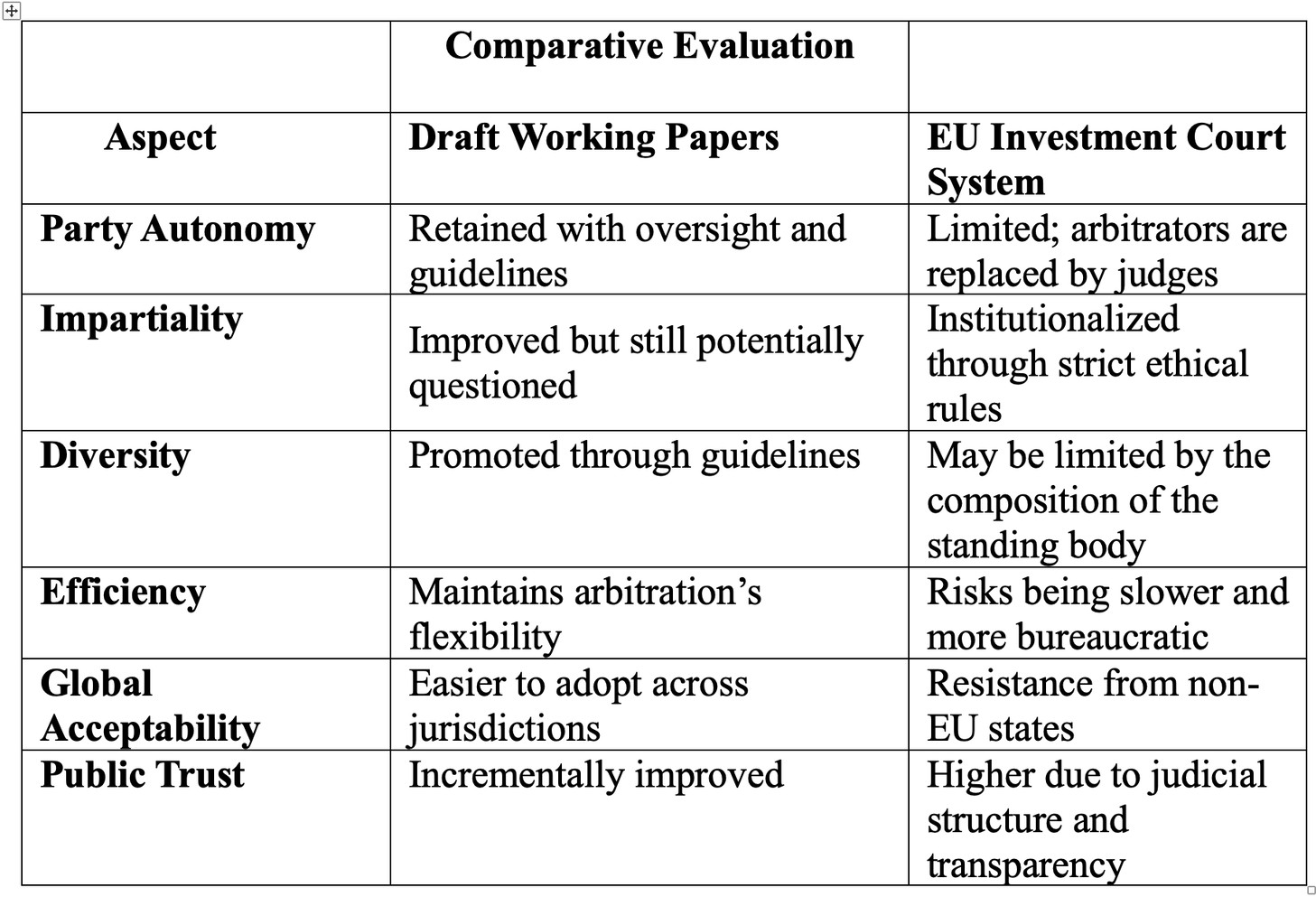
Conclusion
A party’s right to appoint an arbitrator is regarded as a historical and keystone characteristic of arbitration, featuring in the earliest definitions and codifications of international arbitration. It is also regarded as an expression of the principle of party autonomy. In investment arbitration, where tribunals are generally composed of three arbitrators (a president and two co-arbitrators), co-arbitrators are generally party-appointed, meaning that claimant and respondent each have equal rights to appoint one. This is the preferred method of practitioners and is seen as an advantage of arbitration, in particular by States.
While institution-appointed arbitrators might mitigate some criticisms of party appointments, they are not a panacea and could introduce their own issues. A balanced reform approach, incorporating elements of institutional oversight while preserving some party autonomy, may better address the challenges facing investment arbitration.
Both approaches offer viable ways to address concerns about party appointments, but they cater to different priorities:
Draft Working Papers, are better suited for incremental reform, preserving the core features of arbitration while enhancing fairness and transparency.
The EU’s Investment Court System offers a radical shift, focusing on public legitimacy and systemic consistency but at the cost of arbitration’s flexibility and global appeal.
Ultimately, the choice between these models depends on whether the priority is to reform arbitration from within or to replace it with a fundamentally different system. A possible middle ground could involve combining elements of both approaches, such as adopting stricter selection guidelines within the current framework while exploring the ICS model for specific treaty networks or sectors.
The Practice Related to Oral Hearings in International Commercial Arbitration: A Comprehensive Legal Analysis
Abstract This article provides an in-depth exploration of the legal practice surrounding oral hearings within the realm of international commercial arbitration. It examines the historical evolution, procedural significance, practical implementation, and the emerging challenges in the conduct of oral hearings in arbitral proceedings. Through doctrinal interpretation, institutional rules analysis, and a comparative overview, the article offers critical insights into the role oral hearings play in ensuring procedural fairness and upholding party autonomy within international dispute resolution mechanisms.
- Introduction Oral hearings constitute a fundamental component of international commercial arbitration. As a manifestation of the right to be heard, oral hearings embody the principles of audi alteram partem and procedural fairness. This article delves into the multifaceted practice of oral hearings in arbitral proceedings, highlighting their importance, procedural structures under various institutional rules, and evolving trends across arbitral forums.
- Historical and Jurisprudential Foundations While arbitration has historically prioritized flexibility and informality, oral hearings have remained a crucial aspect of procedural fairness. The roots of oral advocacy in arbitration are influenced by common law traditions and the adversarial model. Key jurisprudential and institutional developments, including UNCITRAL Model Law and decisions by arbitral tribunals, affirm the relevance of oral hearings in delivering equitable outcomes.
- Procedural Framework in International Commercial Arbitration The conduct of oral hearings in arbitration is shaped by the applicable arbitral rules and the agreement of the parties. Leading arbitral institutions such as the ICC, LCIA, SIAC, and ICSID provide procedural frameworks that allow for oral hearings, typically at the request of either party. Article 18 of the UNCITRAL Model Law and Article 6 of the ICC Rules uphold the right to a fair hearing, including the opportunity for oral submissions, witness examination, and tribunal-party interaction.
- Functional and Doctrinal Role Functionally, oral hearings serve to clarify legal arguments, assess witness credibility through cross-examination, and facilitate direct engagement between the tribunal and parties. Doctrinally, they reinforce the legitimacy of arbitral awards and ensure transparency and due process. Although not mandatory, oral hearings are often perceived as crucial, particularly in complex or high-value disputes.
- Modern Challenges and Adaptations International arbitration has seen significant adaptations in the practice of oral hearings, particularly with the rise of virtual hearings. The COVID-19 pandemic accelerated the normalization of remote proceedings, leading to concerns around procedural equality, technological accessibility, and confidentiality. Arbitral institutions responded with guidance notes on virtual hearings, balancing efficiency and fairness while maintaining the essence of oral advocacy.
- Comparative Perspectives This section analyzes how major arbitral frameworks approach oral hearings:
- ICC (International Chamber of Commerce): Article 25(6) allows tribunals to decide whether hearings are necessary unless agreed otherwise by the parties.
- LCIA (London Court of International Arbitration): Emphasizes flexibility; Article
19.4 provides that hearings may be conducted physically or virtually.
-
- SIAC (Singapore International Arbitration Centre): Offers parties the right to request oral hearings under Rule 24.
- ICSID (International Centre for Settlement of Investment Disputes): Emphasizes transparency and public access to oral hearings in investment disputes.
- Future Trajectories and Normative Considerations The future of oral hearings in international commercial arbitration hinges on reconciling the desire for procedural efficiency with the principles of fairness and transparency. Normatively, the arbitration community must address challenges such as digital divide, cultural diversity in advocacy styles, and the growing use of AI-assisted tools. Future reforms may involve harmonization of virtual hearing standards and broader adoption of hybrid proceedings.
- Conclusion Oral hearings in international commercial arbitration remain a cornerstone of procedural justice, even as their form evolves with technological advancements. Their continued relevance underscores the need for arbitral institutions and practitioners to preserve the values of fairness, participation, and party autonomy, while embracing innovation to meet the demands of global commerce.
Keywords: Oral hearings, international arbitration, procedural fairness, UNCITRAL Model Law, ICC Rules, virtual hearings, party autonomy, arbitral proceedings, comparative arbitration, dispute resolution.
Effective and Persuasive Written Advocacy in International Commercial Arbitration
The importance of written advocacy
Writing well is a powerful tool in the practice of law. Just like oral advocacy, the purpose of written advocacy is to persuade and in order to be persuasive, the document must be useful for the intended reader. Written work that is dense, impenetrable, lacking cohesion or badly structured will rarely be useful and sometimes may be counter productive. A valuable opportunity to persuade will have been wasted, sometimes irredeemably.
Written advocacy has played the part of the poor second cousin to oral advocacy but increasingly written advocacy has taken on a more significant and important role. Opening and closing submissions are usually filed in civil matters and in appeals written arguments must be filed before the hearing. The written argument thus provides an opportunity to persuade the Court before oral address has any role.
Written advocacy is not confined to submissions. The way in which cases are presented in the form of pleadings, affidavits and witness statements is also a form of advocacy. The techniques of writing effectively and persuasively apply just as much to those documents as they do to written submissions.
Persuasion starts with the Notice of Dispute; Originating Process and means used to defend proceedings such as responses and replies.
Invariably, the first contact that an arbitral tribunal has with the advocate is in the advocate’s written documents:
- the notice of dispute, if the advocate has drafted it;
- the initiating process;
- the statement of claim;
- the response;
- witness statements;
- affidavits;
- submissions on arbitral procedures; interim measures or other matters. Written advocacy generally needs to:
- be structured;
- be clearly expressed;
- identify with precision what it is seeking to be put before the tribunal;
- make efficient use of language.
Written advocacy in international arbitration is of paramount importance. Oral advocacy is significant, but because of the ways in which most arbitrations are structured, written advocacy assumes greater importance in these than most cases heard in Court.
Gibbs CJ observed:1 “…written words remain and the written outline of submissions remain visible when the sound of Counsel’s voices no longer vibrates in the memory…”
Written aspects of an arbitration that form part of the persuasion process include:
- the notice of dispute that will be delivered to the arbitrator(s);
- the statement of claim and/or terms of reference;
- the statement of defence;
- (perhaps) a rejoinder;
- submissions or outline of case;
- or response;
- comprehensive written submissions by each party at the conclusion of the evidence.
At the conclusion of the submission process, parties may have the right to file “post hearing” briefs.
Like the oral advocacy, the written advocacy needs to be pitched according to the:
- the nature and complexity of the case;
- the extent of the issues that are raised by the parties, including jurisdictional issues; applications for interim measures; any other interlocutory applications such as bifurcation of the proceedings and
1 H T Gibbs, ‘Appellate Advocacy’ (1986) 60 ALJ 496, 497.
whether there are cross claims; counter claims or set offs.
Note: witness statements form part of the persuasion process. Statements that are properly drawn; concise and compliant with the rules of evidence that apply to the arbitration are persuasive in themselves.
Process of writing
The process of writing to persuade has other advantages. Good writing imposes a rigour in analysis by exposing the strengths and weaknesses of an argument and forcing an evaluation and re-evaluation of content. Writing out an argument helps the writer to understand his or her case, to define, refine and recast the matters that the Court must decide, to identify the facts that materially bear upon those matters and how best to present and express those facts, and weave them into the legal issues and arguments and how to put the legal argument.
Some techniques for effective and persuasive writing
Written advocacy is a skills based discipline, which is different to oral advocacy. For most people, good writing only comes with a great deal of effort and time consuming iterations of drafts. Perseverance is rewarded with a document that achieves the purpose for which the labours were intended.
People have different styles of writing and should write in style of writing with which they are comfortable. Whatever the style of writing, there are some techniques that are useful tools for effective and persuasive writing.
Framing the question or answer
Identifying the issues in broad abstract terms does not meaningfully convey what the Court must decide. Expressing the issue as:
Did the defendant engage in misleading and deceptive conduct? Of so, what damages is the plaintiff entitled to recover?
tells the Court nothing about the actual dispute or the matters to be decided.
The issue should identify for the Court what the Court must actually decide. Think about how to express the issue so that the judge understands what is in issue and why. A well framed issue provides the roadmap for the presentation of the facts and argument.
Think about how key facts can be used in defining the issue. By way of example:
“In New York, a person who knowingly purchases goods cannot bring a claim for breach of implied warranty. Sandra O’Kefee admitted that she purchased her 2003 Acura-the vehicle she claims the manufacture impliedly warranted – with more than 11,000 miles on the odometer. Did the trial court properly dismiss O’Keefe’s claim for breach of implied warranty because the car was used when she bought it?”
“David Jackson will likely be convicted of capital murder and sentenced to death at next week’s trial unless he can present evidence of his mental retardation. Jackson’s expert on mental retardation must undergo emergency surgery to remove a cancer that his doctors have just discovered. Did the trial court abuse its discretion in denying Jackson’s motion for a continuance to allow him time to find a new expert.”[1]
Using the power of logic, issues can be framed in a way that identifies the question, delivers the answer to the question and the reasons for that answer.
The power of facts
The temptation often is to set out facts chronologically. Sometimes that may be appropriate but more often than not the materiality of the fact is not apparent and often a chronology will include all kinds of facts that simply do not bear upon the issue to be decided.
Only include facts that are relevant to your argument and present them in a way that makes it plain why they are relevant. Working out the facts to mention requires an understanding of your case. Once identified, use those facts in a way that gives them best effect. Sometimes that may be by way of narrative or by incorporating the facts into the legal analysis. Sometimes it may be in the way in which the issue is framed. Facts need careful choice and careful expression. How you order and present the facts can be a powerful tool for persuasion.
The architecture of writing
Structure is important. The document should provide an easy road map for the reader to follow so that the reader from the outset is able to follow the significance of what he or she is reading. Use the first few paragraphs to set the context and explain where the document is leading. Headings can also be useful.
-
- Proceed logically.
- Use simple expression.
- Good grammar, punctuation, use of paragraphs and different sentence lengths are basic tools.
- Choice of active or passive voice will have an impact. You should know the difference and know when to use which voice and why.
- Think about choice in expression. For example, expressing a positive in a negative way may have a more powerful impact or vice versa.
The order in which you present your arguments
-
- Lead with your argument, not your opponent’s argument. By focusing on your opponent’s argument you divert the Court’s attention to that argument, not to the content of your own.
- It is often helpful to bear in mind the CRAC method: Conclusion, Rule, Analysis, Cases. By starting with the conclusion and the rule that informs
that conclusion, the reader is provided with an immediate context for the analysis that follows.
-
- When quoting from cases explain the relevance of the quote. Unless the relevance is explained, there is the danger that the reader will either gloss over the quote, ignore it altogether or misunderstand its relevance.
Write for the reader
Always bear in mind the intended reader and write for that person or persons. If the intended reader is the Court the document can be used to provide a template for the Court for the way you contend that the Court should decide. Ask yourself the question: What does the Judge need to know and how can the material best be presented to the judge?
Written Submissions
“The advocate’s central contribution lies in finding a place where the law and the facts will intersect to achieve the outcome sought by the client in the arbitration. Law and facts are critical inputs, but they are not the only source of the theory of the case. It is equally important that the advocate understands the client’s business and the theory of the case leads to an award that achieves the desired business objective…”2
The basics of persuasive oral argument apply to written submissions, which answer the question of what the advocate is trying to achieve and in form.
Written submissions must help the decision maker to understand what has to be decided. Written submissions only achieve this if submissions are clear. To maximise clarity, the advocate should:
-
- set out clearly what the party contends for in the arbitration;
- identify why a particular decision should be arrived at by the tribunal;
- formulate each proposition of fact and law supported by the evidentiary material;
- organise the issues in a logical sequence;
- use clear, simple language, bearing in mind the aspects of communication referred to above;
- use short sentences;
- use numbered paragraphs;
- use appropriate headings;
- use an appropriate layout to ensure submissions are well set out and provide space for the decision maker to make notes;
- include cross-references to key documents.
Submissions should be coherent: i.e. have a coherent structure and be easy to read and understand.
A document that is well-structured and pleasant to the eye is likely to be more persuasive. The advocate in writing the submissions should:
2 (Guillermo Aguilar Alvarez, ‘Effective Written Advocacy’ in R. Doak Bishop and Edward G. Kehoe (eds), The Art of Advocacy in International Arbitration (Juris, 2nded, 2010), 479.)
-
- begin with a short introduction setting out what the advocate is seeking;
- set out the issues for decision; outline what is not in issue, if appropriate, and set out sufficient facts to enable the decision maker to compare with arguments on the law;
- develop the argument in favour of the advocate’s case and deal with any arguments against;
- include a brief summary of why the tribunal should find in the advocate’s favour;
- be concise, as concise written submissions are easier for the reader to understand. Too much detail not to the point may distract the reader from the main thesis of the submissions, particularly if the reader does not speak English;
- not overload the submissions with unnecessary case references or lengthy quotations. Pick the best authority; cite the case or annex a copy;
- try to pick the three strongest arguments in your favour on each issue and avoid long lists;
- use as few adverbs as possible;
- use short sentences and paragraphs.
If there are to be oral submissions, the advocate should leave some matters to be submitted orally. Put the first draft away and read it through afresh as if he or she were an arbitrator. Make amendments with short passages, removing anything lengthy or unnecessary. Written submissions usually precede oral addresses to the tribunal in international arbitration.
Accordingly, the introduction of the tribunal to the proceedings and to the advocate is usually a set of written submissions; case outlines or written openings and provide the first opportunity in the process of persuading the tribunal of the merits of the case of the respective parties, by establishing the credibility of the advocate and the merits and substance of the party’s case.
Usually, there are directions made at the beginning stages of an arbitration that require that statements of evidence be exchanged together with comprehensive outlines of the respective party’s position.
Most arbitrators will be annoyed or alienated by written submissions that have any of the following characteristics:
-
- prolix – including irrelevances; excessive quotation of fact or authority and failure to distil the essence of the argument;
- issue overload – too many points or issues resulting from a failure to reject weak points;
- incoherence – a lack of logical, unified concept of theme or an absence of interrelated organisation;
- inaccuracy – misstatement of fact or issue; omitting or misquoting authority or quoting out of context;
- mechanical defect – such as lack of an index; inadequate chronology; inaccurate references to authorities and transcripts; typographical errors; poor grammar and spelling and the failure to specify the relief sought and, more particularly, why the relief is sought.
Written submissions should:
- be brief; succinct and carefully use language. The written argument should bring material together in a comprehensive and logical manner. Unduly long written submissions deter readers from close and detailed reading, because they require lengthy periods of concentration;
- be logical. The arguments must develop logically and coherently with the stronger and most compelling argument presented first;
- be mindful that rhetoric and adjectival referencing are more in the province of oral argument “the touchstones are condensation and selection;”3
- contain propositional arguments;
- shortly state the proposition of law or fact to which the party contends, together with the factual or legal references that support the point. If critical material must be cited, it should be the shortest possible reference.
- use an annexure to the submissions if lengthy quotations or detailed references are required, rather than placing them in the main submission.
- Written submissions that are properly formatted are more easily absorbed and conducive to the persuasiveness of the document. Avoid complex numbering;
Systems
“the advocate’s central contribution lies in finding the place where the facts and the law intersect to yield the outcome sought by the client in the arbitration …”4
Again, consideration of the audience is important because of substantial differences in language; legal education and therefore legal skills; life experiences and perceptions. The process of communicating the written message needs to be done with those matters in mind.
Further, the written document establishes the credibility of the advocate.
The persuasion process includes the credibility of the source from which the submission emanates.
Accuracy
Written submissions must be accurate and present an argument fairly. If not, the arbitrator is more likely to put them aside in favour of the opponent’s submission.
Oral submissions speaking to inaccurate written submissions are not persuasive because they lack credibility.5
Comprehension
Submissions that omit important details or are selective to the extent of ignoring important
3 J. L. Glissan and S. W. Tilmouth, Advocacy in Practice (Lexisnexis, 3rd ed), 202
4 Guillermo Aguilar Alvarez, ‘Effective Written Advocacy’ in R. Doak Bishop and Edward G. Kehoe (eds), The Art of Advocacy in International Arbitration (Juris, 2nd ed, 2010), 479, 203.
5 Credibility and source needs to be identified
issues undermine the credibility of the act and the argument. All issues raised need to be dealt with.
The Law
The law needs to be identified clearly and fairly. Misrepresenting the law undermines the credibility of the advocate. Arbitrations are normally heard by experienced lawyers who have a grasp of an extensive body of law.
Case Theory/Case Concept
Marcus Stone writes:6 “a party’s theory of the case is his consistent and integrated view of the undisputed facts, his version of the disputed facts, and what he must prove in the law for the verdict which is his objective. It represents a party’s position, fully thought-out, rather than an assessment of the evidence.”
-
- As part of the preparation for the hearing, development of the concept of the case, or case theory is essential.
- It is, in reality, how the advocate wants the evidence to be and be seen b the tribunal at the conclusion of the evidence.
- It fits within the applicable law, and when the law is applied to evidence, will, hopefully, achieve the result the advocacy seeks. As the preparation advances, the case theory/concept is refined; modified and some parts are often abandoned.
- Some advocates prepare their final address before the case commences, and particularly, before the opening commences.
- In international commercial arbitration, it is important that the case theory/case concept is attracted to the diverse background of the tribunal member(s).
- Therefore, the identification of a case theory/concept is an important component of the persuasion process.
Ten Commandments of Written Advocacy in International Arbitration
During an excavation at the ICC Court of Arbitration’s headquarters site in Paris, workers uncovered a stone tablet buried under boxes and boxes of petrified arbitration pleadings and exhibits. A team of archaeologists worked for months to decipher and then folly grasp the text of the tablet and its significance for international arbitration practitioners today.
A Break in the stone tablet leaves it unclear whether more commandments followed the tenth one. Perhaps excavation will uncover more of the ancients’ wisdom in the future. For now, however, we must be satisfied with these ten which, as interpreted, by Barton Legum7.hopefully provide some small guidance.
6 Marcus Stone, Cross Examination in Criminal Trials (Butterworths, 1988).
7 Partner and Head of the Investment Treaty Arbitration Practice, Salans LLP, Paris, France. The author noted his admiration for the classic work by the late Irving Younger, Cicero on Cross-Examination in the Litigation Manual: Trial 387 (John G. Koeltl & John S.Kiernan eds.,3d ed.1999), which inspired
Commandment No. 1: SHORT SENTENCES.
Blessed are those who use few words.
Arbitrators are busy people. They often have many files running at once. They travel a great deal. Some read a pleading carefully only in the week or two immediately before the hearing. In that week, they also often have to deal with many other files. They occasionally suffer from jet lag and a compressed schedule when they finally read your brief. Many of the top arbitrators are not native English speakers.
All of this means that the most effective writing style is the one that is easy to understand, not the one with the most elegant or beautifully turned phrases. The simple reality is that it is easier for the brain to process short sentences, and short paragraphs, than long ones. Shorter is better for communication. And communication is the reason the client asks us to prepare a brief in the first place.
John Smith’ in ordinary speech, for example- we simply refer to him as ‘Smith’ or ‘Mr. Smith’.
If you do need to define a term for essential reasons of precision, then at least select an abbreviation that reminds the reader of what is being abbreviated. For example, if the term to be defined is ‘ABC Engineering and Design Investment Brazil Incorporated’, define it as ‘ABC Brazil’ or ‘ABC Engineering’ – not as ‘AEDIBI’. 1
Commandment No. 2: KEEP IT INTERNATIONAL.
The common tongue is understood by all.
One of the great challenges of international arbitration n is that of framing your argument terms persuasive to an arbitrator who grew up in a different legal system and national culture than you did. Meeting this challenge requires consciousness of the differences between your national and legal culture and that of the arbitrators. As a general rule, if you are not sure if a given concept translates, find another way of expressing it.
One potentially dangerous area is that of sports analogies. I have heard a US lawyer make extended references in oral argument to ‘getting to third base’ and ‘hitting a home run’. Lacking a background in the basics of baseball, the European arbitrators on the tribunal were baffled. I have also heard English barristers make references to sticky wickets’ that similarly served more to mystify rather than clarify.
Another difficult area is civil procedure in national court systems. It is sometimes tempting for counsel to refer to a procedural device in their national system to describe what they wish to accomplish in a request for an arbitral procedural order. The difficulty is that national systems differ in important ways, and a word used to translate a concept in one system may be entirely inadequate outside the context of that system. As one example, the French word ‘proces’ is often translated by the English word ‘trial’. For a US lawyer ‘trial’ signifies the hearing on the merits. But for a French lawyer ‘proces’ designates the entire procedure, from the filing of the complaint until the final judgment. A French lawyer and a US lawyer discussing ‘pre-trial’ disclosure may have quite different things in mind.
Latin phrases are another complexity. Some lawyers believe that if they express a
him toformat of his article.
concept in Latin, they establish its universality. But not all educational systems in recent decades have valued training in classical languages. As a result, unless your arbitration tribunal is composed of ancient Romans, it is best to express your argument in English terms that you are confident the arbitrators will understand.
The test: if an arbitrator has to get up to look for a dictionary or run a Google search to understand your argument, you are not communicating well.
Commandment No. 3: TOPIC SENTENCES.
Blessed are the paragraphs that begin with the point they seek to make.
Legal arguments are better understood when the reader knows where you are going before you get there. The organization of your argument is stronger and clearer when each paragraph begins with a topic sentence: a sentence that makes or announces the main point of the paragraph.
Legal writing is not like that of a novel – there is no benefit in hiding the point of your narrative until the end, when it surprises the reader. Knowing what the point is in advance allows your argument to fall neatly in place in the mind of the reader- even a reader who, like many arbitrators, is studying your brief when recovering from a long flight, in between conference calls on procedural issues in other cases.
Commandment No.4: PARTY NAMES.
Thou shalt describe the parties by their names and not by by their procedural position.
Every case has at least one claimant and one respondent. Describing the parties as ‘Claimant’ or ‘Respondent’ does not help the arbitrator remember who they are. Even counsel has trouble keeping this straight. I cannot count the number of arguments by opposing counsel I have seen garbled by applying the wrong procedural appellation to their own client.
Moreover, the bland appellations ‘Claimant’ and ‘Respondent’ undo all of the efforts an advocate makes to characterize her client as the ‘good guy’ and the opposing party as the ‘bad guy’. The story comes alive when real names are used in a way that it cannot with procedural appellations.
Commandment No. 5: DO NOT GET PERSONAL.
Thou shalt not use you’ and we’ in legal writing.
Attorneys, in the interest of their clients, are sometimes required to take tough positions in arbitrations, particularly in procedural correspondence. It is sometimes tempting in correspondence with opposing counsel to refer to counsel or their client as ‘you’, and to oneself or one’s own client as ‘we’.
Do not do this. As attorneys, everything we do in an arbitration is on behalf of our clients. None of us likes to feel that we are being accused of misconduct or bad faith. The effect on the blood pressure of the ordinary lawyer of a statement ‘you are seeking to delay the proceedings in bad faith’ is measurably different from that of ‘ABC Corporation is seeking to delay the proceedings in bad faith.’ Keep it professional. Refer to the parties, not to counsel, in correspondence and in pleadings.
Commandment No. 6: MINIMIZE ABBREVIATIONS.
Thou shalt abbreviate only when essential.
An arbitrator’s attention to your arguments is a precious thing. Do not reduce the impact of your arguments by making the arbitrator engage in an exercise of memorizing a succession of abbreviations so that she can make sense of your points. Define an abbreviation only when it is essential to do so. It is not essential in contexts where one would not do so in ordinary speech. We do not stop to define: John Smith’ in ordinary speech, for example- we simply refer to him as ‘Smith’ or ‘Mr. Smith’.
If you do need to define a term for essential reasons of precision, then at least select an abbreviation that reminds the reader of what is being abbreviated. For example, if the term to be defined is ‘ABC Engineering and Design Investment Brazil Incorporated’, define it as ‘ABC Brazil’ or ‘ABC Engineering’-not as ‘AEDIBI’.
Commandment No. 7: DO NOT MAKE YOUR OPPONENT’S ARGUMENT.
Blessed are those who make on their own arguments, and not those if their adversary.
There is a temptation, particularly in responsive pleadings and submissions, to begin a responsive argument by summarizing the point in question. This is necessary to a certain extent. The Tribunal must know which of your adversary’s points you are addressing in order to understand your point in response. There are ways to do this, and ways not to do this.
The path not to be taken is to begin by summarizing your opponent’s argument, and then responding to it. Doing so is confusing for the Tribunal, which expects you to make your client’s argument. It is also dangerous- because many times you will be capable of stating your opponents’ argument in a clearer and more effective manner than they.
The righteous path is to begin the argument by stating that the adversary’s point is wrong. For example: ‘ABC Corporation errs in suggesting that the sun rises in the west’ or ‘ABC’s argument that the sun rises in the west is without merit’.
Commandment No.8: FACTS SHOULD SHOW, NOT TELL.
Blessed are those whose facts lead to the road of righteousness
The fact section of a brief should have a tone different from the argument. It should state the facts in a neutral, non-committal tone. It should not tell the reader what conclusion to draw from the facts that are stated. It should carefully select the facts to be discussed and present them in a way that leads the reader to the conclusion that your client is right and the adversary is wrong. It should show, not tell.
This approach is most effective. A conclusion that the arbitrator reaches herself
will be more persuasive to the arbitrator than a conclusion you tell the arbitrator to reach. That is just the way human minds are.
As a general rule, the fact section should be organized chronologically, since that is the presentation that is generally easiest to follow. It should tell a story and touch
upon the themes important to the case. As a general rule, the facts discussed should be limited to those that are used in the argument that follows. But the tone should
at all times remain factual and neutral, without drifting over into argument.
Commandment No. 9: NO SUPERLATIVES.
Thy words shall not try too hard.
When arbitrators read a pleading, they read it critically. As they read it, they ask themselves whether what you have written makes sense in light of their experience, the other party’s assertions and their knowledge of the law and the record. A good pleading is one that withstands a critical read without making the arbitrator pause even once.
Superlatives provide a ready target for an arbitrator’s critical read but only
rarely are necessary to make the point. An opponent’s point may indeed be very, very bad. But one typically needs to establish only the point’s lack of merit-adding the superlative is unnecessary. In those rare cases where it is necessary or desirable to convey a stronger degree of emphasis, it is almost always better to do so through careful selection of nouns and adjectives than through the addition of a superlative.
Commandment No. 10: LETTERS BEGIN WITH WHAT YOU WANT AND WHO YOU ARE.
They who state their wishes early and clearly shall be heard.
Always begin a procedural letter to the tribunal with what you are asking. A busy tribunal chair should not have to wait until halfway through your letter before she begins to understand why you have written. The discipline of stating the request in the first line also helps focus your thinking and makes your request more effective.
It is also useful always to begin with a clause stating on whose behalf you are acting. You of course remember who your client is and what their role is in the arbitration. An arbitrator with twenty cases in progress, however, may not immediately and always recall which lawyer acts for which party. This is not something to leave to chance.
CONCLUSION
The Written Claim or Counter Claim should ideally begin with Contents/Index of the document then giving out the executive summary of the case, followed by submissions on legal and factual issues ending up with conclusion of a brief which provides both a quick summary of the attorney’s/advocate’s case and a statement as to the relief sought (deny the grievance or make the grievant whole). The summary portion of the conclusion should be short, and in most cases will be a simple one or two sentence statement of the basic theory of the case. It is not necessary to summarize all of the arguments presented in the body of the brief.
The conclusion of the brief should also inform the arbitrator what action the advocate is requesting, such as affirm, deny, cease and desist order, or a make whole remedy. Identifying the action that the advocate is requesting should not be considered just a formality. The relief one or both of the parties wants may not be clear, especially when the issues are relatively complex. It is discouraging, to say the least, for advocates to find that they won the case on its merits, just to find that the remedy provided by the arbitrator is inadequate. To help protect against such an eventuality, the advocate ought be clear and persuasive as to expected relief.
Good brief writing integrates proper form and style with a good sense of persuasiveness. While a technically well- written brief can do much to advance the cause of the advocate, a failure to fully understand the psychology of
persuasion will, in turn, do much to undermine the brief. Two concluding observations are presented with the above point in mind. First, arbitrators generally are not persuaded by heavy sarcasm or material which denigrates the other party. Phrases such as “the absurd position of my opponent” or “the ridiculous interpretation of contract language as offered by the employer” detract from the persuasiveness of the advocate’s case. Second, arbitrators do not like to be threatened. Veiled threats such as “only a person who lacks an understanding of the process could agree with my opponent” may not be intended as intimidation but read as such and work against the advocate’s interest.
Style and form that help to establish clarity, combined with material that is both well- reasoned and persuasive, are the keys to effective brief writing. Attorneys/Advocates who write the brief with these goals in mind will do much to advance the cause of their clients.
You are navigating a tense meeting as arbitrator during arbitration. How can you assert your perspective without creating conflict?
Navigating a tense meeting as an arbitrator requires a delicate balance of assertiveness and diplomacy. Here are some strategies to assert your perspective effectively without escalating conflict:
- Stay Neutral and Professional: Your role is to facilitate resolution, not to take sides. Maintain a neutral stance and demonstrate professionalism to gain respect from all parties.
- Use “I” Statements: Frame your perspective using “I” statements to express your views. For example, “I believe this approach might address the concerns effectively,” rather than “You’re wrong about this.”
- Be Clear and Concise: Articulate your points clearly and succinctly. Avoid jargon and ensure your message is easily understood by all parties involved.
- Acknowledge All Sides: Show that you understand each party’s position by summarizing their views before presenting your perspective. This demonstrates empathy and helps to build trust.
- Focus on Interests, Not Positions: Shift the conversation from fixed positions to underlying interests. This helps parties see potential solutions that address their core needs rather than just their stated demands.
- Suggest Options, Not Ultimatums: Instead of dictating a solution, propose options and invite feedback. This encourages collaboration and makes parties more receptive to your perspective.
- Maintain a Calm Demeanor: Keep your tone and body language calm and composed. This helps de-escalate tension and signals that you are in control of the situation.
- Encourage Open Dialogue: Foster an environment where all parties feel comfortable expressing their views. Open dialogue can lead to mutual understanding and reduce resistance to your perspective.
- Be Empathetic: Show understanding and respect for each party’s feelings and viewpoints. Empathy helps build rapport and can make others more open to your suggestions.
- Seek Common Ground: Identify and emphasize areas of agreement before addressing contentious issues. Building on common ground can make it easier to navigate disagreements.
By using these strategies, you can assert your perspective effectively while minimizing the risk of escalating conflict and maintaining a constructive atmosphere in the meeting.
Preparation and Conduct of Arbitration Hearings: A Brief Overview
This article offers concise, practical tips for arbitration practitioners and in-house counsel to consider during the preparation and conduct of arbitration hearings. It is organized into three key sections:
- The Importance of Hearings in Arbitration Proceedings
- Preparation for Arbitration Hearings
- Conduct of Arbitration Hearings
The Importance of Hearings in Arbitration Proceedings
Renowned American arbitration practitioner Doak Bishop, in his book The Art of Advocacy in International Arbitration, aptly states:
“A good case rarely happens by itself. A case that is thoroughly prepared, sharply focused, supported by concrete evidence, and properly presented is far more likely to be persuasive than one that is not. While the facts and the law form the fundamental matrix, a good case is the product of substantial efforts by good lawyers painstakingly reviewing documents, interviewing witnesses, researching the law, strategizing and focusing the case, and developing compelling written and oral presentations.”
Arbitration proceedings typically consist of two main stages:
- The Written Phase: Submission of memorials/statements of claim, counter- memorials/statements of defense, replies, rejoinders, and, if necessary, post-hearing briefs.
- The Oral Phase: Hearings on jurisdiction, merits, and damages.
Due to the diverse backgrounds of counsel and arbitrators—spanning both common law and civil law traditions—international arbitration involves a fusion of oral advocacy with adversarial common law practices and written advocacy with inquisitorial civil law traditions. This blending results in harmonized procedures unique to arbitration.
Hearings are critical, as they allow arbitral tribunals to form their final views through oral submissions and the cross-examination of fact and expert witnesses. Although written submissions and witness statements remain key references post-hearing, clear, focused oral advocacy during hearings ensures the tribunal comprehends and retains the core arguments.
Interviews with arbitrators consistently reveal that their understanding of a case evolves during hearings, often solidifying by the conclusion of the parties’ opening statements.
Preparation for Arbitration Hearings
Effective preparation is essential for successful arbitration hearings. Key considerations include:
Procedural Framework and Pre-Hearing Preparation
- Procedural Order No. 1: Early in proceedings, the tribunal issues this order to outline rules on witness and expert testimony, the submission of evidence, and procedural matters such as interpretation and transcription during hearings.
- Pre-Hearing Conference: Held shortly before the hearings to finalize procedural rules.
Chronology of Key Events
In complex cases, especially investment arbitrations, a timeline of key events can help tribunals understand the sequence of events and identify critical issues.
Hearing Bundles
These bundles, containing essential factual and legal exhibits, witness statements, and key documents submitted during the written phase, are prepared and shared with the tribunal before the hearings. They serve as a reference during proceedings.
Opening Statements
Opening statements provide counsel with their first opportunity to address the tribunal directly. Effective opening statements:
- Clarify facts and legal issues, addressing potential misunderstandings.
- Summarize written submissions, highlighting key arguments.
- Ensure the tribunal understands the overarching narrative and critical evidence.
Counsel may use outlines or PowerPoint presentations to structure their arguments and make references to documentary exhibits, ensuring clarity and engagement. Overloaded presentations, however, should be avoided to maintain the tribunal’s attention.
Witness Preparation for Cross-Examination Fact Witnesses
Counsel should:
- Review witness statements with the witness to refresh their memory.
- Address any inconsistencies and prepare witnesses to provide concise, focused answers.
- Advise witnesses to avoid speculation or debates with opposing counsel, maintaining credibility.
Expert Witnesses
Expert witnesses must:
- Prepare thoroughly by reviewing their reports and addressing any inconsistencies.
- Be ready for witness conferencing, where opposing experts respond to the same questions from the tribunal.
- Maintain objectivity, as credible, well-reasoned reports are persuasive to the tribunal.
Conduct of Arbitration Hearings
Arbitration hearings generally include:
- Opening Statements: Time limits set by the tribunal are shared among opening statements, witness examinations, and closing arguments.
- Witness Examinations: Direct Examination: Used to confirm witness statements or address minor errors before cross-examination. Cross-Examination: Focuses on testing the credibility and reliability of opposing witnesses. Redirect Examination: Limited to clarifying points raised during cross-examination.
- Tribunal Questions: Arbitrators may interject at any stage to seek clarification on procedural, factual, or legal matters.
- Closing Arguments: Closing arguments, whether oral or written, provide an opportunity to address the tribunal’s final questions and consolidate key arguments. Post-hearing briefs may also be submitted to clarify any outstanding issues or respond to tribunal queries.
Final Thoughts
While new evidence is generally inadmissible post-hearing, exceptional circumstances may warrant its inclusion. Counsel should remain vigilant to ensure the tribunal has all relevant materials to deliver a fair and informed award.
Some questions and answers that address practical aspects of oral hearings in arbitration:
- What is the purpose of oral hearings in arbitration?
Oral hearings serve as an opportunity for the parties to present their case directly to the arbitral tribunal, clarify critical points, and provide oral evidence through witness testimonies. They also allow the tribunal to ask questions, assess the credibility of witnesses and experts, and understand the facts and arguments more deeply than through written submissions alone.
How are the rules for oral hearings determined?
The rules are typically set in a procedural order (often Procedural Order No. 1) issued by the arbitral tribunal at the outset of the proceedings. These rules cover aspects like the format of the hearings, timing, witness and expert testimony procedures, interpretation, and transcription requirements. Any further refinements are finalized during a pre-hearing conference.
What are hearing bundles, and why are they important?
Hearing bundles are compilations of key legal and factual documents, including exhibits, witness statements, and expert reports submitted during the written phase. They help the tribunal and parties quickly reference evidence during the hearing and ensure that the focus remains on the core issues.
How should opening statements be structured?
Opening statements should:
-
- Outline the key facts and legal issues concisely.
- Clarify any misunderstandings in the written submissions.
- Highlight the most critical evidence and arguments.
- Provide a clear roadmap of the party’s position. Visual aids like PowerPoint presentations are often used to enhance clarity and help the tribunal stay engaged.
What are best practices for preparing witnesses for cross-examination?
-
- Review Witness Statements: Ensure the witness is familiar with their statement and clarify any potential contradictions.
- Anticipate Questions: Prepare the witness for likely questions from opposing counsel, especially challenging or confrontational ones.
- Focus on Credibility: Emphasize the importance of clear, honest, and concise answers without unnecessary elaboration.
- Avoid Speculation: Instruct witnesses to only speak about matters within their personal knowledge.
How should counsel prepare for cross-examination?
-
- Identify Weaknesses: Analyze the opposing party’s witness statements and expert reports to identify inconsistencies or weaknesses.
- Draft Key Questions: Prepare targeted questions to challenge the witness’s credibility or the reliability of their testimony.
- Be Adaptive: Be ready to ask spontaneous follow-up questions based on the witness’s responses during the hearing.
- Know Your Limits: Avoid asking questions when unsure of the answer, as it may backfire.
What is witness conferencing, and when is it used?
Witness conferencing (or “hot-tubbing”) involves having expert witnesses from both parties discuss issues simultaneously before the tribunal. The tribunal may pose identical questions to all experts, facilitating a direct comparison of their views. This method is often used in technical or complex disputes to assist the tribunal in understanding conflicting expert opinions.
What role do arbitrators play during oral hearings?
Arbitrators may interrupt counsel or witnesses at any time to ask clarifying questions. They may also inquire about procedural matters, challenge factual assertions, or test legal arguments. This interactive role helps arbitrators gain a better understanding of the issues and form their preliminary views on the case.
Are closing arguments necessary, and how should they be delivered?
Closing arguments can be verbal or written and are used to summarize the party’s case, respond to the tribunal’s questions, and highlight key evidence. Many arbitrators and counsel prefer written closings as they provide time for a thorough and precise presentation of arguments.
However, verbal closings can be impactful when timed effectively, especially after witness testimonies.
Can new evidence or legal authorities be introduced after oral hearings?
Generally, no new evidence or authorities are allowed after the close of hearings. However, in exceptional circumstances-such as if new material emerges after the hearing-a party may request the tribunal’s permission to submit it. The tribunal’s acceptance often depends on whether the new evidence or authority could significantly impact the outcome of the case.
Impact of Artificial Intelligence, its Potential Benefits on Legal Sector and in International Arbitration
Artificial intelligence (AI) is poised to have a transformative impact on the legal sector, though the extent and manner of this impact are still being debated. There are several ways AI could influence legal matters in the future, both in practice and in the administration of justice. Here are key areas where AI is likely to have a significant role:
Automation of Legal Tasks
AI is already being used to automate routine legal work, such as:
-
- Document review: AI systems can quickly analyze vast volumes of documents, identifying relevant information for legal cases or due diligence, saving time and resources.
- Legal research: AI tools can search legal databases for precedents, statutes, and case law more efficiently than manual research, and they can even predict legal outcomes based on past case data.
- Contract analysis: AI can review and flag potential risks in contracts, helping lawyers identify issues like ambiguities or unfavorable terms.
Predictive Analytics
AI systems can process large amounts of legal data to predict the outcomes of cases. By analyzing trends in court decisions, AI tools can provide lawyers with predictions about how a judge might rule in a specific case. This is already being applied in areas like:
-
- Litigation strategy: AI can help lawyers decide whether to settle a case or proceed to trial by estimating the probability of winning.
- Settlement analysis: AI can evaluate past settlements to help attorneys craft more effective negotiation strategies.
AI in Dispute Resolution
-
- Online Dispute Resolution (ODR): AI is being integrated into platforms that mediate disputes online, especially in lower-stakes cases or consumer disputes. This helps reduce the burden on courts and offers an accessible, less formal way to resolve conflicts.
- Smart Contracts and Blockchain: Blockchain technology enables the creation of smart contracts—self-executing contracts where terms are directly written into code. AI can facilitate this by ensuring compliance and monitoring for breaches.
AI-Assisted Legal Decision-Making
While AI will be a powerful tool for lawyers, judges, and arbitrators, it is unlikely to replace human decision-making entirely. However, there are some specific areas where AI might assist in decision-making:
-
- Sentencing: In some jurisdictions, AI systems are being used to provide sentencing recommendations based on data, although this practice raises ethical concerns.
- Bail determinations: AI systems are used in certain places to evaluate the risk of granting bail based on an individual’s background and criminal history.
- Administrative decisions: Some administrative processes, like granting permits or licenses, could be handled by AI systems to streamline decision-making.
Challenges and Ethical Considerations
AI’s role in legal matters brings up critical ethical and practical concerns:
-
- Bias in AI systems: AI tools trained on historical data may perpetuate or even exacerbate existing biases in the legal system, such as racial or gender biases in sentencing algorithms.
- Lack of transparency: Many AI models, especially those based on deep learning, are considered “black boxes” because their decision-making processes are not transparent, which could undermine trust in legal outcomes.
- Legal accountability: If an AI system makes a legal error, who is responsible? Determining liability for AI-based decisions remains a complex issue.
Regulation and AI Governance
Governments and legal bodies are already considering regulations around the use of AI in legal contexts. This includes ensuring that AI technologies comply with human rights standards, protecting privacy, and creating guidelines for ethical AI usage in courts.
AI’s Limitations in Legal Judgment
Despite AI’s advancements, it is unlikely to fully replace human judges and lawyers because:
-
- Legal decisions require nuance: Many legal cases involve complex human emotions, societal values, and moral considerations that AI is currently incapable of understanding at a deep level.
- Interpretation of the law: Laws are often open to interpretation, and applying them to individual cases requires not just logic, but empathy and understanding of context—skills that AI has yet to master.
Role of AI in International Arbitration
AI can assist or even streamline multiple facets of the international arbitration process, including:
Automated Document Review and Evidence Analysis
Arbitration proceedings often involve vast amounts of documents, emails, contracts, and other data sources. AI can assist by:
-
- E-discovery: Automatically sifting through documents to find relevant evidence and flagging key issues.
- Evidence verification: AI could cross-reference facts, verify the authenticity of documents, and detect inconsistencies or discrepancies.
- Predictive Coding: AI tools can categorize and prioritize documents, reducing the need for human review and increasing efficiency.
Legal Research and Precedent Analysis
AI can enhance arbitrators’ and counsel’s ability to conduct legal research, especially when dealing with complex, multi-jurisdictional cases:
-
- Jurisdictional Precedent: AI can compare past arbitration rulings across various legal systems to provide insight into how different tribunals may interpret international conventions, treaties, or laws.
- Legal Framework Identification: AI tools can help identify the most relevant laws, treaties, and cases that apply to a particular arbitration matter, including investor-state disputes.
Predictive Analysis of Outcomes
AI can analyze past arbitration decisions, taking into account similar facts and legal issues, to predict possible outcomes of a case. This helps parties to:
-
- Estimate success rates: Before entering arbitration, parties can use AI tools to assess the likelihood of winning.
- Optimize strategies: AI could recommend negotiation strategies based on prior results in similar arbitrations, helping to streamline settlements or decisions to proceed with arbitration.
AI in Award Drafting
AI could assist in drafting enforceable arbitration awards by:
-
- Checking legal compliance: Ensuring that awards conform to the governing law or treaty frameworks, such as the New York Convention on the Recognition and Enforcement of Foreign Arbitral Awards.
- Consistency and Clarity: AI can analyze the language used in previous awards and ensure the clarity of new awards to enhance enforceability across jurisdictions.
Virtual Hearings and Case Management
International arbitrations often involve parties, witnesses, and arbitrators from multiple countries, creating logistical challenges. AI can enhance:
-
- Virtual hearings: By automating translations, transcriptions, and document sharing, AI could make remote hearings more efficient.
- Case management: AI tools could automate procedural steps such as managing deadlines, filing submissions, and scheduling hearings, reducing administrative burdens.
Potential Benefits of AI in International Arbitration
- Increased Efficiency and Cost Reduction
- AI’s ability to process and analyze large volumes of data quickly means arbitration can be conducted faster and at lower costs. For complex, high-stakes international arbitrations, this could represent significant savings for both parties.
- AI could reduce the need for human labor in routine tasks (like document review and evidence organization), allowing arbitrators and counsel to focus on higher-level strategic decision-making.
Enhanced Consistency and Predictability
-
- AI can identify patterns in prior arbitration awards and ensure that decisions are consistent with established jurisprudence. This could promote greater predictability, a key concern for parties in international disputes.
- By reducing human biases and discrepancies in decision-making, AI can help ensure that similar cases yield similar outcomes, which is critical for maintaining fairness in arbitration.
Broader Access to Arbitration
-
- AI could make international arbitration more accessible to parties with fewer resources by lowering costs and reducing the need for in-person hearings. This would be particularly useful for smaller businesses or individuals who would otherwise be deterred by the costs of arbitration.
Cross-Border Compliance and Enforcement
-
- AI could help ensure that awards are drafted in ways that comply with the enforcement rules of different jurisdictions, making it easier to have awards recognized and enforced under international conventions like the New York Convention.
Risks and Challenges of AI in International Arbitration
- Bias and Lack of Transparency
- Algorithmic bias: If AI tools are trained on biased data (e.g., previous arbitration rulings that may reflect cultural or legal biases), they may perpetuate those biases in future decisions.
- Lack of transparency: Many AI systems, particularly those based on machine learning, are “black boxes” that provide limited insight into how they arrive at decisions. This lack of transparency may undermine trust in AI-driven arbitration outcomes.
Ethical Concerns
-
- Replacing human judgment: Arbitration often involves the interpretation of complex factual and legal issues that require human judgment and moral considerations. Relying too much on AI might reduce the room for equitable or context-sensitive resolutions.
- Accountability: Determining responsibility for errors in AI-driven arbitration is challenging. If an AI system produces a flawed legal analysis or makes an incorrect decision, it raises questions about liability—should the developers, arbitrators, or the parties who used the AI be held accountable?
Enforcement of AI-generated Awards
-
- Legal standing: International treaties like the New York Convention may not yet provide clear guidance on the enforcement of AI-generated or AI-assisted arbitral awards. While AI might assist in drafting awards, tribunals must ensure that human arbitrators are still seen as the ultimate decision-makers to preserve the legitimacy and enforceability of awards.
- Due process concerns: If AI plays too large a role in determining awards or recommendations, it may raise questions about whether the parties were afforded their full procedural rights, which could jeopardize the enforceability of the award in certain jurisdictions.
Data Privacy and Security
-
- International arbitrations often involve sensitive data, and the use of AI introduces risks of data breaches or misuse. Ensuring that AI systems used in arbitration comply with strict data privacy regulations (e.g., GDPR in the EU) is essential to maintaining confidentiality and trust in the arbitration process.
Conclusion:
AI is likely to assist in making legal decisions but is unlikely to completely replace human judgment. Its most probable role will be in augmenting human decision-making by providing data-driven insights, predictions, and analyses. In high-stakes legal matters, especially those involving fundamental human rights, human oversight will remain essential. The future legal landscape will likely be one of collaboration between human legal professionals and AI systems, rather than one where AI acts autonomously.
discuss the role of AI in international arbitrations, the potential benefits of harnessing this technology to make enforceable determinations as well as the risks of doing so.
AI is becoming increasingly relevant in the field of international arbitration, which offers an alternative to litigation for resolving cross-border disputes, especially in areas like construction, trade, investment, and commerce. The integration of AI in this context could fundamentally reshape how arbitration processes are conducted, but it also introduces a range of benefits and risks. Here’s a closer look at both sides.
AI has the potential to revolutionize international arbitration by increasing efficiency, reducing costs, and ensuring consistency. However, its adoption must be carefully managed to mitigate the associated risks, including bias, transparency concerns, and the potential erosion of human judgment. While AI can assist in making arbitration decisions, particularly in procedural matters, it is unlikely that AI will fully replace human arbitrators any time soon. Human oversight will remain essential to ensure fairness, accountability, and the enforceability of arbitration awards across different legal systems.
As international arbitration continues to evolve, a collaborative approach between human arbitrators and AI could offer the best of both worlds: efficiency and accuracy, balanced with legal expertise and ethical judgment.
Artificial Intelligence in the realm of International Arbitration
Executive Summary:
This article delves into the growing role of Artificial Intelligence (AI) within the realm of international arbitration, offering an in-depth exploration of key topics that are shaping the future of dispute resolution. It begins by defining AI in the context of arbitration, clarifying its potential applications in automating and enhancing various stages of the arbitration process.
The article also examines the likelihood of AI becoming more widespread, particularly as global arbitration bodies and legal practitioners increasingly turn to AI-driven tools for case analysis, decision-making support, and procedural efficiency. In doing so, the discussion highlights the benefits AI brings, such as improved speed, cost savings, and enhanced accuracy in evaluating complex legal data.
However, the use of AI in international arbitration also presents risks and challenges. Issues like bias in AI algorithms, lack of transparency, and concerns about accountability are discussed, emphasizing the need for robust ethical and regulatory frameworks.
Finally, the article addresses the inherent limitations of AI in arbitration, noting that while AI can aid in streamlining processes, it cannot replace human judgment or the nuanced decision-making required in the resolution of complex legal disputes.
Introduction:
In this article, we will explore and cover the following topics:
-
- What is meant by AI in the context of arbitration?
- Is AI likely to become more widespread in the future?
- What benefits does AI offer in international arbitration?
- What risks and challenges arise from using AI?
- What are the limitations of AI in the context of international arbitration?” Let’s start with some definitions.
What do we mean by international arbitration.
International arbitration is a private dispute resolution method where a third party, called an arbitrator, makes a legally binding decision (an award) on the dispute between the parties. It can be compared to private sector litigation. The “international” aspect arises when the parties involved come from different legal systems or jurisdictions, or when the arbitration takes place under a legal framework different from that which would normally apply to the parties.
An example of when international arbitration is typically used.
International arbitration generally comes from a contractual agreement where the parties have decided to resolve disputes through arbitration rather than taking the matter to court.
Shifting from IA (international arbitration) to AI (artificial intelligence), how is AI defined in this context.
There have been many definitions of AI over time, evolving alongside technological advancements. In 1950, the Turing test suggested that a machine displays human intelligence if it can hold a conversation indistinguishable from that with a human. Five years later, John McCarthy coined the term “artificial intelligence,” describing it as creating machines that behave intelligently. Today, AI refers to systems capable of performing tasks associated with human cognition, such as understanding natural language, recognizing patterns, and generating human- like outputs. If we can’t tell whether the output is from a human or a machine, we’ve reached the point AI is at today, marking its progression since the Turing test.
How might AI be applied in international arbitration.
With the power of AI, including generative AI and large language models (LLMs), it can be trained on massive datasets to learn language patterns. In arbitration, AI could be used for searching large volumes of documents for key terms, organizing information, and even generating reports or summaries based on input parameters. However, risks like data errors and “hallucinations”-instances where AI produces false information-exist.
Some specific ways AI might be used in the arbitration process.
AI is already being employed in various ways. For instance, speech recognition technology allows AI to transcribe hearings in real time, complete with speaker identification. AI could also assist in interpreting or translating languages during proceedings or translating documents.
Additionally, AI is a powerful tool for legal research, capable of analyzing vast amounts of data quickly. AI might even help in selecting arbitrators, using data to identify the most suitable candidate.
AI can also be leveraged in document review, searching for key phrases, names, or dates among large datasets. In the document disclosure process, which is often expensive and time- consuming, AI could expedite the search for relevant documents, reducing costs. Predictive coding and computer-assisted review are other areas where AI could assist, helping organize materials, draft pleadings, or produce initial drafts of witness statements. Many people have encountered tools like ChatGPT, and it’s likely only a matter of time before such technology is widely used in arbitration, especially for legal drafting.
Although AI can accelerate document analysis and reduce costs, it still requires human oversight to ensure accuracy. In the future, AI will likely be used more frequently in international arbitration, assisting in tasks but still under human supervision.
Now, let’s discuss regulation. What regulations are in place for AI in international arbitration.
Regulation in this area is limited, with regulators trying to catch up. There are protocols like the Seoul Protocol on Video Conferencing in International Arbitration and the ACAS 2020 Cybersecurity Protocol for International Arbitration. In the UK, the Information Commissioner’s Office (ICO) launched a consultation on generative AI earlier this year. The EU passed the Artificial Intelligence Act, though it won’t take effect until 2026. Guidance has also been issued by legal bodies, such as the Bar Council in the UK, advising lawyers to carefully review AI- generated outputs and ensure data privacy is maintained.
Why is regulation necessary.
Transparency and fairness in decision-making are crucial. Tribunals need to ensure that AI- generated submissions are accurate, while clients are concerned with privacy and confidentiality. Moreover, parties must consider not only the law of the seat of arbitration but also the rules in countries where they might seek to enforce the award.
Let’s now discuss the benefits, risks, and challenges of using AI in international arbitration.
Starting with the positives, what are the main advantages of AI.
The most significant benefit of AI is cost savings, especially in reducing the legal input required in arbitration cases. AI can also increase efficiency, enabling faster resolution of disputes.
According to Richard Susskind, AI’s greatest contribution will likely be in empowering non- lawyers to handle their own legal matters. However, in the near term, AI will most likely enhance lawyers’ work rather than replace them.
The risks and challenges of AI usage in international arbitration.
One risk is the potential for data breaches, particularly when confidential client information is involved. Additionally, AI systems can produce false information, or “hallucinations,” as seen in cases where U.S. lawyers cited fictitious cases generated by AI. The courts have censured these lawyers not for using AI, but for failing to verify the information.
There’s also the risk of over-reliance on AI, which could lead to legal mistakes. AI might raise ethical concerns, such as bias in decision-making. Although some claim AI is less biased than humans, it is still a concern.
The limitations of AI in international arbitration, and could AI replace human arbitrators.
While AI can assist arbitrators, replacing human arbitrators is a different question. Though algorithms can resolve simpler disputes (e.g., eBay resolves most disputes this way), complex international arbitration cases are less likely to be decided by AI. Humans excel in emotional intelligence and nuanced decision-making, which are critical in arbitration. There’s also the “black box” problem, where the decision-making process of AI is not entirely understood.
Additionally, the New York Convention 1958, the framework for enforcing arbitral awards, doesn’t explicitly state that arbitrators must be human. However, some jurisdictions may require arbitrators to have legal training and other qualities only humans possess. There could also be issues regarding the enforceability of AI-generated awards.
Final thoughts: What does the future hold for AI in international arbitration.
Overall, the future looks positive for AI’s role in international arbitration, especially from a client perspective, as it can reduce costs and expedite the process. AI is evolving, and while there may be challenges, such as data hallucination and the “black box” issue, the potential benefits outweigh these concerns. AI will continue to play an increasing role in arbitration, transforming the field in unpredictable ways.
While AI can streamline processes and increase productivity, important questions remain: Can we trust a machine to deliver justice? Can AI overcome its limitations in terms of emotional intelligence and nuanced decision-making? These are the key topics we will be discussing in the years ahead.
ARBITRATION PROCEDURE AND ARBITRATION AWARDS IN PAKISTAN
Introduction
Award means decision or determination rendered by Arbitrators upon a controversy submitted by the parties. Enforcement of arbitral award means that the execution of award accordingly1.Apart from the legal requirements, the execution of an award requires some little care in order to the formalities required by arbitration agreement. It has already been pointed out that any directions contained in the arbitration agreements as to the execution of the award should be carefully followed 2.Unless otherwise agreed by the parties, an award by the tribunal made pursuant to an arbitration agreement is final and binding both on the parties and on any persons claiming through or under them. This means that, subject to any contrary agreement by the parties and to the right of challenge, once made the award is immediately enforceable. Many awards are implemented without the need for further steps to be taken against the losing party, but if a party refuses to comply with the award, enforcement proceedings will be necessary. 3
1 Black’s Law Dictionary 5th Ed. p. 474.
2 Arbitrations & Awards by David M. Lawrence published by The Estate Gazette LTD. London, p. 85.
Arbitration is a legal procedure to solve disputes, precisely commercial matters, outside court of law. Its functioning is analogous to judicial courts and arbitration awards are equally binding on contesting parties. Arbitration is gaining recognition and emerging businesses, companies are opting arbitration as a mode to resolve disputes. An arbitration award can be described as a formal and legal declaration and recognition of the merits of matter in dispute, by an arbitration tribunal which is equivalent to the judgment of judicial courts.
Although arbitration is a popular mode of commercial dispute resolution around the globe; yet it remains an unattractive substitute for litigation in Pakistan, primarily owing to inconsistent or ambiguous laws. The parties while signing a contract can agree that any dispute relating to the contract would be referred to arbitrators who shall decide the matter in accordance with laws of a particular country (called governing law) at a designated place (called seat of arbitration). The decision of arbitrators (called arbitration award) is usually binding on the parties. In legal language, a contractual clause providing for arbitration is called an arbitration agreement.
Judgment in terms of Award:
Under section 15(1) of the Arbitration Act of 1899, the award was not incorporated into a decree but was enforceable as such, as if it was a decree of a Court. The present section makes a change inasmuch as the Court will now first pronounce a judgment in accordance with the award and upon the judgment the Court pronounces a decree. The English Law is also changed in this respect by the Act of 1934 (vide section 10). Though an award was executable as decree of a Court, the Court had no power under section 15 of the Act of 1899 to pass a decree on the basis of the award. But according to the present section i.e. Section 17 of the Arbitration Act, 1940 where the Court thinks that there is no need to remit the award for reconsideration or to set aside the award, the Court must pronounce judgment according to the terms of award subject to the expiry of limitation in application to set aside the award. An award under the Act has to be followed by a judgment and decree – without this procedure, the award cannot be enforced by the court of law4.
The provisions of section 17 of the Arbitration Act, 1940 are mandatory and the Court will have no jurisdiction to pass a decree in terms of the award without complying with the provisions of this section. Where there is no valid submission, there could be no award on which the Court could make a decree and if it is so made, it is based on something, which is not an award. Under this section the Court is to wait at least for a period of thirty days from the date of the service of notice of filing of the award before pronouncing judgment on the award. But such a judgment can be passed within the prescribed period if the parties so desired. An objection that there is no valid reference does not come within the scope of section 17 or section 30. Where no appeal has been filed against an order rejecting objection to an award but only against the final judgment and decree the award becomes final and the
judgment can only by challenged on the grounds contained in section 17 of the Act. Where the application for filing of award and making it rule of Court has been made, the Court can make award a rule of Court under section 17 after dismissal of objections to the validity of the award. Award not made a rule of the Court would not operate to create any right, title or interest in the property, which is subject matter of the award5.
The following conditions must be complied with before the Court may pronounce judgment upon the award and before passing a decree:
-
- The Court must have given notice to the parties of the filing of the award.
- time for making an application to set aside the award must have expired or if such application has been made it must have been refused.
- the Court must have seen that there was no cause to remit or set aside the award. All these conditions are cumulative and must be fully satisfied6.
Court’s judgment, upon the award filed with, does not depend upon the objections filed by the parties to the award. The law provides independent responsibility to the Court to examine the award and satisfy itself about the following aspects before passing a decree in terms of the award. This law confers suo moto powers, rather imposes duty, upon the Court to:
- Find if there is any cause for remitting or setting aside the award, and,
- decide about the competency of reference and the validity of the resulting award.
- Correct or modify the award under its limited jurisdiction.
In Pakistan, in case of M/s Awan Industries Ltd. v. Executive Engineer, Lined Channel Division7,the court held that the provisions of section 17 of the Arbitration Act impose a duty on Courts to see that there is no cause to remit the award or any of the matters referred to arbitration for reconsideration or, set aside the award. This can be done by the Court suo moto, apart from the application, which a party may make for either remission of the award or its reversal. Where, therefore, an award is found to be nullity because of the invalidity of the arbitration agreement or for any other reason or the award is prima facie illegal and not fit to be maintained, the Court has power under section 17 of the Act to set it aside without waiting for objection to award being filed or without considering any application for setting it aside, if there be any, and irrespective of the question whether the objection, if filed, was not within time. In India, in the case of Deo Narain Singh
v. Siabar Singh 8the Court held that the mere fact that an objection is not filed by any of the parties to the award, it does not altogether absolve the Court from its responsibility of deciding that there was a competent reference, and, the award was a valid award on the face of it. These are the matters, the Court observed, which really go to the root of the award
5 Ibid.
6 Ibid.
7 1992 SCMR 65.
8 AIR 1952 Patna 46.
itself and irrespective of any objection by the parties, these matters have to be decided by the Court before a decree can be passed on the basis of the award.
Delay or omission on the part of the aggrieved party to file his objections within the statutory period of 30 days does not deprive the Court from exercising its limited jurisdiction to correct, modify or amend the award under limited circumstances. The Supreme Court of Pakistan, in case of Ascon Engineers (Pvt.) Ltd v. Province of Punjab9,held that there was no cavil with the proposition that objections to the award must be filed within 30 days from the date of notice under Article 158 of the Limitation Act. For instance, there is no objection to award but the Court seized with the matter i.e. Appellate Court exercising jurisdiction under section 30 of the Act or revisional jurisdiction under section 115, CPC has noticed that there is error apparent on the face of record, or award suffered from infirmity or legal defect and an error can be seen without substituting the opinion and in that case, the court can exercise jurisdiction to remove such defect or infirmity. It may also be noted that although the Appellate Court has very limited jurisdiction to interfere in the award but such limited jurisdiction can be exercised primarily with a view to save the award from remitting to the Arbitrator once again so the parties may not suffer rigors of proceedings either before the arbitrators or the Court.
The parties are at liberty to enter upon a compromise between them on matters decided by the award or outside it. Such a compromise can be reached even after the award has been filed in the Court, but before a decree in terms of the award has been passed. The compromise agreement between the parties shall substitute the award. Such a compromise may include matters that are:
- Either not separable from the matters upon which the award is given;
- or, separable from the matters on which the award is given.
Resultantly, the award to that extent would be modified by the compromise reached between the parties and in that case the Court would pass a decree in terms of the modified award and not in terms of the original award made by the arbitrator(s) or umpire.
The Supreme Court of India, in case of Munshi Ram v. Banwari Lal & another10,held that if the parties were dissatisfied with the award and wanted to substitute it by a compromise involving matters alien to the original dispute which were inseparable, the court might supersede the submission, and left the parties to work out their agreement in accordance with the law outside the Arbitration Act. In such circumstances, the new compromise itself may furnish a very good ground for superseding the reference and thus revoking the award. Where the parties do not throw the award overboard but modify it in its operation, the award, in so far as it is not altered, still remains operative and continues to bind the parties and cannot be
9 2002 SCMR 1662.
10 AIR 1962 S.C 903.
revoked. In that contingency, the Court may follow one of the two modes indicated by the Privy Council, in Hemanta Kumari’s case11. As follows:
“If the whole of the subject matter of the compromise is within the reference, the Court may include in the operative part of the decree the award as modified; but if it is not so, the Court may confine the operative part of the decree to the award as far as accepted and the other terms of the settlement which form a part thereof, if severable and within the original reference, in a schedule to the decree. The portion included in the operative part would be executable, but the agreement included in the schedule would be enforceable as a contract, of which the evidence would be the decree; the power to record such an agreement and to make it a part of the decree, whether by including it in the operative portion or in the schedule, will follow from the application of the Code of Civil Procedure by section 41 of the Arbitration Act and also section 141 of the Code; In a reference without the intervention of the Court, the Court has no general jurisdiction over the subject-matter as in a reference in a pending suit. If the submission is superseded in the former, there is nothing more the Court can do, but in the latter, the Court must proceed with the suit before it and give effect to the compromise in the suit according to law”.
How an Award is made a Rule of Court?
After filing the award before the Court of competent jurisdiction for purpose of making it a rule of Court, the Court issues the notice to the parties to the effect that the award has been filed before the Court. If any party files any objection against the award before the Court, the court decides these objections accordingly, otherwise pass the decree in terms of award. In Pakistan, Article 178 of the law of Limitation12allows a period of 90 days for filing the award in the Court. These 90 days are to be counted from the notice of making the award. In case of Haji Abdullah v. S. Iqbal Naseem, the award was signed on 18.3.1985 and filed by the Arbitrator on 6.8.1985, obviously after 4 months and 22 days. The Court rejects the objection that the award has been filed after the expiry of time limit prescribed by the Limitation Act. Elaborating this issue, the Court held that the period of 90 days allowed under Article 178 of the Limitation Act would be applicable only in such cases where a party to the Arbitration Agreement moved the Court for filing of the award. This article would have no application if the Arbitrator himself filed the award in Court. The Court observed that none of the parties had applied to the Court for a direction to the Arbitrator for filing the Award in Court. The arbitrators filed the Award with a covering letter. This action of the Arbitrator was held to be a ministerial act to which Article 178 of the Limitation Act had no application. Under section 96 of the Court of Civil Procedure all decrees are appealable but Section 17 of the Arbitration Act 1940 makes a decree /rule of Court passed on the basis of an award is non-appealable, unless it is:
-
- in excess of the award, or
11 AIR 1919 PC 79.
12 The Limitation Act, 1908
-
- not in accordance with the award. Before the Court passes a decree under this section, it will have to wait for the period of limitation (thirty days) prescribed for filing objections. If a decree is passed before the period expires, an appeal against the decree might be maintainable13.
The award rendered by an arbitrator is lifeless and is not capable of being executed till the time when the Court infuses the life in it by passing a decree in accordance with the same14.Where the award was not presented before any Court for making the same rule of the Court, the award could not operate to create, declare, assign, limit or extinguish, whether in present or in future, any right, title or interest, whether vested or contingent, in the property in dispute15. Mere making of an award simplicitor was of no value and did not create, extinguish or pass any right, title or interest and no party could be prejudiced by mere existence of the award. It only becomes effective when it is made rule of the Court. Until the decree is passed, the award has no status in the eyes of law16.Section 14 (2) of the Arbitration Act, 1940 requires the Arbitrator to file the award in the Court for making it rule of the Court and further requires that the Court give notice to the party after filing of it. The purpose of notice is to enable the parties to file their objections, if any, within the prescribed period of time17.An award, which has not been made rule of Court, does not require registration but after making the rule of Court, its registration becomes compulsory18.
Finality of Decree:
It is the right of a party to challenge the award, according to the provisions of the Arbitration Act, 1940, before pronouncing the judgment by the Court but not in any other way. On becoming a decree of the Court, the only remedy opened to the party is to appeal from the decree and that can only appeal on the ground that the decree was in excess of or not in accordance with the award. No suit lies against the award to challenge the validity and effectiveness of the award19.Where the objections against the award have been over-ruled and a decree has been passed in terms of the award, an appeal will not lie from such a decree and such decree will be final. The decision / award given by the Arbitrator, when it becomes final, put an end to all the controversies between the parties. If the Court passes decree in terms of award without allowing the parties within prescribed time for filing objections against the award it is liable to be set aside.
13 Haji Abdullah v. S. Iqbal Naseem PLJ 1987 Kar 455
14 PLJ 1994 Lah 446.
15 Haji Muhammad v Syed Manzoor Hussain Shah PLD 2003 Lah 208.
16 Abdul Karim v. Mirza Bashir Ahmed PLD 1974 SC 61., Rai Batey Khan v. Raja, 1991 MLD 587.
17 PLD 2002 Kar 434.
18 PLD 2003 Lah 208.
19 Ismail Muhammad Bhai v. Yousaf Ali, 1992 SCMR 699.
Execution of Decree in Terms of Award:
Under section 15 of the Arbitration Act, 1899, an award filed in Court was enforceable as it was a decree. The proceedings for enforcement of an award under section 15 were governed by section 47 of Civil Procedure Code, and an appeal was competent from an order rejecting such application. But under the section 17 of the Act, 1940 the Court must pronounce a judgment according to the award and upon the judgment so pronounced a decree shall follow. This decree is to be executed like any other decree passed by a Civil Court. An executing Court can neither refuse to execute an award nor amend it in any way, unless it is apparent on the face of the award that it has been passed without jurisdiction. If the award merely declares the rights of the parties in the property and does not state that possession is to be delivered to the parties, the award is merely declaratory and is not capable of being executed. A party to the award cannot, for the first time, in the execution proceeding raise an objection about valuation in order to oust the jurisdiction of the Court. Nor can it raise in the execution proceedings, the question as to the jurisdiction of the Court to entertain the suit in which the reference was made.
Procedure of Execution:
When the award becomes the rule of the Court and the Court pronounces the judgment in terms of award, such rule of Court or judgment becomes the decree of the Court. The execution process of decree of the court is given in the Code of Civil Procedure. The execution proceedings are very complicated and time gaining. The execution of decree passed in terms of award will be executed according to the Code of Civil Procedure. Part-II
i.e. Section 36 to 74, of the Code of Civil Procedure deals with the execution proceedings of the decree and Order 21 of the Code of Civil Procedure provides complete procedure for the execution of decree20.It is admitted fact that the execution of decree, passed in term of domestic award as well as in terms of foreign award, will be governed under the Code of Civil Procedure. In the enforcement of foreign judgment in any country, there are two principles: first is the principle of comity and second is the principle of reciprocity. Section 13 of the Code of Civil Procedure provides the procedure for the enforcement of foreign judgment and the conditions mentioned in above-noted section 13 are based on the doctrine of comity but the foreign award is not considered equal to the foreign judgment. It is pertinent to note that the Code of Civil Procedure, 1908, governs the procedure of execution of decree passed in terms of domestic award as well as foreign award.
Mostly, decrees passed in terms of award, are money decree. Rule 10 of Order 21 of Code of Civil Procedure provides the procedure for filing an application for the execution of the decrees and rule 23-A of the said Order provides that (a) in the case of a decree for the payment of money, the party either deposit the decretal amount in the Court or furnishes security for its payment; and (b) in the case of any other decree, the objecting party furnishes security for the due performance of the decree. This rule provides discretion to the executing
20 Code of Civil Procedure Act V of 1908.
Court to take security instead of decretal amount in money decree and in other decrees, this is a main hurdle in smooth and rapid execution of decree. Rule 58 to 103 of Order 21 of the Code of Civil Procedure is very complicated procedure, which deals with the procedure of investigation and objection, sale of the property whether moveable or immovable, and resistance to the delivery of possession to the decree holder or purchaser. These provisions of law provide further remedy to the parties in execution proceedings in the form of appeal, revision and constitutional petitions, which basically start the third round of litigation which commences from executing Court and goes up to the Apex Court. This is the difficulty in the execution of decree.
Remedies against Execution of Award:
The Convention of 1958, on the recognition and enforcement of foreign arbitral award, superseded the Geneva Convention 1927. In Geneva Convention, 1927 the burden of proof lies on the party who wants to enforce the award, while the Convention 1958 shifted the duty of burden of proof to the party who defended to enforce the arbitral award. The Convention 1958 provides seven limited defenses. The five of these are given in defenses Parsons and Whittemore Overseas Co. v. Societe General De L’Industrie Du Papier (Rakta)21
- When foreign award is contrary to the public policy.
- When subject matter of differences is not capable of settlement through arbitration i.e. non arbitrability.
- When inadequate opportunity is given to the party to present his defense.
- When arbitration proceedings are conducted in excess of the jurisdiction of arbitration.
- When award is given manifest disregard of law.
Award Operating as Res-judicata:
The doctrine of res-judicata is the principle of law of procedure which is categorically explained and defined in section 11 of the Code of Civil Procedure, 1908. A judgment and decree based on award is final and it would constitute res-judicata. A judgment by consent is intended to put a stop to litigation between the parties. A judgment and decree passed in terms of award, after solemn investigation by arbitrators, may constitute res-judicata. An award incorporated in a decree operates as res-judicata to bar a subsequent suit in respect of the same cause of action even though the award is not strictly in terms of reference. In case the Court hears and decides the question of validity of the reference as well as award, the party aggrieved cannot be allowed to re-agitate the same question in a subsequent suit22.
Arbitration is an integral part of the national and religious norms of Pakistani society. As such, it is an effective tool for the resolution of both domestic and international commercial and other disputes. Numerous judicial precedents in Pakistan confirm the acceptance and
21 U.S. Supreme Court of Appeals, 2nd Circuit, 1974. (508 F.2 d. 969).
22 Section 11 of the Cod e of Civil Procedure,1908 (Act V of 1908), Commentary by Aamer Raza Khan, 9th ed. 2005 p.59.
viability of the arbitration process, despite controversy generated by the recent judgment7 of the Supreme Court of Pakistan (SCP) in the WAPDA v. HUBCO23 arbitration case restraining HUBCO from invoking the arbitration clause on account of allegations of fraud. One cannot overlook the fact that the Karachi High Court24 recognized and upheld an international (ICC) arbitration clause, which was also supported by a minority of the Supreme Court judges in the above-noted SCP judgment25. Hence, Pakistani courts have always been and remain committed to letting the parties to a contract settle their disputes through arbitration, even foreign arbitration. The HUBCO case was an exception based on grounds of public policy, which is also well recognized in English jurisprudence.
Institutional Arrangements
Arbitration is an ad hoc procedure recognized and enforced by law in Pakistan. Unlike some other countries26, Pakistan does not have a national arbitral institution. The trade and industry sectors in Pakistan have, however, established arbitral mechanisms for a limited purpose. For example, the Federation of Pakistani Chambers of Commerce and Industry (FPCCI) has set up arbitration machinery under section 12 of the 1961 Trade Organisations Ordinance to arbitrate disputes arising between FPCCI and its members27.
International Investment
As part of the protective investment regime, international investors seek arbitration as a means of settling their disputes 28.International arbitration mechanisms are, therefore, being increasingly applied for the settlement of disputes between foreign investors and host states.
23 The Hub Power Company Ltd. (HUBCO) v. Pakistan WAPDA, LII All Pakistan Legal Decisions (PLD) 2000 Supreme Court 841, wherein the majority view was that public policy required a finding about alleged criminality; the matter was, therefore, not referable to arbitration
24 HUBCO v. WAPDA, 1999 Civil Law Cases 1320
25 The minority view, given by the acting Chief Justice, was that a valid contract could not become contrary to public policy because of an allegation that a later amendment was the product of an illegal act.
26 In many countries, central or national arbitration organizations have been established to provide facilities for arbitration of disputes. For example, the Indian Council of Arbitration was established at the national level in India in 1965.
27 Rules and Regulation of the Arbitration Tribunal (set up under Trade Organisations Ordinance, 1961 S. 12 of the Federation of Pakistan Chambers of Commerce and Industry, approved by the Ministry of Commerce, Government of Pakistan, vide letter no. 1001(2) 1969, dated January 3, 1969.
28 See generally UNCTAD, TRENDS IN INTERNATIONAL INVESTMENT AGREEMENTS (IIA): AN
OVERVIEW (Sales No. E.99.II.D.23).
In the absence of an international or multilateral regime 29,these are generally being included in bilateral investment treaties (BITs) between states.
Bilateral Investments Treaties
Pakistan has so far entered into fifteen BITs with: China (1989), France (1983), Germany (1959), Italy (1997), Republic of Korea (1988), Kuwait (1983), Kyrgyz Republic (1995),
Malaysia (1995), Netherlands (1988), Romania (1978), Spain (1994), Sweden (1981),
Switzerland (1995), Turkey (1995), and United Kingdom (1994).
Epilogue
There is frequent recourse to international arbitration in foreign trade and investment transactions in Pakistan. Pakistan and Pakistani nationals subscribe to international arbitration institutions and mechanisms such as the ICC, ICSID and UNCITRAL. The arbitration cases are, of necessity (because of governing law and/ or jurisdiction clauses), generally dealt with by Western lawyers in Western capitals. Budgetary constraints and exchange rate disadvantages constantly beset Pakistani parties while defending disputes in international arbitration. Furthermore, the high cost of international arbitration creates an “access” problem and there are resultantly very few arbitrations that are initiated by Pakistani parties. Some international arbitration experts have, therefore, suggested a regional approach as a possible solution to avoid the high cost of international arbitration30. For Pakistan, one possibility in this regard could be the development of a regional arbitration institution, such as the Arbitration Council proposed by the South Asian Association for Regional Cooperation (SAARC)31.
However, what would even be better would be the strengthening and promotion of national laws and procedures and the development and promotion of an institutional framework with a view to providing a fair, expeditious and inexpensive arbitration mechanism in Pakistan. Arbitration is very much part and parcel of the national and cultural landscape of Pakistan. However, the arbitration laws are outdated and there is no institutional support provided to the process of arbitration in Pakistan. Pakistan’s 1940 Arbitration Act does not contemplate international arbitration. The subject is partially covered by the 1937 Arbitration (Protocol
29 There are only guidelines on the subject. See World Bank Guidelines on the Treatment of Foreign Direct Investment (1992). The negotiations towards a potential Multilateral Agreement on Investment (the MAI Negotiating Text, dated February 14, 1998) at the Organization for Economic Cooperation and Development have now ceased without any agreement being concluded.
30See, e.g., M. Jaffer, Settlement of Investment Disputes: State-State Mechanisms: Investor-State Mechanisms, paper presented at the UNCTAD Sub-Regional Workshop for South Asia on Recent Development in International Investment Agreements, in Colombo, Sri Lanka on December 15– 16, 1999.
31 The Indian Council of Arbitration has prepared the Rules of Arbitration for the proposed SAARC Arbitration Council along the lines of the UNCITRAL Arbitration Rules 1976.
and Convention) Act, which is itself outdated. It is important for the country’s arbitration law to be in line with international norms. Pakistan, therefore, needs to revamp its domestic and international arbitration laws and to adopt a nationally oriented policy framework. With modern arbitration laws and procedures in place and a proper institutional framework to support the mechanism, Pakistan may be able to introduce an exhaustion of local remedies rule as a matter of policy and thereby give a boost to the local arbitration industry. The Pakistani Government would be well advised to take the following measures in this regard:
- establishment of an effective legislative framework for the resolution of international disputes. Pakistan should adopt a holistic approach to international arbitration legislation. A single statute that includes international arbitration should be promulgated. The 1940 Arbitration Act should be modernized taking into account the UNCITRAL Model Law on International Commercial Arbitration;
- ratification of the 1958 United Nations Convention on the Recognition and Enforcement of Foreign Arbitral Awards with appropriate declarations and reservations; establishment of a Pakistan Council of Arbitration, based on the experience of the Indian Council of Arbitration, to provide facilities for arbitration of both domestic and international commercial disputes;
Arbitrations and awards can be categorised in two types, domestic and foreign. The law tells us that a domestic arbitration and award is regulated by rules set out in the Arbitration Act, 1940 and foreign arbitration agreements and awards are enforceable under the provisions of Recognition and Enforcement (Arbitration Agreements and Foreign Arbitral Awards) Act 2011. The uncertainty on what constitutes a domestic or foreign award, is one of the biggest problems in commercial arbitrations in Pakistan. It is clear that any arbitration taking place in Pakistan where all parties originate from Pakistan and the underlying contract is governed by Pakistani law is a domestic arbitration. Nonetheless, the law is unclear where either governing law or seat of arbitration is a foreign country.
The 2011 Act, applicable to foreign arbitration agreements and awards is an adaptation of the New York Convention, 1958 (the NY Convention). Prior to the 2011 Act, the governing law was Arbitration (Protocol and Convention) Act, 1937 (the 1937 Act). The 2011 Act has repealed the 1937 Act.
While interpreting the 1937 Act, the Supreme Court of Pakistan recognised only those awards as foreign awards where the contract between parties is governed by foreign law and at the same time the seat of arbitration is also a foreign country, every other award was declared a domestic award.
However, the intent of the New York Convention and the 2011 Act negate this proposition. The NY Convention is applicable to a wider range of arbitration awards. In particular, the purpose of the NY Convention was to accord the same treatment and status to all arbitral awards which are made in a country, signatory to the NY Convention.
The benefit of this approach is to bring global certainty to commercial dispute resolution and enforcement of foreign awards. When multinational parties select a seat of arbitration which is a country signatory to the NY Convention, they acknowledge that in case of dispute an arbitration award would be enforceable in all countries signatory to the NY Convention. For example, the United Kingdom ratified the NY Convention. The Arbitration Act, 1996 as enforced in the UK, defines ‘New York Convention award’ as an award made, in pursuance of an arbitration agreement, in the territory of a state (other than the United Kingdom) which is a party to the New York Convention which means that all awards where the seat of arbitration is a foreign country signatory to the New York Convention are treated as foreign arbitral or convention awards in the UK.
The Convention on the Recognition and Enforcement of Foreign Arbitral Awards (“Convention”), 1958 was adopted by Pakistan on 14 July 2005 through the Recognition and Enforcement (Arbitration Agreements and Foreign Arbitral Awards) Ordinance, 2005. This was re-promulgated in the years 2006, 2007, 2009 and 2010 until it was finally enacted in 2011 (“2011 Act”). The purpose of the 2011 Act was to adopt the Convention by recognising and enforcing: (i) foreign arbitration agreements (under Sections 3 and 4 of the 2011 Act); and (ii) foreign arbitral awards (under Sections 6 and 7 of the 2011 Act). In doing so, the 2011 Act limited the judicial discretion of the Pakistan Courts (by using the word “shall”) and repealed the Arbitration (Protocol and Convention) Act, 1937 (“1937 Act”).
With the enactment of the 2011 Act, international award creditors filed applications for recognition and enforcement of the foreign awards on the basis that the new law was clearer and had lessor scope of judicial intervention. The 2011 Act, being a special law, was to be strictly construed with the effect that the Courts under Sections 6 and 7 of the 2011 Act “shall” not refuse an application for recognition and enforcement of the foreign award unless it was contrary to the grounds enumerated in Article V of the Convention. However, in practice, the Pakistan Courts could not adapt to the radical change in law (since the 1937 Act) and, consequently, the recognition and enforcement of foreign awards was delayed (making such awards redundant) or inconsistent judgments were passed contrary to the established principles of arbitration.
The judgment of the Lahore High Court titled Taisei Corporation versus A.M. Construction Company (Private) Limited32, is a first example in which the Court, while interpreting Section 14 of the Arbitration Act, 1940 (“1940 Act”) and Sections 6 and 7 of the 2011 Act, held that the powers of the Court to recognise and enforce a foreign award under the 2011 Act are limited and thus, the general remedy to seek recognition and enforcement under Section 14 of the 1940 Act would remain available. This appears to be incorrect as the 1940 Act applies to domestic awards and not foreign awards.
32 PLD 2012 Lahore 455
Another interesting interpretation is the judgment of Abdullah versus CNAN Group Spa33,which held that an award debtor could not seek to nullify a foreign award through a civil suit filed against such award on the grounds mentioned in Article V of the Convention. The Court held that the grounds mentioned in Article V could only be taken by the award debtor in defence to any proceedings initiated by the award creditor for recognition and enforcement of the foreign award.
A unique perspective was seen in the judgment of Rossmere International Limited versus Sea Lion International Shipping Inc.34, in which the Quetta High Court recognised a foreign award but rejected its enforceability on the basis that the award debtor did not have any assets or bank accounts in the territorial jurisdiction of the Court. It also created an interesting procedural deviation by holding that: (i) in the case of assets and person (i.e. of the award debtor), a civil suit (which could result in a re-trial) for recognition and enforcement is to be filed by the award creditor in the court of territorial jurisdiction where such assets / person are present; and (ii) in the case of a money award, an application for recognition and enforcement is to be filed by the award creditor in the court of territorial jurisdiction where the bank accounts of the award debtor are maintained.
This procedural issue has led Pakistan Courts astray in the previous century and also defeated the purpose of international arbitrations. The 2011 Act aimed to address it but it does not also specify any procedure for the Courts to recognise and enforce foreign awards. Moreover, the Federal Government has also not framed any rules under Section 9 of the 2011 Act which outlines a procedure for recognition and enforcement of foreign awards. Pakistan Courts have thus remained inconsistent with respect to the procedure for recognition and enforcement of the foreign awards and are unable to decide inter alia:
-
- whether an award creditor is required to file a civil suit (which could result in a re- trial) or an application (summary procedure) for recognition and enforcement of the foreign awards; and
- the parameters of the Court’s discretion and powers in recognising and enforcing foreign awards. the respective judges have not passed any judgment in the matter – which has thus suffered inordinate delay.
In the my opinion, the answer to Pakistan’s problem in recognising and enforcing foreign awards lies in an article authored in the year 2004 by the former Chief Justice of Pakistan namely Justice Mian Saqib Nisar titled; “International Arbitration in the context of Globalization: A Pakistani Perspective”, which stated that;
“The enforcement of foreign awards has also been much simplified and the legal framework strengthened in favour of the award…The Convention, and hence the Ordinance, can be said
33 PLD 2014 Sindh 349
34 PLD 2017 Baluchistan 29
to have a “pro- enforcement” bias and a strong case can be made out that the grounds under Article V are to be applied restrictively and construed narrowly” (emphasis added).
This simple, yet important, guideline has the capacity to remove major inconsistencies in interpreting the 2011 Act and improve the quality of precedents of the Pakistan Courts at par with its international counterparts.
Unlike the law of UK and many other countries, the 2011 Act of Pakistan fails to define what it means by a NY Convention Award or an award ‘made’ in a signatory contracting state. Judicial precedents in Pakistan, instead of resolving, have only added to the controversy. At present, the Sindh High Court has recognised an award as convention award or foreign award if the seat of arbitration was in a country signatory to the NY Convention.
However, the Lahore High Court upheld the interpretation of 1937 Act i.e. a foreign award must be governed by foreign law regardless of the seat of arbitration, nature of dispute or parties. The matter of interpretation of foreign arbitral award is pending before the Supreme Court of Pakistan for final resolution.
The distinction between domestic and foreign awards is relevant for commercial parties for several Firstly, the enforcement of a foreign arbitration award is easier and less cumbersome compared to the enforcement of a domestic arbitration award.
A foreign award can be directly filed in a High Court for enforcement, whereas a domestic arbitration award is first filed in a civil court for making it rule of the court. The difference of filing forum presages the number of years it would take to finally dispose of the case i.e. superior the filing forum for the award, sooner the matter would attain finality.
Since a domestic arbitration award has to be filed at a lower forum it potentially allows the losing party to contest the award on more judicial forums and hence drag the matter for years. In contrast, a foreign award can only be challenged before the High Court or the Supreme Court.
To encourage uniformity in the treatment of commercial arbitration awards the principle of pecuniary jurisdiction of the court should be applicable for enforcement of domestic awards. This would allow an award beyond a certain monetary limit to be directly filed by the parties or arbitrator in the High Court.
Secondly, the recognition and enforcement of foreign award under NY Convention can only be refused on limited grounds of a procedural nature compared to a domestic arbitration award which is susceptible to challenge on a wide range of technical and legal objections.
Thirdly, no stamp duty is payable on enforcement of foreign arbitral award whereas a stamp duty of three per cent of the amount of award is payable on a domestic award. The stamp fee alone discourages parties from filing a domestic award in court. The stamp fee is payable by
the party filing the award in court regardless of whether it seeks to set it aside or make it enforceable. As a matter of policy, no stamp fee should be payable on a domestic award as well.
The legal costs should remain consistent between different modes of alternate dispute resolution and at least more advantageous than litigation costs. In comparison, in an ordinary commercial dispute/ suit before a Pakistani court for resolution (not involving arbitration) no such stamp fee is payable. The court may grant damages or other monetary relief to a party but nothing is payable by the winning or losing party to the public exchequer on the amount decreed in a suit.
Nonetheless, even if the stamp remains payable on a domestic award, the law must settle the fact that the stamp duty on the value of the award would only be payable by the winning party when the award is made rule of court and no further challenge lies to the award.
Commercial dispute resolution demands cost effectiveness, time efficiency and legal certainty. Fortunately, the plight of commercial arbitrations can be relieved by amendment in the relevant laws. It is time that Pakistan aligns its law of arbitration with international developments in the area to bring uniformity and certainty in dispute resolution.
Is stamping of domestic arbitration award obligatory for enforcement?
For an arbitration award to be enforceable, there are a number of obligatory and non- obligatory requirements that ought to be fulfilled, for proper execution or setting aside of arbitration award. One of those requirements is stamping and registration of domestic arbitration awards. Insufficiency or any inadequacy in stamping of documents have certain consequences over its validity and enforceability. Some of the major legislations and provisions governing such issues are, Section 30 and 34 (setting aside of arbitration award and enforcement/execution of arbitration award respectively) of Arbitration Act 1908, Section 17 and Section 3 of Stamps Act, 1899.
Issues Pertaining to Unstamped Domestic Arbitration Awards
After completion of the process of arbitration, finality to the merits is given by pronouncing an arbitration award. Consequent to the passage of award, there are two possible outcomes namely, setting aside of arbitration award and enforcement of such award by execution under Sections 30 and 34 of Arbitration Act, 1908 respectively. Some case laws are briefed below, about unstamped or inadequately stamped arbitration awards, their validity and status with regard to the Stamp Act, 1899.
According to Section 33 of the Stamps Act, a public officer is obligated to impound any document which is inadequately stamped or unstamped. It is a mandatory clause and not merely directory. Such public officer while exercising his/her power under Section 33 of the Stamps Act, 1899 cannot force the parties to produce documents and also, has the power to
impound only original instruments and not copy of it. As per Section 31(5) of the Act, after pronouncement of arbitration award each party is to be delivered copy of the award, in case of contesting such award under Section 34 of the Act, i.e. challenging the award passed on the grounds as enumerated under Section 34.
Therefore, to rectify the conflict between Section 33 of Stamps Act, 1899 and Section 34 of the Arbitration Act of 1908, the Superior Courts practice directions are to be followed, whether an unstamped arbitration award challenged under Section 30 of Arbitration and Act can be impounded on the basis of Section 33 of Stamps Act, 1899. The provision under Section 33 of Stamps Act, 1899 is mandatory and thereby, an unstamped arbitration award under Section 30 for setting aside arbitration award is liable to be impounded as per Section 33 of the Stamps Act, 1899.
Remedies for Setting aside an Arbitration Award
Remedies which parties to an arbitration agreement may avail in Pakistan is setting aside an arbitration award. When an aggrieved party feels that he has sufficient grounds to believe that an arbitration award is not valid, he may apply for setting aside an arbitral award before the Court. There are certain grounds mentioned under section 30 of the Arbitration Act 1940 for setting aside an arbitral award. An aggrieved party is required to challenge an arbitral award for setting it aside within 30 days in Pakistan under article 158 of the Limitation Act 1908. An aggrieved party to an arbitral award can challenge an arbitral award for setting it aside on prescribed grounds mentioned in section 30 of the Arbitration Act 1940. Section 30 of the Arbitration Act 1940 states that on request of parties, the Court can annul arbitral award;
- if arbitrator misconducts himself.
- if arbitrator misconducts with arbitration proceedings.
- if arbitral award has been improperly procured.
- if arbitral award is made after order of the Court superseding arbitration.
- if arbitral award has superseded arbitration.
- if arbitral award is otherwise invalid.
Burden of proof in case of arbitration award annulment is upon applicant who seeks remedy of annulment before the Court. Sindh High Court held in a case between ENGRO Fertilizers Limited v Federation of Pakistan that burden of proof for proving that arbitration award is not based upon findings and upon produced evidence before arbitrator is upon an applicant who seeks remedy of setting aside an arbitration award. Applicant must prove serious irregularity on the face of it about procedure of arbitration tribunal and that irregularity cannot be ignored otherwise it would cause serious injustice.
An arbitration award is also void when arbitrator excesses his powers. An arbitrator has powers determined by parties given in an arbitration agreement but if parties have not decided it, the Arbitration Act 1940 gives certain powers to an arbitrator in Pakistan. When
arbitrator excesses his powers, aggrieved party may apply in the Court for setting aside an arbitration award.
An arbitration award may also become void if it is improperly procured or if subject matter of arbitration proceedings is not allowed to be arbitrated, e.g., arbitration process runs in civil nature cases between contracting parties and not in criminal matters, disputing parties may avail method of mediation and other modes of Alternate Dispute Resolution for resolving their disputes outside the Court in criminal matters.
If findings of an arbitrator are based upon documentary evidence and there is no misreading or non-reading of an evidence, the Court will not disturb arbitration award. The Court would always go in favour of non-interference rather than interference in findings of an arbitrator based upon documentary evidence. The Court can only interfere in arbitration award if there is gross miscarriage of justice.
One more case which is decided by Peshawar High Court between Government of N.W.F.P. v Jan Construction Company, the Court straightaway announced arbitration award rule of the Court without commenting upon validity of an arbitration award. Peshawar High Court held that the Court is duty bound under law of the land to consider all questions of law and fact, the Court is empowered to deny decision of an arbitrator to be made rule of the Court as well as it has jurisdiction under section 16 of the Arbitration Act 1940 to resend arbitration award to an arbitrator if there are certain deficiencies.
If arbitrator holds an inquiry in arbitration proceedings, takes sufficient documentary evidence, hears both sides of an arbitration agreement, decides issue and submits it in the Court with authentication of both parties in accordance with provisions of the Arbitration Act 1940, parties to an arbitration agreement cannot take back their statements made before an arbitrator and cannot state anything different of what they have said earlier before an arbitrator and law of Estoppel would apply upon arbitral award and parties to arbitration agreement.
Similarly, article 52 of ICSID Convention 1965 contains grounds of setting aside an arbitration award as it states that either party of arbitration proceedings may request annulment of an arbitral award by an application in writing within 120 days of its pronouncement;
- if arbitral tribunal was nor properly constituted.
- if arbitral tribunal exceeded from its powers.
- if members of arbitral tribunal involved in corruption.
- if there was a serious departure from fundamental rules of procedure (due process, fair trial, right of notice, right of hearing etc.).
- if arbitral award has failed to state reasons. These grounds are not imbedded in Pakistani law hence an aggrieved party may not avail these grounds to set aside an arbitral award in Pakistan.
No stamp duty is payable on enforcement of foreign arbitration award whereas a stamp duty of three per cent of the amount of award is payable on a domestic award. The stamp fee alone discourages parties from filing a domestic award in court. The stamp fee is payable by the party filing the award in court regardless of whether it seeks to set it aside or make it enforceable. As a matter of policy, no stamp fee should be payable on a domestic award as well.
For an arbitration award to be enforceable, there are a number of obligatory and non- obligatory requirements that ought to be fulfilled, for proper execution or setting aside of arbitration award. One of those requirements is stamping and registration of domestic arbitration awards. Insufficiency or any inadequacy in stamping of documents have certain consequences over its validity and enforceability Ideally, and in accordance with serial No. 4, Schedule I of the Arbitration Act 1940 (the “Arbitration Act”), the arbitration proceedings are to be concluded within a period of 4 months. However, this is far from what actually happens and this delay is attributable to multiple reasons. A major determining factor in the time consumed for arbitration is the attitude and diligence of counsel representing the parties to the dispute, the parties themselves, and the arbitration tribunal. The spirit of arbitration is for the expeditious resolution of proceedings, as opposed to adjudication from courts, the latter being a laborious process.
The matter of conclusion of arbitration proceedings within four months is obviously not a hard and fast rule and parties can have the proceedings extended either by the consent of both parties during the arbitration proceedings, or through an application before the court for extension of time under section 28 of the Arbitration Act. In the case of an application before the courts under section 28, we find that the courts are quite lenient towards extending the time in the interest of substantive justice and the adjudication of disputes on merits.
The actual time required for conclusion of the proceedings depends greatly on the diligence and efforts put in by the counsel from the claimant side, who has the most to gain from timely completion of the arbitration proceedings and finalization of the arbitration award. A dedicated and diligent effort on part of the counsel ensures that the arbitration tribunal gives shorter dates and also puts pressure on the respondent to be prepared for substantive proceedings on the dates fixed by the arbitration tribunal. On the contrary, a laid-back attitude of the claimant and its counsel only allow for the proceedings to be unduly delayed and extended as the arbitrators are neither under any scrutiny or pressure to make timely awards, nor are they pushed to expedite the proceedings. On the other hand, respondents also prefer to keep the matter in limbo as expeditious resolution of disputes does not necessarily lead to any payment to them.
Considerations for Upholding and Setting Aside of Arbitration Awards by Courts
The matter regarding upholding or setting aside an arbitration award as laid down in the Arbitration Act is not very detailed, however it has been sufficiently elaborated upon though
several decades of jurisprudence of the superior courts of Pakistan. The courts generally uphold and set aside arbitration awards on the following principles and considerations:
The main issue that courts are concerned with is whether the arbitration award provides substantial justice in deciding the dispute between the parties, and if so, the courts tend to be very hesitant in setting aside arbitration awards on procedural technicalities. In any case, it should be noted that procedural technicalities as laid down in the Civil Procedure Code or laws of evidence of Pakistan, such as the Qanoon e Shahadat Order of 1984, clearly state that they do not apply to the arbitration proceedings;
Arbitration is the ultimate adjudication stage regarding all questions of law and fact between the parties, as by ousting the jurisdiction of the ordinary courts, the parties have instead chosen their own forum to settle their dispute. Courts lack jurisdiction to look into merits of the case and therefore are inclined to not set aside the arbitration award, even when the court may arrive at a different conclusion from that arrived at by the arbitration tribunal;
All that the arbitration tribunal is bound to do is to ensure that it upholds rules of natural justice in concluding the arbitration proceedings, meaning thereby, that both parties have got an equal opportunity of producing evidence and presenting their arguments. The courts therefore have a very high threshold for setting aside an arbitration award. The only grounds available to a party contesting the arbitration award and to have it set aside are that the arbitration tribunal had a bias against the objecting party, and/or the arbitration tribunal misconducted itself or the proceedings in any other way;
Courts have also opined that the arbitration awards have more sanctity than the judgments of courts, as even a superior court’s judgment can be challenged on merits before different superior courts, through an appeal or review, while the award of an arbitration tribunal cannot be questioned or challenged on merits;
Courts have further laid down that they should have all inclinations towards upholding the arbitration awards as opposed to vitiating it because it is a forum that the parties choose themselves and once this forum gives its verdict the parties are bound to respect it;
On a number of occasions, courts have reprimanded the government authorities for unduly challenging arbitration awards through frivolous objections in courts as a standard procedure. Courts have observed that once parties agree to resolve their disputes through their private arbitration tribunals they lose the right to challenge that adjudication unless there is a serious violation of the principles of natural justice in view of a misconduct by the arbitration tribunal;
While it is the court’s duty to apply its mind in reviewing awards and any objections raised against the same before making it a rule of the court, courts also prefer to not dig very deep into factual controversies of the dispute as that is considered to be the domain of the
arbitration tribunal. The courts rarely scrutinize the process chosen by the arbitration tribunal when arriving to its decision, and when they do it is to a very limited extent;
It is crucial to appreciate that there are no specific requirements for the arbitration tribunal to come good on any specific formalities. If the court is satisfied after perusal of the relevant document and records that the arbitration tribunal has decided the matter after giving adequate opportunity of hearing to the parties, it will then proceed to uphold the arbitration award. In similar vein, it may also be mentioned that arbitration tribunals are not required to specifically refer to all the evidence that they have relied upon. However, this does not mean that the award can be based on extraneous considerations. The reason for not creating a strict requirement of recording evidence is that arbitrators do not always have the same understanding of these intricate technicalities as a lawyer or a judge, and therefore they are not expected to write the award as a competent judicial officer would. As the final arbiter of the dispute, the arbitration tribunal is the sole adjudicator of the quality and quantity of evidence and if it decides a matter in favor of one party upon being satisfied with the evidence produced, then courts respect such adjudication;
Arbitration tribunals are also not expected to address each and every issue in their awards to ensure that they make a speaking award. All that the courts require is for the arbitration awards to substantiate and back the conclusions with logical reasoning and that the arbitration awards are not perverse in any way;
Courts always attach a presumption of correctness to the arbitration awards while reviewing the same, and therefore any procedural or technical matters that do not have any material or substantive effect cannot become the basis for setting aside arbitration awards;
One of the grounds for setting aside an arbitration award is that there is perversity in the same and upholding it would make a mockery of justice. However, even for that to occur the party alleging such perversity has to prove the perversity alleged through evidence. Doing so would defeat the crucial requirement of ensuring substantial justice;
In case the court suspects that the arbitration tribunal committed some serious miscarriage of justice through personal misconduct or by misconducting the proceedings, the court then has the discretion of framing an issue for leading evidence for proving such misconduct before setting aside the arbitration award;
Courts have even gone on to hold that an arbitration award can only be set aside where the objecting party can prove that the arbitration tribunal misconducted the proceedings on purpose, and there was a deliberate disregard of the law. Minor mistakes in application of the law would not nullify an arbitration award as long as substantive justice is done;
In order for a party to successfully have an award set aside, the error must be apparent on the face of the arbitration award, meaning thereby that the arbitration award must be bad at the
very outset and the same need not be proved through detailed fishing of records and evidence;
In order to explain the position of the courts in looking at the validity of an arbitration award, courts have time and again reiterated that in rule of court proceedings the courts do not sit as a court of appeal and do not have the same powers as that of an appellate court. The importance of this statement can be understood from the fact that an appellate court generally has the discretion to get into each and every aspect of the controversy which is similar to the authority of the trial court;
Generally, for setting aside an arbitration award the courts examine whether there an error so glaring that it cannot be overlooked, and if it is overlooked it would result in the miscarriage of justice. The reason for this is that the main focus and concern for the courts is to be satisfied that the arbitration award has done substantial justice in resolving the dispute between the parties, and if that is done it is difficult to convince a court to set aside an arbitration award;
However, on occasion the courts have also stressed that they are not supposed to simply “rubber stamp” arbitration awards. That they are supposed to examine the arbitration awards and proceedings to determine whether the dispute has been decided properly. Such judgments have created a vagueness in the law, and even upon examination of the Arbitration Act, we see that a lot of discretion has been left to the courts. This has led to uncertainty in the law, which leads to a negative environment for investors.
Section 16 of the Arbitration Act 1940 states that the Court may resend matter to an arbitrator;
- when arbitral award has not determined all matters referred to an arbitrator for resolution.
- when arbitral award consists matter which was not referred to an arbitrator for consideration.
- when the Court cannot modify an arbitral award because it would affect other part of arbitral award.
- when arbitral award is incapable of execution because it is indefinite, (v) when reservation upon legality of an arbitral award is obvious.
Sindh High Court held in a case between Abdullah Contractors v Water and Power Development Authority that the Court has supervisory jurisdiction upon arbitral award and not appellate jurisdiction. The Court in supervisory jurisdiction examines whether parties have given equal opportunities before arbitrator or not and if award is not based upon evidence as no evidence was produced before arbitrator disclosed by examining record, the Court would annul arbitral award and resend same to an arbitrator and ask him to reconsider matter and give equal opportunities to contracting parties again and give decision based upon solid evidence. The Court may also resend award;
-
- if decision of an arbitrator or an umpire is ambiguous and not clear.
- if fundamental issues between parties are not addressed.
- if there are additional things mentioned in an arbitral award which were not referred to an arbitrator for arbitration and that thing cannot be set apart from arbitral award without affecting other part of arbitral award.
- Moreover, when arbitrator does not file arbitral award in the Court within 4 months and an umpire within 2 months in Pakistan, the Court would remit an arbitral award because decision of an arbitrator submitted in the Court after expiration of prescribed time renders an arbitration award invalid.
Sindh High Court held in a case between Falcon Enterprises v National Refinery Limited that the Court acts in supervisory jurisdiction and examines whether arbitration award made by arbitrator is based upon material placed before him and whether parties to arbitration agreement had given equal opportunity to prove their opinion. If arbitrator does not decide case upon solid evidence, the Court would declare an arbitration award void and resend it to an arbitrator for reconsideration.
Similarly, Lahore High Court held in a case between S.M.I Brothers v Municipal Committee Murree that the Court has limited jurisdiction while examining validity of an arbitration award. If there is any clear error or disregard of law during arbitral proceedings, the Court would set aside an arbitration award and resend matter to an arbitrator.
Another similar case is a case between Water and Power Development Authority v MESSRS Ice Pak International Consulting Engineers of Pakistan, Lahore High Court held that arbitrator is bound to act on terms agreed upon by contracting parties, if arbitrator fails to fulfil implementation of arbitration agreement between contracting parties, it would be considered an error on the face of it which will nullify arbitration proceedings.
One more case gives clearer picture is the decision of Sindh High Court in a case between Adamjee Construction Company Limited v Islamic Republic of Pakistan, the Court held that before making award rule of the Court, it is obligation of the Court to see whether there is any cause exists to resend award to an arbitrator and to remove clerical mistake or typographical error. If aggrieved party is not successful to file objection within specified time, it would not be precluded that the Court becomes Functus Officio. It is duty of the Court as a supervisory body to see whether there is any kind of irregularity in arbitral award or whether there is any error or omission. It is also duty of the Court to see whether arbitral tribunal worked under arbitration agreement and under special law related to matter or not and after watching all aspects of arbitral award thoroughly, the Court is required to make an order for making an arbitral award rule of the Court for execution. The Court should thoroughly watch;
- whether there is any ground for modification or not.
- whether there is any matter to remit arbitral award left by arbitrator or not.
22
- whether arbitration agreement is valid and arbitral tribunal acted as per arbitration agreement and law of the land or not.
Enforcement of Foreign Arbitral Awards in Pakistan
Overview
The Recognition and Enforcement (Arbitration Agreements and Foreign Arbitral Awards) Act, 2011, governs the enforcement of foreign arbitral awards in Pakistan. This Act aligns with the United Nations Convention on the Recognition and Enforcement of Foreign Arbitral Awards, 1958, commonly known as the New York Convention. Pakistan, being a signatory to this Convention, has incorporated its principles into domestic law to facilitate international arbitration and the enforcement of arbitral awards.
Key Features of the Act:
-
- Application of the New York Convention:
The Act implements the provisions of the New York Convention in Pakistan. The Convention facilitates the recognition and enforcement of foreign arbitral awards and arbitration agreements, promoting international arbitration as an effective means of resolving cross-border commercial disputes.
Recognition of Foreign Arbitral Awards:
Under this Act, foreign arbitral awards are recognized and enforced in Pakistan as if they were domestic awards, provided that they meet certain conditions specified in the New York Convention.
Conditions for Enforcement:
The Act outlines specific grounds on which the recognition and enforcement of a foreign arbitral award may be refused. These grounds include situations where:
-
-
- The arbitration agreement is not valid under the applicable law.
- The party against whom the award is invoked was not given proper notice or was otherwise unable to present their case.
- The award deals with a matter not contemplated by or not falling within the terms of the arbitration agreement.
- The composition of the arbitral authority or the arbitral procedure was not in accordance with the agreement of the parties.
- The award has not yet become binding or has been set aside or suspended by a competent authority in the country where the award was made.
-
Arbitration Agreements:
The Act recognizes arbitration agreements in writing between parties to submit disputes to arbitration. Such agreements must be enforced by the courts, ensuring that disputes covered by the agreement are referred to arbitration rather than litigated in the courts.
Court’s Role:
Pakistani courts are given a supportive role in arbitration under this Act. They may intervene in arbitration matters only in specified circumstances, such as when the enforcement of an award is sought, or when a challenge to the validity of an arbitration agreement is raised.
Limitation Period:
The Act specifies the time limits within which applications for the recognition and enforcement of foreign arbitral awards must be made. This is in line with the general principles of the New York Convention and ensures timely enforcement.
Public Policy Consideration:
Recognition or enforcement of a foreign arbitral award may be refused if it is found to be contrary to the public policy of Pakistan. This exception is narrowly interpreted to promote the enforcement of foreign awards unless they clearly violate fundamental principles of justice or morality in Pakistan.
Importance in International Trade:
The Recognition and Enforcement (Arbitration Agreements and Foreign Arbitral Awards) Act, 2011, plays a crucial role in making Pakistan a more arbitration-friendly jurisdiction, encouraging foreign investment and trade by providing legal certainty and a reliable framework for the resolution of international disputes. It ensures that foreign investors can confidently engage in business in Pakistan, knowing that arbitration agreements and awards will be respected and enforced in accordance with international standards.
The courts in Pakistan have generally been supportive of the enforcement of foreign arbitral awards under the Recognition and Enforcement (Arbitration Agreements and Foreign Arbitral Awards) Act, 2011. However, the judiciary’s approach has been influenced by the need to balance international obligations with domestic legal principles, particularly regarding public policy considerations.
Key Provisions of the Act
Application and Scope (Section 1)
The Act applies to all of Pakistan and covers arbitration agreements made before, on, or after its commencement. It is applicable only to foreign arbitral awards made after July 14, 2005.
- Definitions include terms such as “foreign arbitral award,” which refers to awards made in states that are parties to the New York Convention or notified by the Pakistani government.
Jurisdiction (Section 3)
High Courts in Pakistan have exclusive jurisdiction to handle matters arising under this Act. The courts are to follow procedures similar to those in the Code of Civil Procedure, 1908.
Enforcement of Arbitration Agreements (Section 4)
If legal proceedings are initiated despite an existing arbitration agreement, the court must refer the parties to arbitration unless the agreement is deemed void or inoperative.
Recognition and Enforcement of Foreign Arbitral Awards (Section 6)
A foreign arbitral award, unless refused under Section 7, is recognized and enforceable as if it were a judgment of a Pakistani court. The award is binding and can be relied upon in legal proceedings within Pakistan.
Grounds for Refusal of Enforcement (Section 7)
Enforcement of a foreign arbitral award may be refused based on grounds outlined in Article V of the New York Convention, such as incapacity of parties, invalidity of the arbitration agreement, lack of proper notice to the party against whom the award is invoked, or if the award deals with a difference not contemplated by or falling within the terms of the submission to arbitration.
Inconsistency and Precedence (Section 8)
In case of any inconsistency between the Act and the New York Convention, the provisions of the Convention prevail.
Practical Implications for Enforcement
To enforce a foreign arbitral award in Pakistan, the party seeking enforcement must furnish the necessary documents as per Article IV of the New York Convention. These include the authenticated original award or a certified copy, and the original arbitration agreement or a certified copy thereof.
The enforcement process respects the principle of minimal judicial intervention, aiming to uphold the validity and applicability of arbitration agreements and the finality of arbitral awards. This approach fosters a pro-arbitration environment conducive to international trade and investment.
The Recognition and Enforcement (Arbitration Agreements and Foreign Arbitral Awards) Act, 2011, is a significant piece of legislation in Pakistan that aligns the country with international standards for arbitration, particularly with the New York Convention on the Recognition and Enforcement of Foreign Arbitral Awards, 1958.
Key Judicial Views and Trends:
- Pro-Enforcement Bias:
Pakistani courts, in line with the objectives of the New York Convention and the 2011 Act, have typically shown a pro-enforcement bias. This means that courts are inclined to enforce foreign arbitral awards unless there are compelling reasons not to, such as a violation of public policy or a clear procedural irregularity.
Courts have emphasized that the grounds for refusing enforcement are limited and should be narrowly interpreted to promote the finality and certainty of arbitration.
Public Policy Exception:
One of the main reasons courts may refuse to enforce a foreign arbitral award is if it is contrary to the public policy of Pakistan. However, the interpretation of “public policy” has been restrictive, focusing on fundamental legal principles, justice, and morality.
Courts have generally avoided using public policy as a blanket reason to refuse enforcement, recognizing that it should only apply in cases where the award fundamentally offends Pakistan’s legal or moral framework.
Limited Judicial Intervention:
The Act restricts the role of courts in arbitration matters, limiting judicial intervention to specific circumstances. Courts have generally respected this limitation, intervening only when there are serious questions about the validity of the arbitration agreement or the award.
This limited intervention reflects an understanding that arbitration is intended to be an alternative to court litigation, and the judiciary should not undermine its effectiveness by excessive interference.
Recognition of Arbitration Agreements:
Courts have upheld the validity and enforceability of arbitration agreements, even when one party attempts to challenge the agreement to avoid arbitration. The judiciary has stressed the importance of respecting the parties’ choice to resolve disputes through arbitration, in line with international arbitration principles.
When a valid arbitration agreement exists, Pakistani courts have generally stayed proceedings in domestic courts, directing the parties to arbitration as per their agreement.
Enforcement Process:
The courts have developed a consistent approach to the enforcement process, requiring the party seeking enforcement to provide the necessary documentation, such as the original arbitration agreement and the duly authenticated original award or a certified copy.
Challenges to enforcement are usually dealt with swiftly, as the courts recognize the importance of maintaining the efficiency and effectiveness of arbitration as a dispute resolution mechanism.
Challenges and Issues:
Despite the generally supportive stance, there have been instances where enforcement of foreign arbitral awards has faced delays due to procedural challenges or resistance from the losing party. These issues often stem from broader concerns about judicial efficiency and the capacity of the legal system to handle complex arbitration matters swiftly.
Notable Cases:
Dallah Real Estate and Tourism Holding Company v. Ministry of Religious Affairs, Government of Pakistan: Although this case was decided in the UK, it highlighted issues related to the enforcement of arbitral awards involving Pakistani entities and brought attention to how Pakistani courts might approach similar issues. The case involved complex questions of jurisdiction and the validity of the arbitration agreement, with significant implications for enforcement in Pakistan.
Hub Power Company Limited v. Pakistan WAPDA: This case is an example of the Pakistani courts’ approach to arbitration agreements and enforcement of arbitral awards in domestic and international contexts. The court emphasized the importance of upholding arbitration agreements and minimizing judicial interference in arbitration proceedings.
Criticism
While the Recognition and Enforcement (Arbitration Agreements and Foreign Arbitral Awards) Act, 2011, represents a significant step forward for Pakistan in aligning with international arbitration standards, it has faced criticism on several fronts. These criticisms highlight areas where the law and its implementation may fall short of the expectations of foreign investors, arbitration practitioners, and even domestic parties involved in international commercial disputes.
Judicial Inconsistency and Delays:
Inconsistent Application: One of the primary criticisms is the inconsistency in the application of the law by Pakistani courts. While some judges have embraced the pro-enforcement bias mandated by the New York Convention, others have been more cautious or even resistant. This inconsistency can lead to unpredictability in the enforcement of foreign arbitral awards.
Delays in Enforcement: The enforcement process can be lengthy, with cases often being bogged down by procedural delays. This undermines the efficiency of arbitration as a quick and effective dispute resolution mechanism, potentially deterring foreign investors from choosing Pakistan as a seat for arbitration or doing business with Pakistani entities.
Public Policy Exception:
Broad Interpretation: Although courts have generally taken a narrow view of the public policy exception, there have been instances where the exception has been interpreted broadly, leading to the refusal of enforcement of foreign arbitral awards. This broad interpretation can create uncertainty for foreign parties seeking to enforce awards in Pakistan, as it opens the door to subjective judicial interpretation.
Lack of Clear Guidelines: The Act does not provide clear guidelines on what constitutes a violation of public policy, leaving it to the discretion of the courts. This vagueness can lead to inconsistent rulings and reduce confidence in the enforcement process.
Limited Judicial Expertise in Arbitration:
Need for Specialized Courts: Critics argue that the general judiciary may lack the specialized knowledge and expertise required to handle complex arbitration matters, particularly those involving international commercial disputes. The lack of specialized arbitration courts or trained judges can result in decisions that do not fully align with international arbitration principles.
Training and Awareness: There is a perceived need for greater training and awareness among judges about the nuances of international arbitration and the importance of aligning with global standards. Without this, Pakistan may struggle to become a truly arbitration-friendly jurisdiction.
Procedural Issues:
Bureaucratic Hurdles: The enforcement of foreign arbitral awards can be hindered by bureaucratic hurdles, including the requirement for extensive documentation and the need to navigate complex legal procedures. These hurdles can deter parties from seeking enforcement in Pakistan, especially when compared to more streamlined processes in other jurisdictions.
Over-reliance on Formalities: The Act requires strict adherence to formalities, such as the provision of original or certified copies of the arbitration agreement and award. While these requirements are standard, the stringent application of such rules without flexibility can lead to unnecessary complications in enforcement proceedings.
Impact on Foreign Investment:
Investor Confidence: The criticisms surrounding the Act’s implementation, particularly the delays and potential for inconsistent rulings, can negatively impact foreign investors’ confidence. If investors perceive Pakistan as a jurisdiction where arbitration awards are difficult to enforce, they may be less inclined to engage in business or investment in the country.
Comparison with Regional Peers: Compared to some of its regional peers, Pakistan may be seen as less arbitration-friendly, particularly if neighboring countries offer quicker and more predictable enforcement of foreign arbitral awards. This could place Pakistan at a competitive disadvantage in attracting foreign investment.
Need for Legislative Reform:
Updating the Legal Framework: Critics argue that the Act could benefit from further legislative reform to address its shortcomings, such as by providing clearer guidelines on public policy, reducing procedural barriers, and introducing provisions for expedited enforcement of awards.
Harmonization with International Standards: There is also a call for greater harmonization with international arbitration standards and best practices to ensure that Pakistan remains an attractive destination for arbitration and foreign investment.
Conclusion
The Recognition and Enforcement (Arbitration Agreements and Foreign Arbitral Awards) Act, 2011, significantly aids in the facilitation of international arbitration involving Pakistani entities or interests. By closely adhering to the New York Convention, Pakistan ensures that foreign arbitral awards are recognized and enforced efficiently, thereby enhancing its appeal as a favorable destination for international commercial activities.
Pakistani courts generally view the Recognition and Enforcement (Arbitration Agreements and Foreign Arbitral Awards) Act, 2011, as a key tool for promoting arbitration as a reliable and efficient means of dispute resolution in line with international standards. The judiciary’s approach has been to support the enforcement of foreign arbitral awards while carefully applying the limited grounds for refusal provided under the Act, particularly the public policy exception.
While the Recognition and Enforcement (Arbitration Agreements and Foreign Arbitral Awards) Act, 2011, has made significant strides in promoting arbitration in Pakistan, it is not without its challenges. The criticisms focus primarily on the implementation of the law by the judiciary, the interpretation of key provisions like the public policy exception, and the procedural hurdles that can impede enforcement. Addressing these concerns through judicial training, legislative reform, and efforts to streamline the enforcement process could help strengthen Pakistan’s position as an arbitration-friendly jurisdiction.
Pakistan Courts approach towards out of Court settlement through the Alternate Dispute Resolution (the “ADR”)
Introduction
Pakistan’s justice system is buckling under the immense strain of a backlog exceeding two million cases, with some legal disputes dragging on for decades. For the average citizen, seeking justice often means enduring years of frustration, financial hardship, and emotional distress. The traditional courtroom model, designed for a vastly different era, is struggling to keep pace with a rapidly expanding population and increasingly complex legal conflicts. In this challenging landscape, Alternative Dispute Resolution (ADR) is not merely a supplementary option but an essential solution for ensuring timely justice in Pakistan.
ADR encompasses mediation, arbitration, and conciliation, offering a more efficient and cost-effective alternative to conventional litigation. Unlike the rigid formal court process, ADR prioritizes consensus-building and swift dispute resolution, making it particularly well- suited to Pakistan’s socio-economic realities. Its potential to transform access to justice is immense, yet it remains underutilized and widely misunderstood. Cases that would take years to resolve in court can often be settled within weeks through ADR—a level of efficiency that Pakistan’s overburdened legal system urgently requires.
Cost is another critical concern. For many Pakistanis, justice remains an unaffordable luxury. Legal fees, court expenses, and endless delays create insurmountable barriers, especially for marginalized communities. ADR offers a viable alternative by providing a faster, less costly means of resolving disputes, thereby making justice accessible to those who need it most. Imagine a small business owner resolving a contractual disagreement without depleting their financial resources or a family settling a property dispute without getting entangled in years of litigation. ADR makes these scenarios possible.
The concept of alternative dispute resolution is not new to Pakistan. For centuries, rural communities have relied on jirgas and panchayats to settle disputes. While these traditional mechanisms are often criticized for their patriarchal and sometimes unjust nature, they reflect a deep-rooted cultural inclination toward resolving conflicts outside formal courts. Modern ADR builds upon this tradition but introduces fairness, transparency, and equality into the process. It serves as a bridge between Pakistan’s historical dispute-resolution practices and the demands of a modern justice system.
The concept of alternative dispute resolution (ADR) is not unfamiliar to Pakistan. For centuries, rural communities have relied on jirgas and panchayats to resolve conflicts. While these traditional mechanisms are often criticized for their patriarchal and sometimes unjust nature, they highlight a deeply rooted cultural preference for settling disputes outside formal courtrooms. Modern ADR builds upon this legacy but enhances it by incorporating principles of fairness,
transparency, and equality. It serves as a bridge between Pakistan’s cultural heritage and the evolving needs of a contemporary justice system.
Should Mediation or ADR be Mandatory?
A key question arises: Should the existing preference for mediation extend to making Alternative Dispute Resolution (ADR) a prerequisite for initiating certain or all commercial disputes in court? In practical terms, this would mean that the law mandates parties in commercial disputes to first attempt mediation or another ADR mechanism before seeking judicial intervention. If this requirement is not met, courts would be obligated to refer the dispute to ADR, except in cases involving purely legal questions. Notably, this statutory obligation would apply irrespective of the parties’ prior consent or agreement to use ADR.
The Case for Mandatory ADR in Pakistan
Pakistan’s judicial system faces immense pressure due to a heavy caseload, particularly in the High Courts and subordinate courts, where cases often take years to reach a final decision. In commercial disputes, where timely resolution is crucial for business stability and profitability, prolonged litigation proves highly counterproductive. Lengthy proceedings drain corporate resources, discourage entrepreneurial initiatives, and undermine investor confidence. The ripple effects of delayed dispute resolution include stalled projects, lost business and employment opportunities, and increased financial burdens—all of which negatively impact not only businesses but also the broader economy and society.
Additionally, commercial disputes frequently involve complex financial, technical, and operational matters requiring specialized expertise. Industries such as oil and gas, power, technology, and telecommunications deal with intricate issues that trial courts may lack the capacity to handle effectively. As a result, inadequate decisions at the trial level often lead to prolonged litigation through appeals, reviews, and revisions. Procedural complexities, long waiting periods, and frequent adjournments further fail to meet the time-sensitive needs of businesses.
A statutory requirement for mediation or another ADR mechanism in commercial disputes could create a more business-friendly legal framework, ensuring faster and more effective dispute resolution. Such a system would provide businesses with a streamlined process, fostering a conducive environment for economic growth and investment. By resolving commercial disputes more efficiently, judicial resources could be reallocated to address other pressing civil and criminal matters, ultimately benefiting society as a whole.
Global Trends in Mandatory ADR
Countries worldwide are increasingly adopting ADR mechanisms, including mediation and arbitration, to reduce court congestion and enhance the business climate.
United Kingdom: The Civil Procedure Rules (CPR) encourage the integration of ADR within the civil justice system. Recent amendments empower courts to order parties to engage in ADR
or stay proceedings pending ADR if deemed appropriate and proportionate. In Churchill v. Merthyr Tydfil Borough Council (2023), the UK Court of Appeal affirmed that courts have the authority to mandate ADR, provided it does not infringe on the essence of a party’s right to a judicial hearing under Article 6 of the European Convention on Human Rights. While the court ultimately encouraged voluntary mediation in this case, it acknowledged the legitimacy of mandatory ADR under appropriate conditions.
Australia: Several Australian courts have statutory powers to refer cases to mediation, either with or without party consent. Certain laws, such as the Civil Procedure Act 2010 (Victoria) and the Civil Dispute Resolution Act 2011 (Commonwealth), impose mandatory mediation requirements before a claim can be filed. The Uniform Civil Procedure Rules (New South Wales) further empower courts to direct parties to mediation during pre-trial proceedings, promoting efficiency and preserving judicial resources while fostering a culture of ADR.
India: The Commercial Courts Act 2015 mandates mediation for commercial disputes unless urgent interim relief is sought. This requirement applies to disputes concerning contracts, construction projects, insurance, and intellectual property. Mediation is conducted by accredited ADR centers and must be completed within three months, with a possible two-month extension upon mutual agreement. If mediation results in a settlement, the agreement is enforceable as a court decree. If unsuccessful, litigation proceeds.
Establishing Thresholds for Mandatory ADR
To ensure effective implementation, specific thresholds and categories of commercial disputes should be identified for mandatory mediation or ADR. Some key qualifying criteria may include:
- Monetary Threshold: Commercial disputes exceeding a specified financial value should be subject to mandatory ADR, ensuring that high-stakes cases are resolved swiftly.
- Technical Disputes: Cases involving financial, technical, or operational complexities— such as contractual claims, construction, energy projects, intellectual property, IT, and telecommunications—should be directed to ADR.
- Cross-Border Transactions: International trade disputes should automatically undergo ADR, aligning with global best practices and ensuring consistency in resolution mechanisms.
- Mediation-Linked Arbitration: If court-mandated mediation fails to resolve a dispute, particularly in technical matters, arbitration should immediately follow to prevent unnecessary delays and maintain resolution momentum.
By implementing a structured, mandatory ADR framework, Pakistan can significantly enhance its commercial dispute resolution system, fostering economic stability, reducing judicial backlogs, and improving access to timely justice.
Should there be Mandatory Mediation or ADR?
A question arises whether the pro-mediation bias may be extended to make ADR a pre-condition for bringing all or select types of commercial disputes to a Court. In practical terms, this would
mean that the law requires the parties to a commercial dispute to first use mediation or any other ADR mechanism before approaching the Courts. If the parties do not fulfil this pre-condition, the Courts would refer the dispute to ADR on a mandatory basis except where pure questions of law are involved. The statutory pre-condition of mediation or ADR would not be dependent upon the consent or prior agreement of the parties for ADR.
The judicial system of Pakistan operates under immense pressure due to an overwhelming caseload. The High Courts and subordinate Courts grapple with an ever-growing docket of cases, often taking years to reach final decision. In commercial disputes, where swift dispute resolution is critical to maintaining business viability and profitability, lengthy proceedings are just counterproductive. Prolonged litigation drains corporate resources, discourages entrepreneurial activity and erodes investor confidence. Delays in resolving commercial disputes can have cascading effects, including stalled projects, loss of business and employment opportunities, and increased financial costs and liabilities. These outcomes not only harm the business but the economy and people as a whole.
Moreover, commercial disputes often involve complex financial, technical and operational issues that require specialised knowledge. Consider the business activities of oil and gas industry, power sector, technology, telecommunication and trade. Capacity to handle intricate commercial matters in these sectors is limited. In particular, capacity constraints at the trial level can lead to decisions that may not reflect the commercial realities and interests of the parties, resulting into multiplicity of litigation including appeals, reviews and revisions. Additionally, procedural complexities, waiting periods and frequent adjournments fail to meet the time-sensitive needs of businesses.
The legal pre-condition of mediation or another ADR mechanism to resolve commercial disputes can create a system tailored to the nuances of business and trade, enhancing both the expediency and quality of dispute resolution. It would provide businesses with the opportunity of dispute resolution within a short time, fostering a business-friendly environment and stimulating growth and investment. This pre-condition is likely to resolve commercial disputes in an expedited manner, freeing up judicial resources for other pressing matters. Additionally, it would reduce caseloads leading to enhanced efficiency in addressing criminal and civil cases, benefiting society at large.
Comparative Developments
Globally, the trend towards using ADR tools, including arbitration and mediation, is gaining momentum. Several countries have embraced mandatory and incentivized ADR mechanisms to reduce court congestion and improve the business climate. In the United Kingdom, the Civil Procedure Rules (CPR) emphasize the integration and promotion of ADR, including mediation, within the civil justice system. Recent amendments in the CPR enable courts to order parties to participate in ADR or stay proceedings pending ADR when it is appropriate and proportionate. UK courts can now order participation in ADR processes like mediation. The focus is on
settlement that is fair, quick and cost-effective. The courts may even impose cost sanctions, if a party unreasonably refuses to engage in ADR or fails to comply with ADR-related court orders. In the leading case of Churchill vs. Merthyr Tydfil Borough Council (2023), the UK Court of Appeal ruled that courts have the authority to stay proceedings and mandate ADR. The Court of Appeal clarified that mandatory ADR, if implemented proportionately and without impairing the “essence” of a party’s right to a judicial hearing, does not violate Article 6 of the European Convention on Human Rights. The Court of Appeal refrained from ordering a stay for ADR and encouraged the parties to explore mediation voluntarily.
In Australia, several courts have statutory power to refer cases to mediation and other forms of ADR. In some instances, with the consent of the parties and in others without their consent. Some laws require mediation to be undertaken or offered before a claim is filed. For example, the Civil Procedure Act, 2010 (Victoria) and the Civil Dispute Resolution Act 2011 (Commonwealth) incorporate mandatory mediation provisions. These laws allow courts to direct parties to mediation during pre-trial proceedings. Similarly, the Uniform Civil Procedure Rules (New South Wales) grant courts discretion to order mediation for cases before them. Such systems are designed to promote efficiency and preserve judicial resources while fostering a culture of dispute resolution outside the adversarial courtroom setting.
India enacted its Commercial Courts Act, 2015 which mandates the parties to a commercial dispute to attempt mediation unless the plaintiff seeks urgent interim relief. This pre-condition applies to disputes of contracts, construction projects, insurance and intellectual property. Mediations are conducted by established ADR centers, using accredited practitioners. The process must conclude within three months, with an option of two-month extension, if the parties mutually agree. If mediation results in a settlement, it becomes binding and enforceable as a court decree. In case of failure, the plaintiff can proceed with litigation.
Thresholds for Mandatory Arbitration
To ensure the efficient implementation of mandatory mediation, clear thresholds and categories of commercial disputes should be specified to meet the proposed statutory pre-condition of mediation or another ADR. Consider, for instance, the following qualifying criteria:
Monetary Threshold: All commercial disputes involving claims exceeding a certain amount should qualify to meet the ADR pre-condition. This ensures that significant disputes, often involving substantial financial stakes, are resolved expeditiously.
Technical Disputes: Cases involving financial, technical or operational issues, such as disputes over contractual claims, construction, energy projects, intellectual property, IT services, technology and telecommunication should fulfil the prior condition of ADR.
Cross-Border Transactions: Any dispute arising from international trade or cross-border agreements should automatically be referred to ADR, aligning with global business practices and ensuring consistency in dispute resolution.
Mediation-Linked Arbitration: Disputes that fail to resolve during Court-mandated mediation should immediately proceed to arbitration to avoid delays and preserve the momentum of resolution efforts, if they are technical disputes.
Pakistan Courts approach towards out of Court settlement through the Alternate Dispute Resolution (the “ADR”)
The courts in Pakistan have adopted the approach of mediation/out of Court settlement through the Alternate Dispute Resolution (the “ADR”) in the light of the jurisprudence already developed by High Courts Court as well as the Supreme Court of Pakistan. Recently, whilst dilating upon fostering a pro-settlement bias, Hon’ble Mr. Justice Syed Mansoor Ali Shah of the Supreme Court of Pakistan has observed and held in the judgment dated 06.11.2024, passed in the case of Messrs. Mughals Pakistan (Pvt.) Limited V/s Employees Old Age Benefits Institution through Director Law, Lahore and others (PLD 2025 SC 1) that:
“… Mediation must be increasingly seen as a right of the parties within the litigation process. Access to justice includes the right to have disputes resolved in a timely and efficient manner. Mediation, as a faster and cost-effective alternative, satisfies this fundamental aspect of justice. Mediation respects the autonomy of the parties by giving them control over the process and outcome, unlike litigation, where outcomes are imposed by judges. Litigants have the right to avoid the adversarial consequences of litigation, such as financial strain, emotional distress, and reputational harm. Mediation provides a non-confrontational environment that mitigates these risks. Procedural justice emphasizes the fairness of the process, and mediation upholds this by ensuring participation, neutrality, and respect – core elements of a fair process. In contexts where economic inequalities limit access to legal representation, mediation ensures that the justice system remains accessible to the underprivileged. Many societies have strong traditions of community-led dispute resolution. Mediation builds on these traditions, ensuring justice remains culturally relevant. “Mediation is at the heart of access to justice. Courts must embrace it as an essential tool for efficient and humane dispute resolution.”4 In conclusion, mediation is not merely an alternative to litigation but a complementary and necessary component of the justice system.
… The reasons which make mediation a compelling choice for an appropriate avenue to resolve disputes efficiently and effectively, inter alia, include: (i) Cost- effectiveness; mediation incurs lower legal fees and expenses due to shorter and less formal processes;
(ii) Time efficiency; resolutions can often be reached much faster through mediation than through court Director Law, Lahore and others (PLD 2025 SC 1) that:
“… Mediation must be increasingly seen as a right of the parties within the litigation process. Access to justice includes the right to have disputes resolved in a timely and efficient manner. Mediation, as a faster and cost-effective alternative, satisfies this
fundamental aspect of justice. Mediation respects the autonomy of the parties by giving them control over the process and outcome, unlike litigation, where outcomes are imposed by judges. Litigants have the right to avoid the adversarial consequences of litigation, such as financial strain, emotional distress, and reputational harm. Mediation provides a non-confrontational environment that mitigates these risks. Procedural justice emphasizes the fairness of the process, and mediation upholds this by ensuring participation, neutrality, and respect – core elements of a fair process. In contexts where economic inequalities limit access to legal representation, mediation ensures that the justice system remains accessible to the underprivileged. Many societies have strong traditions of community-led dispute resolution. Mediation builds on these traditions, ensuring justice remains culturally relevant. “Mediation is at the heart of access to justice. Courts must embrace it as an essential tool for efficient and humane dispute resolution.”4 In conclusion, mediation is not merely an alternative to litigation but a complementary and necessary component of the justice system.
… The reasons which make mediation a compelling choice for an appropriate avenue to resolve disputes efficiently and effectively, inter alia, include: (i) Cost- effectiveness; mediation incurs lower legal fees and expenses due to shorter and less formal processes;
(ii) Time efficiency; resolutions can often be reached much faster through mediation than through court proceedings, which can take years to conclude, (iii) Flexibility; the procedures in mediation are flexible, allowing parties to tailor the specific processes to their specific needs, including choosing their mediator and deciding the rules for the proceedings,
- Confidentiality; unlike trials in courts which are generally public, mediation processes are private. This confidentiality can be crucial for preserving personal relationships, protecting trade secrets or avoiding negative publicity, (v) Preservation of relationships; mediation encourages cooperation and communication, which can help maintain or even improve relationships between parties, a key consideration in business context or family disputes, (vi) Control over the outcome; parties have more control over the resolution as they are directly involved in negotiating the settlement, (vii) Expertise; parties have choose an expert in the filed relevant to their dispute to act as the mediator, which can lead to more informed decisions and (viii) Reduced hostility; mediation tends to be less adversarial than court litigation, which can reduce tensions and hostility between parties… It needs to be reiterated that “an ounce of mediation is worth a pound of arbitration and a ton of litigation.” Our courts, more recently, have encouraged ADR. The courts should not only encourage “mediating more and litigating less” but also exhibit a pr mediation bias which connotes a pre- disposition within the legal system for resolution of disputes through mediation rather than through litigation or other forms of dispute resolution. Such bias does not favor one party over another but rather prioritizes mediation as the preferred method of dispute resolution. It is grounded in the belief that
settlements are generally more efficient and satisfactory for all parties involved compared to outcomes determined by a court. Mediation offers the best chance of a solution where both parties leave with dignity and satisfaction, as opposed to the all-or- nothing results of litigation.”
A truly remarkable judgement authored by Honorable Justice Syed Mansoor Ali Shah, Honorable Justice Ayesha A. Malik and Honorable Justice Aqeel A. Abbasi, which has strengthened the ADR/Mediation eco-system in Pakistan. This judgement has given an overview of the marvelous evolution of ADR in Pakistan, re-emphasized the need for a pro-settlement approach and has set the tone for a future where the shift from litigation to ADR is inevitable. The judgement has recapped the judicial efforts to bring ADR/mediation to the forefront by referencing these landmark judgments over the years:
The Supreme Court ruled that the courts should adopt a resolute stance of non-interference, encouraging arbitration and other forms of alternative dispute resolution (ADR), such as mediation, as the preferred modes of resolving disputes.
The judgment authored by Justice Syed Mansoor Ali Shah said:
“This judicial mindset is particularly vital for our country, where an overburdened judicial system and burgeoning case backlogs impose immense economic costs on both the judiciary and society. By respecting arbitration agreements and fostering an environment conducive to swift dispute resolution, courts can play a pivotal role in alleviating this crisis.”
“Courts in Pakistan must therefore embrace this ethos, recognizing that promoting arbitration is not merely a legal necessity but also an economic and commercial imperative for ensuring the country’s progress and prosperity. It is with this pro- arbitration approach that we proceed to address and decide the questions raised in the instant case.”
The facts of the case are that Qatar Lubricants Company W.L.L. (QALCO) and Fawad Naeem Rana (respondents) filed a petition before the Lahore High Court, invoking its jurisdiction as a Company Bench under the Companies Act 2017 (Companies Act). Through the said petition, they sought, inter alia, rectification of the register of sharers under Section 126 of the Companies Act and action against Atif Naeem Rana and Sameen Naeem Rana (petitioners) under Section 127 of the Companies Act. The respondents alleged that the petitioners had fraudulently secured the transfer of the respondents’ shares in Kausar Rana Resources (Pvt.) Ltd. (KRR) in the register of sharers, relying on an illegal and void agreement dated 12.04.2020 (agreement).
The petitioners appeared before the Company Bench in the said petition and filed an application under Section 34 of the Arbitration Act 1940 (Arbitration Act), seeking a stay of the proceedings on the respondents’ petition and for referring the matter to arbitration by any retired Judge of a High Court or the Supreme Court, in accordance with clause (13) of the agreement. The
respondents opposed the application by filing a written reply. Through a judgment dated 24.06.2024, the Company Bench dismissed the petitioners’ application. Consequently, the petitioners have filed the present petition for leave to appeal.
The apex court set aside the judgment of Company Bench, and accepted the petitioners’ application under Section 34 of the Arbitration Act.
The dispute concerning the alleged fraudulent transfer of shares is referred to arbitration and meanwhile, the proceedings on the respondents’ petition under Sections 126 and 127, etc., of the Companies Act before the Company Bench shall remain stayed.
The Court proposed the name of Justice (retired) Maqbool Baqar as the arbitrator. It expected that the arbitrator will conduct the arbitral proceedings as expeditiously as possible and endeavour to decide the matter preferably within a period of four months from the date of the submission of claims by the parties before him.
The judgment said in case the said Arbitrator declines to accept the assignment, then the parties are free to approach the Company Bench through a proper application for the appointment of a new Arbitrator.
The court directed that the award made by the arbitrator be filed before the Company Bench for further proceedings in accordance with the Arbitration Act.
Justice Mansoor wrote that arbitration alleviates the burden on national courts, enhances business productivity and provides a faster resolution process, thereby, minimising disruptions to businesses. Furthermore, the ability to enforce international arbitration awards strengthens trade and commerce; while arbitration’s stable and predictable dispute resolution mechanism promotes investor confidence, making the country an attractive destination for foreign investment.
The court was informed that a draft bill for a new Arbitration Act, prepared by the Law and Justice Commission of Pakistan, was submitted to the federal government through the Ministry of Law and Justice on 2 May 2024.
It expected that the federal government will priorities the larger economic interest of the nation and ensure the swift enactment of fresh arbitral legislation to provide an effective and contemporary dispute resolution mechanism for the people. The SC office directed to dispatch a copy of this judgment to the attorney general of Pakistan for onward correspondence and as a reminder to the concerned ministry.
“Taisei Corporation v. A.M. Construction, 2024 SCMR 640; Commissioner Inland Revenue v. RYK Mills, 2023 SCMR 1856; National Highway Authority v. Sambu Construction, 2023 SCMR 1103; Orient Power Company v. Sui Northern Gas, 2021 SCMR 1728; Federation of Pakistan v. Attock Petroleum, 2007 SCMR 1095; Waqas Yaqub v. Adeel Yaqub, 2024 CLD 990; Faisal Zafar v. Siraj-ud-Din, 2024 CLD 1; Fiaz Hussain Minhas v. SECP, C.O. No. 75025/2022 (unreported); Netherlands Financiering v. Morgah Valley, 2024 CLD 685; Strategic Plans v.
Punjab Revenue Authority, PLD 2024 Lahore 545; Sohail Nisar v. Nadeem Nisar, 2024 LHC 1435; Messrs. Alstom Power v. Pakistan Water, PLD 2007 Lahore 581; Shehzad Arshad v. Pervez Arshad, 2024 CLD 1121; Focus Entertainment v. Television Media, 2021 CLD 885; Asif
S. Sajan v. Rehan Associates, PLD 2012 Sindh 388; Messrs. U.I.G v. Muhammad Imran Qureshi, 2011 CLC 758; Miss Memoona Zainab Kazmi v. Additional District Judge, 2023 CLC 207; Imperial Electric Company v. Zhongzing Telecom Pakistan, 2019 CLD 609”
In the earlier judgment reported as Province of Punjab through Secretary C&W, Lahore, etc. Vs. M/s Haroon Company, Government Contractor, etc. (2024 SCMR 947) the Supreme Court of Pakistan has held as under:
“Mediation, as a form of alternative dispute resolution (ADR), has garnered widespread acclaim for its efficiency, cost-effectiveness, and ability to facilitate amicable settlements. In contrast to the adversarial nature of litigation, mediation embodies a collaborative approach, encouraging parties to find mutually beneficial solutions. The courts should not only encourage mediation but also exhibit a pro-settlement bias and a pro-mediation bias. By Pro- mediation bias or pro-settlement, we mean a predisposition or preference within the legal system for resolving disputes through mediation rather than through litigation or other forms of dispute resolution. This bias is not about favoring one party over another but rather about favoring the process of mediation itself as a preferred method of dispute resolution. This bias is grounded in the belief that settlements are generally more efficient and satisfactory for all parties involved compared to outcomes determined by a court. … By fostering a pro-settlement bias, courts can contribute to a more harmonious and efficient dispute resolution landscape, where parties are empowered to resolve conflicts collaboratively and constructively. Encouraging mediation aligns with the broader goals of justice systems worldwide: to resolve disputes in a manner that is fair, efficient, and conducive to the long-term well-being of all involved parties.”
In another case cited as Commissioner Inland Revenue Vs. Messrs. RYK Mills (2023 SCMR 1856), a four members Bench of the Supreme Court of Pakistan, while hearing an issue pertaining excise tax, has held that:
“A show cause notice can also be viewed as being akin to alternative dispute resolution (“ADR”) as it provides a pre- litigation opportunity for the recipient to present their position and show cause. By doing so, the matter can potentially be resolved before it escalates and requires any adjudication. This not only saves time and resources but also encourages the efficient resolution of disputes, acting as an effective mode of resolving disputes outside of the traditional legal framework. Thus, while acting as a means to ensure due process and fair trial by allowing the recipient to explain their position and respond to the allegations before any legal action is taken, the issuance of a show cause
notice also acts as a tool to resolve the issue in the pre- litigation stage, similar to the objective of ADR.”
Earlier the Supreme Court of Pakistan in the case relating to the Sales tax issue, reported as Federation of Pakistan and others Vs. Attock Petroleum Ltd. Islamabad (2007 SCMR 1095), in which the following observation has been made:
“The centuries old traditional method of settlement of private dispute through negotiation is not only familiar in the modern world, but this voluntary scheme for settlement of tax dispute through mediation and negotiation is an effective method to be followed. … There are various forms of ADR such as mediation, arbitration, conciliation and compromise with or without intervention of court and provisions of the ADR in the above statutes clearly demonstrate that scheme of ADR is not applicable to the casein which in addition to the tax liability an aggrieved person is also facing criminal charge.”
Whilst deriving guidance formulated by the Supreme Court of Pakistan in the aforementioned judgments, this High Court in case relating to the Companies Act, 2017 (the “Companies Act”) reported as Faisal Zafar and another V/s Siraj-ud- Din and 4 others (2024 CLD 1) held that
“a corporate dispute or petition under sections 286 and 287 of the “Act” alleging the mismanagement of members of a company may be resolved through mediation and compromise before passing any determination by the Court with the consent of the parties involved in such dispute, since the law permits it.”
Again, in a Lis under the Companies Act, this Court held in the case of Netherlands Financiering Maatschappij Voor Ontwik kelings landen N.V. (F.M.O.) (PLD 2024 Lahore 315 = 2024 CLD 685) that
“Section 276 and 277 of the “Act” can be invoked in order to protect the interest of the Company and the Court can initiate process of the “ENE” and then mediation. Parties are encouraged throughout the litigation process to attempt to settle disputes, for good reason, and this decision may encourage more litigants to explore settlement possibilities before being ordered to do so by the court. Mediation’ outcomes not only save time and money of parties, but it also reduces load of work in the courts as well as it is a most updated way on resolutions based on the “divine culture of Peace.”
The Court further elaborated the concept of mediation in the judgment reported as Strategic Plans Division and another V/s Punjab Revenue Authority and others (PLD 2024 Lahore 545). The afore-mentioned judgments of this Court had then been followed in the judgment cited as Sohail Nisar V/s Nadeem Nisar & others (2024 LHC 1435) (LHC Citation), wherein it was held by my learned bother Shahid Karim, J. that
“As the statutory wording makes clear, a court is obliged to refer a case for mediation. This is a mandatory requirement enjoined by law now and equally applies to proceedings
under the Companies Act, 2017 to the extent as this Court may determine in its discretion. Reference may be made to section 6(15) of the 2017 Act … Mediation, in the first instance, should be the preferred mode of resolution and applies, a fortiori, to cases which involve wrangling between close family members. This method has many obvious benefits least of all to save cost, businesses and personal relations. If taken under the scrupulous attention of this Court and by a respectable Mediator, the process will likely succeed in its purpose.”
In a judgment passed by the Sindh High Court the principles/guidelines settled by the Court in the cases of Faisal Zafar and Netherlands Financiering supra have been in the courts as well as it is a most updated way on resolutions based on the “divine culture of Peace.” This Court further elaborated the concept of mediation in the judgment reported as Strategic Plans Division and another V/s Punjab Revenue Authority and others (PLD 2024 Lahore 545). The afore- mentioned judgments of the Court had then been followed in the judgment cited as Sohail Nisar V/s Nadeem Nisar & others (2024 LHC 1435) (LHC Citation), wherein it was held by my learned bother Shahid Karim, J. that
“As the statutory wording makes clear, a court is obliged to refer a case for mediation. This is a mandatory requirement enjoined by law now and equally applies to proceedings under the Companies Act, 2017 to the extent as this Court may determine in its discretion. Reference may be made to section 6(15) of the 2017 Act … Mediation, in the first instance, should be the preferred mode of resolution and applies, a fortiori, to cases which involve wrangling between close family members. This method has many obvious benefits least of all to save cost, businesses and personal relations. If taken under the scrupulous attention of this Court and by a respectable Mediator, the process will likely succeed in its purpose.”
The judgment passed by the Sindh High Court followed principles/guidelines settled by Lahore High Court in the cases of Faisal Zafar and Netherlands Financiering supra have been reiterated by the Sindh High Court in the case reported as Shehzad Arshad V/s Pervez Arshad and 2 others (PLD 2024 Sindh 408) while holding that
“pro- mediation bias is heightened by the overwhelming and ever-increasing pendency of cases before this Court on the Original Side due to the systemic bottleneck created by the Sindh Civil Courts Ordinance, 1962, as observed by a Division Bench of this Court in the case reported as Ghulam Asghar Pathan and others v. Federation of Pakistan and others PLD 2023 Sindh 187, making it all the more imperative to embrace alternate means of dispute resolution such as mediation. … The parties have already expressed their desire for mediation through Clause 7.1, as reproduced above, and on query posed to learned counsel during the course of proceedings as to whether they had any preference as between the two aforementioned centers, they have jointly expressed familiarity with the workings of MICADR and concurred that a referral be made to that center”.
Even earlier, in the case of Messrs. Focus Entertainment (2021 CLD 885), a settlement agreement voluntarily executed amongst parties with intervention of the mediator aiming at resolving wholesome disputes of parties, was acknowledged to be in line with requirements of Section 89- A(1) and Rule 1-B of Order X of The Civil Procedure Code, 1908 as well as the relevant suit was decreed in accordance thereof on request of the parties. Learned Division Bench of the Singh High Court has further taken the same view by adopting the same approach in the judgment reported as Civil Aviation Authority of Pakistan V/s Federation of Pakistan and others (2024 PTD 1507 = 2024 CLD 1518), wherein it has been held that
“Fostering a pro-mediation drive initiated by the Courts, the learned Lahore High Court in the case of Faisal Zafar and Netherlands Financiering has eloquently deliberated upon the role of Courts in promoting mediation in Company matters pursuant to Sections 276 and 277 of the Companies Act, 2017. Similarly, in the case of Shehzad Arshad, a learned Judge of this Court has also dilated upon the importance and requirements of settlement of a dispute pertaining to a family company. … Lastly before parting, we find it apt to refer to the learnings from the Global Pound Conference Series 2016-2017, wherein members concluded, inter alia, that dispute resolution may not simply be just about “ADR = alternative dispute resolution”. There are certain disputes which may not be appropriate for mediation or conciliation or arbitration or litigation and may well require a combination of approaches. Therefore, the proper nomenclature for “ADR” is “ADR = appropriate dispute resolution”, which accepts the proposition that litigation, arbitration, conciliation and mediation, are all tools to deepen and widen access to justice to the public. This approach puts the onus on lawyers and their clients to know their case and what options are best suited to settle the dispute. The best solution to any problem is one that the parties themselves create. This is the cornerstone of effective dispute resolution. Therefore, lawyers must understand all available options for dispute resolution, including the costs and consequences of ill-advised litigation to burden the Courts when the dispute is better suited for an alternative approach. Lawyers must be Appropriate Dispute Resolution advisers and not just litigation advisers. To this end, it is vital for the bench also to understand its role (i.e. the role of Judges) in the development and facilitation of Appropriate Dispute Resolution.”
Moreover, it was previously held in the case of Asif S. Sajan and another V/s Rehan Associates through Partner and 4 others (PLD 2012 Sindh 388) that
“The purpose of alternate dispute resolution by way of mediation is to bring the parties together at a neutral forum to which they have agreed, and to make an attempt to resolve the pending issues or disputes between them as a result of a mediation exercise to be carried out under the guidance and with the assistance of a neutral mediator. It is entirely incorrect to suggest or to believe that a mediation exercise is limited by any formal requirement … In my view, any such fetters if imposed on the mediation exercise would in fact be against the spirit of such an exercise and may well reduce it to futility by making it
subject to those very formalities the avoidance of which is one of the primary purposes and goals of alternate dispute resolution by way of mediation.” It was also held in the case of Messrs. U.I.G. (Pvt.) Limited through Director and 3 others V/s Muhammad Imran Qureshi (2011 CLC 758) that “the Court to bring an end to the controversy and for expeditious disposal of case by consent of the parties may adopt any alternate method of dispute resolution including mediation, conciliation or any other means.”
The judgments passed by Islamabad High Court on mediation in the cases of Miss Memoona Zainab Kazmi V/s Additional District Judge (MCAC) Islamabad West, Islamabad and 2 others (2023 CLC 207) and The Imperial Electric Company (Pvt.) Limited V/s ZHONGXING Telecom Pakistan (Pvt.) Limited and others” (2019 CLD 609) also support ADR.
Main Takeaways from the above Judgments on ADR are:
Promotion of Mediation: Mediation is emphasized as a key aspect of access to justice, promoting cost-effective, timely, and efficient dispute resolution. Mediation provides a non- confrontational environment, preserving relationships, protecting confidentiality, and empowering parties with control over outcomes.
Judicial Endorsements: Supreme Court and High Courts cases endorse mediation.
Legal Framework: There are several legislations and rules existing which support ADR.
- Amended S.89-A of the Civil Procedure Code, 1908 (as amended in 2002) read with Order X Rule 1-A (deals with alternative dispute resolution methods).
- Rules of Mediation & Conciliation for Court Annexed ADR under Section 89-A Civil Procedure Code.
- Punjab Amendments in the First Schedule to Civil Procedure Code 2017,
- The Code of Civil Procedure (Punjab Amendment) Act 2018,
- The Code of Civil Procedure (Punjab Amendment) Ordinance The Code of Civil Procedure (Punjab Amendment) Ordinance 2020
(These legislations support the case management and use of ADR for expeditious resolution to disputes), including new draft of Section 89A C.P.C. and a full-fledged law on ADR.
- Rules of Business 2005 for Musalihat Anjuman under the Local Government Ordinance. under the Gender Justice Through Musalihat Anjuman Project (GJTMAP) of the Government of Pakistan & UNDP for “Constitution and Mobilization of the Musalihat Anjumans in all Union Councils in the pilot districts in Khaybar Pakhtunkhwa.
- ADR Act, 2017
- Punjab ADR Act, 2019
- Punjab ADR Rules 2020,
Judicial Precedents: Some Court Cases such underline court directives for mediation in company disputes and family disputes to preserve relationships and reduce court workload.
Cost-Effectiveness and Efficiency: Mediation is lauded for reducing financial and emotional burdens compared to litigation. Encourages early resolution, saving time for both litigants and the judiciary.
Role of Judges and Lawyers: Judges are urged to foster pro-mediation policies actively. Lawyers are advised to act as “Appropriate Dispute Resolution (ADR)” advisers, guiding clients on the best methods to resolve disputes.
Global Influence: The judgments reflects modern trends in ADR globally, advocating that mediation should not be seen merely as “alternative dispute resolution” but as “appropriate dispute resolution.”
Judgments Impact: Stress that ADR is essential for reducing judicial backlog and ensuring justice is accessible to all, aligning with cultural and economic realities.
These judgment set a strong precedents for integrating mediation into Pakistan’s legal system, urging the judiciary, legal practitioners, and litigants to adopt ADR for sustainable dispute resolution.
Recently the Federal Cabinet has officially approved Pakistan’s decision to sign the United Nations Convention on International Settlement Agreements Resulting from Mediation (Singapore Convention). This landmark step will facilitate the recognition and enforcement of international mediated settlement agreements (IMSAs), strengthening Pakistan’s legal framework for cross-border trade and investment. This is a historic moment for Pakistan-a step towards becoming a reliable and competitive player in the global economy.
Adopted in 2018 and in force since 2020, the Singapore Convention eliminates the need for prolonged court proceedings to enforce mediated agreements, offering a streamlined, cost- effective solution for international dispute resolution. With 57 signatories and growing global acceptance, this Convention marks a pivotal shift toward modernizing dispute resolution mechanisms and fostering investor confidence.
Conclusion:
Mandatory mediation or ADR neither means exclusion of Court remedies nor amounts to pre- defined outcomes. Incorporating a “mediation first” approach into Pakistan’s legal framework could provide the most-needed efficiency in resolving commercial disputes. By mandating mediation as an initial step, parties will have the opportunity to resolve commercial disputes amicably while reserving arbitration for technical issues, and even litigation where ADR fails. This layered approach can ensure optimal use of resources while promoting a culture of compromise and cooperation. Importantly, the pre-condition of ADR in commercial disputes will reduce the burden on Courts, ensuring timely decisions for businesses and enabling specialized resolution. Mandatory mediation is likely to foster a business-friendly environment, boost investor confidence and benefit the collective economic interests of the people.
Recent rulings by Pakistan’s superior courts have consistently underscored the importance of ADR, particularly in commercial disputes (e.g., 2024 SCMR 640, 2023 SCMR 1856, 2023 SCMR 1103, 2024 CLD 1, and 2024 CLD 990). In a recent case (CA 256/2024), the Supreme Court of Pakistan emphasized:
“The courts should not only encourage mediating more and litigating less but also exhibit a pro- mediation bias, which connotes a predisposition within the legal system for resolving disputes through mediation rather than litigation or other forms of dispute resolution.”
These judgments reflect the judiciary’s growing inclination toward mediation as the preferred method for dispute resolution. At the same time, they reinforce the significance and effectiveness of ADR mechanisms in resolving commercial disputes.
Recent Developments in International Commercial Arbitration in Pakistan (2023-2024): Case Law Analysis and Emerging Trends
Introduction
International commercial arbitration has emerged as a critical mechanism for resolving cross- border disputes involving Pakistan, particularly in sectors such as energy, infrastructure, and foreign investments. With Pakistan’s increasing participation in projects like CPEC and large- scale foreign direct investments, arbitration has become a common feature of contracts involving foreign parties. This research document provides an analysis of key judicial decisions from 2023- 2024 and outlines emerging trends in international commercial arbitration in Pakistan.
Legal Framework for International Arbitration in Pakistan Key Legislation
-
- Arbitration Act, 1940 (for domestic arbitration)
- Recognition and Enforcement (Arbitration Agreements and Foreign Arbitral Awards) Act, 2011 (incorporating New York Convention 1958)
- ICSID Convention (ratified 1966)
Relevant cases related to international commercial arbitration in Pakistan, covering how Pakistani courts have interpreted and applied laws governing arbitration, including both domestic legislation (like the Arbitration Act, 1940) and international instruments (like the New York Convention 1958):
Key Cases on International Commercial Arbitration in Pakistan
- Hub Power Company Ltd. v. WAPDA (2000 SCMR 841)
- Court: Supreme Court of Pakistan
- Key Issue: Enforcement of an international arbitration clause under a Power Purchase Agreement.
- Holding: The Supreme Court upheld the principle of party autonomy in arbitration agreements and reinforced that Pakistani courts should respect and enforce arbitration agreements in commercial contracts, especially when parties opted for foreign arbitration.
Orient Power Company (Pvt) Ltd v Sui Northern Gas Pipelines Ltd (PLD 2019 Lahore 607)
-
- Court: Lahore High Court
- Key Issue: Recognition and enforcement of foreign arbitral awards under the New York Convention 1958.
- Holding: The court reaffirmed that under the Recognition and Enforcement (Arbitration Agreements and Foreign Arbitral Awards) Act, 2011, Pakistani courts must give effect to
international arbitration agreements and foreign awards unless they violate Pakistan’s public policy.
Dallah Real Estate & Tourism Holding Company v. Ministry of Religious Affairs, Government of Pakistan (UKSC 2010)
-
- Court: UK Supreme Court (with indirect relevance in Pakistan)
- Key Issue: Whether Pakistan was bound to arbitrate under an ICC arbitration clause.
- Holding: Although this is a UK case, it has significant relevance in Pakistan because it demonstrates how Pakistani state entities can be involved in international arbitration. The court found that Pakistan was not a party to the arbitration agreement, so the ICC award was unenforceable against Pakistan in the UK.
International Technical Trading Services v. Government of Pakistan (PLD 2016 SC 637)
-
- Court: Supreme Court of Pakistan
- Key Issue: Enforcement of a foreign arbitral award.
- Holding: The Supreme Court emphasized that Pakistani courts are bound to recognize and enforce awards under the New York Convention unless the limited exceptions (under Article V) apply. This case strengthened the pro-enforcement stance of the Pakistani judiciary regarding foreign arbitral awards.
M/s Société Générale De Surveillance (SGS) S.A. v. Pakistan (ICSID Arbitration)
-
- Tribunal: ICSID
- Key Issue: Jurisdiction of ICSID in relation to a bilateral investment treaty (BIT) between Pakistan and Switzerland.
- Relevance: While this was not heard in Pakistan directly, it is a landmark case related to Pakistan’s international arbitration obligations under investment treaties, impacting commercial arbitration discourse in Pakistan.
Pakistan Steel Mills Corporation v. M/s Voest Alpine Industries (PLD 2010 Karachi 7)
-
- Court: Sindh High Court
- Key Issue: Stay of domestic proceedings in favor of international arbitration.
- Holding: The court upheld the supremacy of the arbitration agreement and stayed domestic litigation, sending the matter to international arbitration as per the contract’s arbitration clause.
Hub Power Co Ltd v. WAPDA (2000 CLD 676 SC)
-
- Court: Supreme Court of Pakistan
- Key Issue: Scope of judicial intervention in international arbitration.
- Holding: The court reaffirmed the principle that once parties have opted for arbitration, courts should show restraint and allow the arbitration process to conclude without unnecessary interference.
Sui Southern Gas Co Ltd v. Habibullah Coastal Power Co (2010 CLD 1660)
-
- Court: Sindh High Court
- Key Issue: Stay of court proceedings in favor of arbitration.
- Holding: The court upheld the mandatory nature of arbitration agreements in international commercial contracts and stayed the court proceedings, directing the dispute to arbitration.
Summary Table: Key Cases on International Commercial Arbitration in Pakistan
| Case Name | Court/Tribunal | Key Issue | Decision/Impact |
| Hub Power v. WAPDA | Supreme Court 2000 | Enforcement of
international arbitration clause |
Upheld party
autonomy, enforced arbitration agreement |
| Orient Power v. SNGPL | Lahore High Court 2019 | Enforcement of foreign arbitral award under NY
Convention |
Confirmed pro- enforcement approach under 2011 Act |
| Dallah Real Estate v. Pakistan | UK Supreme Court 2010 | ICC Arbitration – whether Pakistan was bound | Pakistan not bound; important for Pakistan’s state
immunity claims |
| International Technical Trading
Services v. Pakistan |
Supreme Court 2016 | Enforcement of foreign award | Strong enforcement of NY Convention
awards |
| SGS v. Pakistan | ICSID 2003 | ICSID jurisdiction under BIT | Recognized Pakistan’s obligations under investment
arbitration |
| Pakistan Steel Mills
v. Voest Alpine |
Sindh High 2010 | Stay of domestic
litigation in favor of arbitration |
Domestic courts must
respect arbitration clause |
| Hub Power v. WAPDA (again) | Supreme Court 2000 | Judicial intervention in arbitration process | Courts should minimize interference |
| Sui Southern Gas v. Habibullah Coastal
Power |
Sindh High Court 2010 | Stay of court proceedings in favor
of arbitration |
Confirmed supremacy of arbitration
agreement |
Detailed Case Briefs: Key International Arbitration Cases in Pakistan
- Hub Power Company Ltd. v. WAPDA
Citation: 2000 SCMR 841
Court: Supreme Court of Pakistan
Facts:: Hub Power (HUBCO) and WAPDA (Water and Power Development Authority) entered into a power purchase agreement (PPA) which included an international arbitration clause
referring disputes to International Chamber of Commerce (ICC) Arbitration in London. WAPDA challenged the arbitration clause, seeking to have disputes resolved in Pakistani courts.
Legal Issues:
-
- Can Pakistani courts intervene in a contractually agreed arbitration process?
- Does the Arbitration Act 1940 allow judicial interference in an international arbitration?
Court’s Reasoning:
The Supreme Court upheld party autonomy, stressing that parties who agreed to arbitrate abroad must honor their commitments. Courts should avoid interfering when there’s a clear, binding arbitration clause. This case strengthened Pakistan’s pro-arbitration approach and enforced the international arbitration clause.
Outcome:
International arbitration clause upheld. Domestic litigation stayed.
Significance:
This case laid the foundation for limiting judicial interference and enforcing international arbitration agreements in Pakistan.
Orient Power Company (Pvt) Ltd v Sui Northern Gas Pipelines Ltd
Citation: PLD 2019 Lahore 607 Court: Lahore High Court Facts:
A gas supply agreement between Orient Power and SNGPL contained a clause for international arbitration. A foreign arbitral award was rendered in favor of Orient Power. SNGPL resisted enforcement in Pakistan, arguing the award violated public policy.
Legal Issues:
-
- How should Pakistani courts enforce foreign arbitral awards under the Recognition and Enforcement (Arbitration Agreements and Foreign Arbitral Awards) Act, 2011?
- What constitutes “public policy” under Article V of the New York Convention?
Court’s Reasoning:
The court applied a narrow interpretation of public policy, emphasizing that only violations of Pakistan’s fundamental principles of law, morality, or national interest could block enforcement. Simple legal or procedural errors were not enough.
Outcome:
The foreign arbitral award was enforced.
Significance:
This case reinforced pro-enforcement bias under the New York Convention and discouraged frivolous public policy defenses to resist enforcement.
Dallah Real Estate and Tourism Holding Company v. Ministry of Religious Affairs, Government of Pakistan
Citation: [2010] UKSC 46 (UK Supreme Court)
Court: UK Supreme Court (but relevant to Pakistan)
Facts:: Dallah, a Saudi company, entered into a contract with Pakistan’s Ministry of Religious Affairs, which provided for ICC arbitration in Paris. After the award favored Dallah, Pakistan challenged enforcement in UK courts, claiming it was not a party to the arbitration agreement. Legal Issues:
-
- Can an arbitral tribunal extend jurisdiction to a state entity not formally a signatory?
- How should state immunity be treated in commercial arbitration?
Court’s Reasoning:
The UK Supreme Court found that Pakistan was not a proper party to the arbitration agreement, so the award was unenforceable in the UK. The court upheld strict consent requirements in arbitration agreements involving states.
Outcome:
Award refused enforcement.
Significance:
This case shows how state entities must be careful when signing contracts — even “implied consent” arguments won’t work in international enforcement if consent is not clearly documented.
International Technical Trading Services v. Government of Pakistan
Citation: PLD 2016 SC 637 Court: Supreme Court of Pakistan Facts:
A foreign arbitral award was issued against the Government of Pakistan. The Government resisted enforcement, again invoking public policy and procedural irregularities.
Legal Issues:
-
- To what extent can Pakistani courts review the merits of a foreign arbitral award during enforcement?
- What is the scope of public policy under the 2011 Act?
Court’s Reasoning:
The Supreme Court held that courts cannot review the merits of a foreign arbitral award — their role is limited to verifying compliance with the New York Convention exceptions (Article V). Procedural flaws that don’t violate core principles of justice do not trigger public policy.
Outcome:
The award was enforced.
Significance:
This case confirmed Pakistan’s commitment to honoring foreign awards, aligning with global arbitration norms.
Société Générale de Surveillance (SGS) v. Pakistan
Citation: ICSID Case No. ARB/01/13 (2003) Court: ICSID Tribunal
Facts:
SGS, a Swiss inspection company, initiated arbitration against Pakistan under the Pakistan- Switzerland BIT after a dispute over a pre-shipment inspection contract. Pakistan challenged ICSID’s jurisdiction, claiming it was a purely contractual dispute.
Legal Issues:
-
- Can a contractual dispute become an investment dispute under a BIT?
- How broadly should BIT arbitration clauses be interpreted?
Tribunal’s Reasoning:
The ICSID tribunal found that even though the dispute arose from a contract, the BIT’s broad language covered disputes related to investments, including contracts. Pakistan’s objections were dismissed.
Outcome:
ICSID asserted jurisdiction.
Significance:
This case expanded the scope of international investment arbitration for Pakistan, showing that commercial disputes with foreign investors can trigger BIT protection.
Recent Developments (2023-2024)
There have been increasing discussions in Pakistani courts and legal circles around:
-
- Public policy exceptions: Courts are refining what constitutes “public policy” for refusing enforcement of foreign arbitral awards.
- Arbitration and state-owned enterprises: Several cases have emerged regarding the enforceability of arbitration clauses against SOEs (State-Owned Enterprises), especially in sectors like energy, infrastructure, and investment treaties.
- Shift toward institutional arbitration: More parties are choosing institutions like ICC, LCIA, SIAC instead of ad-hoc arbitration under the Arbitration Act 1940.
Case Law Analysis: 2023-2024
Shanghai Electric Group Co. Ltd v. Government of Pakistan (2023)
Court: Sindh High Court
Facts: Dispute under a CPEC power project contract, providing for arbitration under HKIAC Rules. GoP sought to block arbitration, citing public policy and strategic importance of the project.
Ruling:
-
- Public policy exception narrowly interpreted.
- Arbitration clause upheld; arbitration allowed to proceed in Hong Kong.
- Court emphasized Pakistan’s treaty obligations under the New York Convention. Significance: Reinforces pro-arbitration stance even for strategic projects under CPEC.
Pakistan LNG Limited v. Gunvor Singapore (2023)
Court: Islamabad High Court
Facts: Supply chain disruption triggered force majeure claim under an LNG contract with arbitration in Singapore. Pakistan LNG resisted enforcement of the award, citing COVID-19 economic impact.
Ruling:
-
- Economic hardship, including COVID-19, does not constitute public policy grounds to resist enforcement.
- Foreign award enforced.
Significance: Clarifies that commercial hardship is a contractual risk, not a legal ground for refusing enforcement under the New York Convention.
Karakoram Highway Contractor v. National Highway Authority (2024)
Court: Lahore High Court
Facts: Payment dispute under CPEC Karakoram Highway project referred to arbitration under CIETAC Rules (Beijing). NHA argued that strategic nature of the project warranted domestic court jurisdiction.
Ruling:
-
- Arbitration clause upheld.
- Strategic importance does not override express arbitration clauses under the 2011 Act. Significance: Confirms Pakistan’s adherence to arbitration agreements, even in sovereign contracts.
Pakistan v. Tethyan Copper Company (2023 Settlement)
Forum: ICSID Tribunal (post-award settlement)
Background: Pakistan faced a $6 billion ICSID award after revoking TCC’s mining lease in Reko Diq. The dispute was settled in 2023 through renegotiated terms between Pakistan and TCC. Significance: Demonstrates Pakistan’s pragmatic approach to managing large arbitral liabilities through negotiated settlements.
Government of Balochistan v. TCC (2024 Judicial Oversight)
Court: Supreme Court of Pakistan
Facts: Supreme Court initiated suo moto review of the Reko Diq settlement to assess its constitutionality and transparency.
Significance: Reflects growing judicial oversight over large investor-state arbitration settlements, especially in extractive industries.
Recent Cases & Developments in International Commercial Arbitration (Pakistan: 2023- 2024)
- Shanghai Electric Group Co. Ltd v. Government of Pakistan (2023)
Court: Sindh High Court Facts:
A dispute arose under a power generation contract between Shanghai Electric (a Chinese company) and the Government of Pakistan (GoP). The contract had a clause for arbitration under HKIAC Rules (Hong Kong). When Shanghai Electric initiated arbitration after payment defaults, GoP filed suit in Pakistan arguing public policy, sovereignty, and national interest in local court. Legal Issues:
-
- Can Pakistan resist arbitration proceedings under “public policy” for strategic infrastructure projects?
- Does the 2011 Act override public policy arguments when the parties agreed to foreign arbitration?
Court’s Reasoning:
The court emphasized:
-
- Pakistan’s obligations under the New York Convention.
- The “public policy” defense must be narrowly interpreted.
- Even in sensitive sectors like energy, commercial disputes should follow agreed mechanisms (i.e., arbitration).
Outcome:
GoP’s case was dismissed. Arbitration in Hong Kong allowed to proceed.
Significance:
This case reinforced Pakistan’s pro-arbitration stance — even CPEC-related projects are subject to international arbitration if contracts allow.
Pakistan LNG Limited v. Gunvor Singapore (2023)
Court: Islamabad High Court Facts:
Dispute arose under a LNG supply contract, with arbitration in Singapore. After a supply chain disruption, Pakistan LNG tried to invoke force majeure and resisted enforcement of an arbitral award issued in favor of Gunvor (a major global LNG trader). Pakistan LNG challenged enforcement in Islamabad High Court.
Legal Issues:
-
- Can COVID-19 supply disruptions amount to public policy to resist enforcement?
- How strictly should Pakistani courts apply the New York Convention’s Article V exceptions?
Court’s Reasoning:
The court found that:
-
- Economic hardship, even caused by COVID-19, does not trigger the public policy exception.
- Enforcement could only be resisted if the award fundamentally breaches core legal principles.
- Commercial risks (including pandemics) should have been addressed in contract drafting. Outcome:
The foreign award was enforced in Pakistan.
Significance:
This case sends a clear message: commercial risk ≠ public policy, and COVID-19 is not a blanket excuse to block enforcement.
Karakoram Highway Contractor v. National Highway Authority (2024)
Court: Lahore High Court Facts:
A Chinese contractor involved in CPEC’s Karakoram Highway upgrade faced payment delays from NHA (National Highway Authority). Arbitration was seated in Beijing under CIETAC Rules. NHA argued in Lahore High Court that disputes related to strategic infrastructure projects should be resolved in Pakistani courts.
Legal Issues:
-
- Can strategic importance override an arbitration clause?
- What’s the interaction between CPEC agreements and Pakistan’s arbitration obligations? Court’s Reasoning:
The court held:
-
- Arbitration clauses in sovereign contracts must be enforced unless explicitly unlawful.
- The 2011 Act (implementing the New York Convention) applies regardless of the project’s strategic nature.
- Pakistan’s international commitments (under CPEC agreements and bilateral treaties) require honoring arbitration clauses.
Outcome:
NHA’s case was dismissed; arbitration in Beijing allowed to proceed.
Significance:
This case confirms that even CPEC infrastructure contracts often seen as politically sensitive remain subject to contractual arbitration clauses.
Pakistan v. Tethyan Copper Company (Post-Reko Diq Settlement – 2023 Update)
Tribunal: ICSID Background:
This case started years ago after Pakistan canceled a mining license for the Reko Diq project. Pakistan faced a $6 billion arbitral award by ICSID in 2019. In 2023, after settlement negotiations, Pakistan renegotiated terms with Tethyan Copper (a joint venture of Barrick Gold and Antofagasta) and settled the dispute outside formal enforcement.
Key Issue:
-
- Managing enforcement risk of massive foreign arbitral awards.
- Balancing investment protection with resource sovereignty. Significance:
This shows Pakistan’s evolving approach toward investment arbitration — seeking out-of-court settlements to manage financial risk while preserving investor confidence.
Government of Balochistan v. TCC (2024 Monitoring Process)
Court: Supreme Court of Pakistan Facts:
Although the Reko Diq dispute was settled, the Supreme Court took suo moto notice to examine whether:
-
- The new agreement aligns with Pakistan’s Constitution.
- Whether the arbitration settlement is transparent and fair.
Legal Issues:
-
- Judicial oversight over investment arbitration settlements.
- Transparency in state-investor dispute resolution. Court’s Approach:
The Supreme Court has shown a watchdog approach — allowing settlement but reserving the right to review its compliance with constitutional protections (especially for provincial autonomy over minerals).
Significance:
This shows increasing judicial scrutiny over state arbitration settlements — balancing investment climate with constitutional rights.
Key Case Law Analysis (2023-2024)
| Case | Court/Tribunal | Key Issue | Outcome | Significance |
| Shanghai Electric v. GoP | Sindh High Court | CPEC contract & public policy
defense |
Arbitration allowed | Reinforces narrow public
policy doctrine |
| Pakistan LNG v. Gunvor | Islamabad High Court | COVID-19 &
force majeure in LNG contract |
Award enforced | Commercial
hardship public policy |
| Karakoram Highway Contractor v.
NHA |
Lahore High Court | CPEC arbitration clause validity | Arbitration allowed | Even strategic contracts follow NY Convention |
| Pakistan v. Tethyan Copper | ICSID
Settlement Process |
Post-Reko Diq award management | Settlement approved | Balancing investor
confidence & state sovereignty |
| Judicial review of arbitration
settlement |
GoB v. TCC | Supreme Court | Review ongoing | Courts assert review power in
resource deals |
Key Trends from 2023-2024
| Trend | Explanation |
| Narrowing “public policy” defense | Courts now require clear, fundamental legal
breaches to trigger public policy exceptions. |
| Pro-enforcement stance | Pakistani courts are increasingly enforcing
foreign awards unless clear exceptions exist. |
| Respect for arbitration clauses in sovereign
contracts |
Even CPEC and strategic contracts follow
international arbitration if agreed. |
| Judicial review over settlements | Courts are more active in reviewing |
| settlements in large disputes involving state
assets. |
|
| Push for institutional arbitration | More parties prefer ICC, SIAC, HKIAC over
ad hoc arbitration under the 1940 Act. |
Emerging Trends in 2023-2024
Narrow Interpretation of Public Policy Exception
-
- Courts increasingly apply Article V(2)(b) of the New York Convention restrictively.
- Public policy invoked only for violations of fundamental legal principles (e.g., violation of constitutional rights or procedural fairness).
Pro-Enforcement Bias
Courts show strong preference for recognition and enforcement of foreign awards, especially under the 2011 Act.
Respect for Arbitration Clauses in Sovereign Contracts
Even CPEC contracts (often seen as politically sensitive) are treated as commercial agreements if the arbitration clause is explicit.
Judicial Oversight of Arbitration Settlements
In high-value investor-state disputes (like Reko Diq), courts signal their intent to review settlements to ensure compliance with constitutional mandates, especially regarding natural resources.
Shift Toward Institutional Arbitration
Parties increasingly specify ICC, SIAC, HKIAC in contracts rather than relying on ad hoc arbitration under the 1940 Act.
Comparative Perspective
Pakistan vs. India
| Aspect | Pakistan | India |
| Public Policy Scope | Narrow (Fundamental Breach) | Wider (Patent Illegality
Doctrine) |
| Enforcement Bias | Pro-Enforcement (2011 Act) | Improved Post-2015
Amendment |
| Judicial Intervention | Declining | Moderate |
| Sovereign Contracts | Arbitration Enforced | More Judicial Scrutiny |
Pakistan vs. UAE
| Aspect | Pakistan | UAE |
| Legal Framework | 1940 Act & 2011 Act | Federal Arbitration Law 2018 |
| Institutional Preference | Growing (ICC, SIAC) | Preferred (DIAC, DIFC-LCIA |
| Public Policy | Narrow | Sharia & UAE Legal Principles |
Recommendations for Pakistan
-
- Judicial Training: Specialized training for judges handling arbitration enforcement cases.
- Model Arbitration Clauses: Standardize dispute resolution clauses in state contracts, especially for CPEC and infrastructure projects.
- Specialized Arbitration Benches: Establish commercial courts dedicated to arbitration enforcement.
- Promote Institutional Arbitration: Encourage use of leading arbitration centers (ICC, SIAC, HKIAC) to enhance credibility
Conclusion
Pakistani courts have progressively moved toward a pro-arbitration approach. The New York Convention 1958 is firmly embedded into Pakistan’s legal framework through the 2011 Act. Pakistani courts are generally inclined to respect party autonomy and enforce foreign arbitral awards, unless clear violations of public policy occur. Judicial intervention in ongoing arbitrations is limited, ensuring arbitration-friendly jurisprudence.
The 2023-2024 period marks Pakistan’s strongest judicial alignment with pro-arbitration global standards. Courts consistently enforce arbitration clauses and uphold foreign arbitral awards, strengthening investor confidence. Future reforms should focus on speedier enforcement and building institutional capacity to cement Pakistan’s status as an arbitration-friendly jurisdiction. The law confirms pro-arbitration shift in Pakistan. Courts increasingly align with international best practices. The next frontier is ensuring faster enforcement and predictable court behavior — essential for foreign investor confidence.