
The Case for More Governable Provinces, Democratic Presidentialism, Empowered Local Government, Independent Institutions and a One-Year Constitutional Roadmap
Barrister Mian Zafar Iqbal Kalanauri
Advocate, Supreme Court of Pakistan, International Arbitrator (FCIArb), Internationally Accredited Mediator & Master Trainer, Reformist and Professor of Law
Abstract
Pakistan’s contemporary debate over devolution and the creation of additional provinces should not be reduced to the drawing of new boundaries. Nor should constitutional reform be confined to determining whether power belongs to Islamabad or the existing provincial capitals. The deeper question is whether Pakistan’s present constitutional and administrative architecture remains capable of governing a rapidly expanding population, delivering justice and essential public services, creating employment and exports, managing scarce resources, responding to climate change, maintaining fiscal discipline and holding public institutions meaningfully accountable.
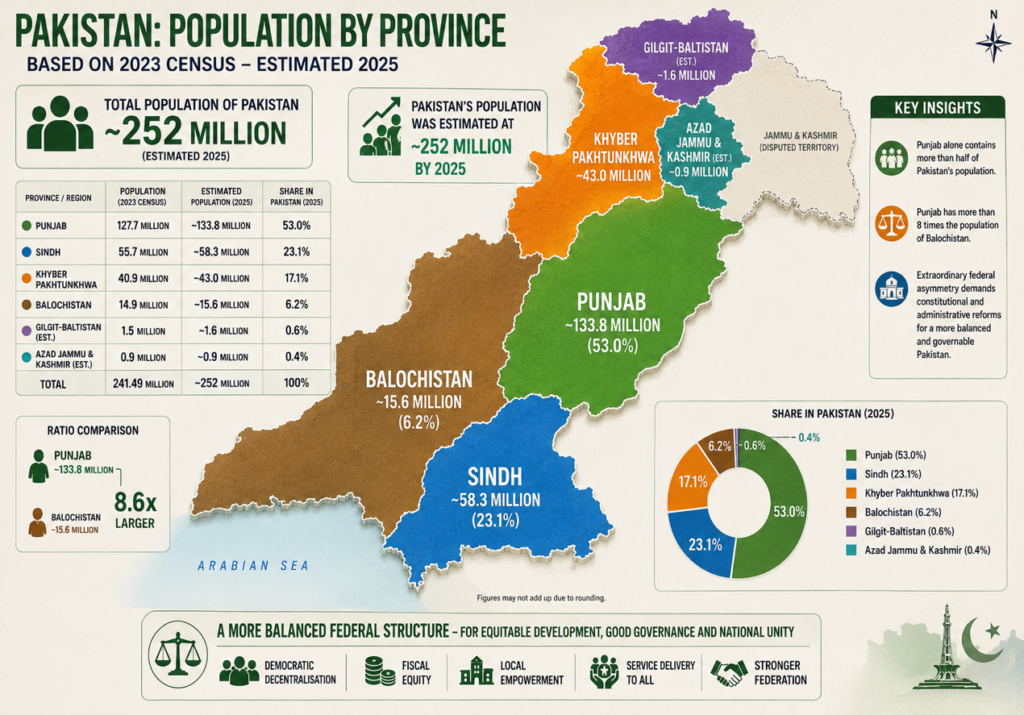
The demographic imbalance among Pakistan’s existing federating units is extraordinary. The 2023 Census recorded approximately 241.5 million people: Punjab alone contained about 127.7 million, Sindh 55.7 million, Khyber Pakhtunkhwa 40.9 million and Balochistan 14.9 million. Punjab therefore contained more than half the national population and more than eight times the population of Balochistan. Pakistan’s population was estimated at approximately 252 million by 2025. These figures make provincial restructuring a legitimate question of state capacity rather than merely territorial politics.
This article argues that Pakistan should consider moving towards more administratively manageable and economically viable federating units, but only through a democratic, evidence-based and constitutionally lawful process. More provinces are not presented as a cure for corruption, unemployment, public debt, educational failure or weak healthcare. Rather, territorial restructuring should form one element of a larger constitutional reconstruction founded upon subsidiarity, local democracy, fiscal responsibility, national minimum standards and institutional accountability.
The paper further examines whether Pakistan should replace the existing parliamentary executive with a carefully constrained democratic presidential system based upon a directly elected President, directly elected provincial Governors, an independent bicameral legislature and constitutionally protected local governments. It proposes that defence, foreign affairs, currency, central banking, federal finance, customs, citizenship, inter-provincial commerce and specified national regulatory functions remain federal subjects. Education and health should operate under nationally uniform minimum standards while administration and service delivery remain substantially devolved.
The article proposes metropolitan and district policing, including city police services; consolidation rather than proliferation of specialised security agencies; one coherent anti-corruption law; a professionally independent FIA for defined federal and serious corruption investigations; and an independent prosecution service. It recommends local dispute-resolution forums, mediation, honorary magistrates under judicial supervision, and examination of a hybrid adversarial-inquisitorial justice system.
It also proposes a National Constitutional Appointments Commission to depoliticise appointments to the Election Commission, Auditor-General’s office, FIA, State Bank, FBR, prosecution services, HEC and other independent institutions. Higher education and legal education should be reconstructed around merit, stakeholder representation, professional independence and skills-based learning.
The central proposition is:
Pakistan does not merely need more provinces. It needs more governable units, fewer overlapping institutions, stronger local democracy, nationally guaranteed rights and a constitutional system in which power, resources, responsibility and accountability travel together.
Keywords
Pakistan; constitutional reform; devolution; new provinces; federalism; presidential system; President; Governors; local government; Article 140A; Article 239; Election Commission; judiciary; Federal Constitutional Court; judicial reform; city policing; FIA; prosecution; anti-corruption; HEC; legal education; PPRA; FBR; vocational education; ADR; fiscal federalism; good governance.
I. INTRODUCTION: THE REAL QUESTION IS GOVERNABILITY
Pakistan’s debate over “Devolution of Provinces and Good Governance” is often framed through one apparently straightforward question:
Should Pakistan create more provinces?
That question is important, but it is incomplete.
A country can create numerous provinces and remain over-centralised, corrupt and administratively ineffective. Conversely, a country can retain relatively large federating units while delivering effective government through powerful municipalities, districts and metropolitan institutions.
The fundamental issue is therefore governability.
Pakistan must ask whether its constitutional institutions correspond to its contemporary demographic, economic and social realities.
The original premise of this study was that devolution has three inseparable dimensions: political, administrative and fiscal.
That premise remains central.
Political devolution without money creates powerless elected institutions.
Fiscal transfers without accountability create opportunities for waste.
Administrative responsibility without authority produces excuses.
The constitutional formula must therefore be:
Power + Resources + Responsibility + Accountability.
All four must accompany one another.
II. THE SCALE OF PAKISTAN’S GOVERNANCE CHALLENGE
Pakistan is no longer governing the population for which many of its inherited administrative assumptions were designed.
The 2023 Census recorded approximately 241.49 million people. Punjab alone contained approximately 127.7 million, Sindh around 55.7 million, Khyber Pakhtunkhwa around 40.9 million, and Balochistan approximately 14.9 million.
This produces an extraordinary federal asymmetry.
Punjab contains more than half of Pakistan’s population and more than eight times the population of Balochistan.
Pakistan’s population was estimated at approximately 252 million by 2025.
The constitutional question is therefore unavoidable:
Can four federating units of radically different demographic scale continue to perform broadly comparable governmental responsibilities effectively?
This question should not be interpreted as criticism of any province.
It is a question of administrative design.
III. POPULATION GROWTH AND THE GOVERNABILITY PROBLEM
Population growth magnifies almost every governance problem.
More people require:
- more schools;
- more teachers;
- more hospitals;
- more doctors;
- more housing;
- more water;
- more electricity;
- more courts;
- more judges;
- more police;
- more transport;
- more jobs; and
- more social protection.
Pakistan also possesses a large young population.
This can become a tremendous national asset if young people receive education, skills and employment.
Without those opportunities, demographic growth places increasing pressure upon public services, housing, labour markets, cities and natural resources.
Population policy should therefore become an integral part of national governance rather than a peripheral health programme.
Smaller federating units cannot themselves solve population growth.
They can, however, make maternal healthcare, girls’ education, family planning, population data, school enrolment and local demographic planning more manageable.
IV. WHY THE CASE FOR MORE PROVINCES DESERVES SERIOUS CONSIDERATION
The argument for additional provinces should not be based principally upon ethnicity.
It should be based upon administrative scale, accessibility, economic viability, service delivery and democratic accountability.
The original article recognised that demands concerning South Punjab, Bahawalpur, Hazara and other regions cannot simply be dismissed because they frequently reflect concerns about distance from decision-making and unequal development.
A province containing tens or more than one hundred million people inevitably contains areas with significantly different:
- economic structures;
- environmental conditions;
- infrastructure requirements;
- development deficits;
- agricultural systems;
- urbanisation patterns; and
- service-delivery challenges.
Creating more viable administrative centres can potentially shorten the distance between citizen and government.
But there must be an essential qualification:
More provinces must mean more accessible government—not more government for politicians.
V. MORE PROVINCES ARE NOT A MAGIC SOLUTION
The argument must remain intellectually disciplined.
Creating additional provinces cannot automatically:
- reduce poverty;
- eliminate corruption;
- create employment;
- increase exports;
- improve schools;
- improve hospitals;
- reduce debt;
- eliminate court delays; or
- solve climate change.
Smaller provinces can themselves be corrupt, fiscally dependent and administratively centralised.
If Pakistan simply creates additional:
- Governors’ residences;
- secretariats;
- ministers;
- bureaucracies;
- official vehicles; and
- patronage networks,
then restructuring will increase rather than reduce the burden upon taxpayers.
The case for more provinces therefore depends upon institutional redesign accompanying territorial redesign.
VI. ADMINISTRATIVE DISTANCE
Large provincial administrations naturally become capital-centric.
Citizens may effectively confront:
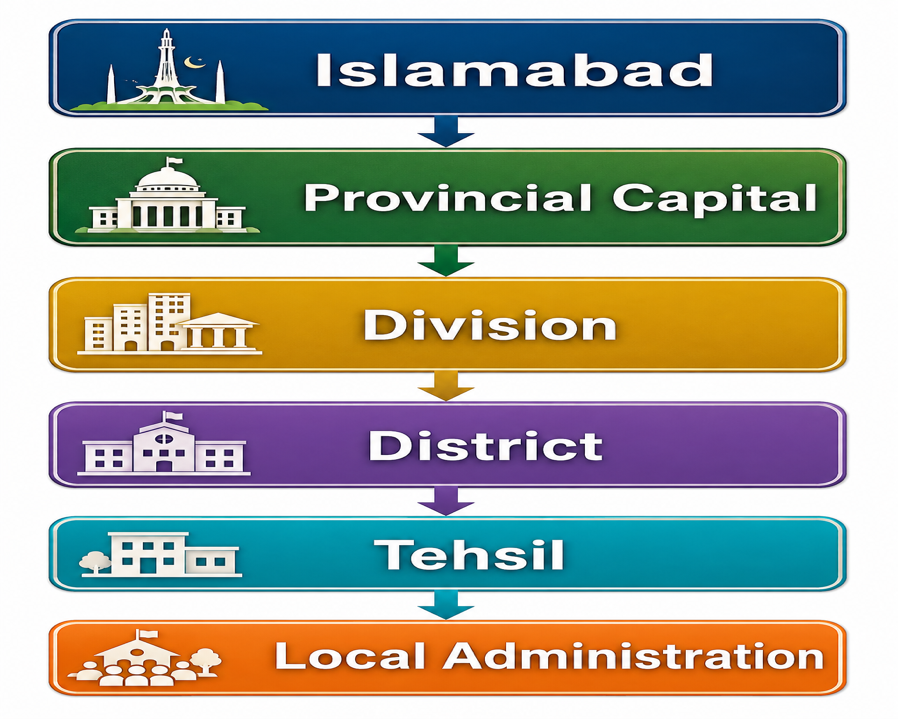
The longer this chain becomes, the easier it becomes for responsibility to disappear.
More manageable provinces can reduce administrative distance.
But even smaller provinces must constitutionally devolve power further.
Otherwise Pakistan would merely replace four centralised provincial governments with a larger number of centralised provincial governments.
The governing principle should therefore be:
Federal devolution must reach provinces; provincial devolution must reach districts and cities; local government must reach communities.
VII. EDUCATION: THE SCALE OF THE CHALLENGE
Education demonstrates why territorial restructuring must accompany national standards.
Pakistan continues to confront low literacy, large numbers of children outside formal schooling and substantial regional disparities.
The solution cannot be a completely fragmented educational system.
A Pakistani child’s basic educational entitlement should not depend upon whether that child lives in Lahore, Karachi, Bahawalpur, Hazara, Quetta, Gwadar, Peshawar or a remote rural district.
Education should therefore become a nationally guaranteed constitutional entitlement.
The constitutional formula should be:
Uniform national minimum standards + regional diversity + decentralised administration.
The Federation should establish minimum standards in:
- literacy;
- mathematics;
- science;
- digital competence;
- teacher qualifications;
- assessment;
- civic education;
- constitutional education; and
- educational infrastructure.
Provinces should coordinate implementation.
Local governments should increasingly administer schools.
VIII. EDUCATION MUST MOVE FROM DEGREES TO SKILLS
Pakistan requires a fundamental change from:
memorisation → examination → degree
towards:
understanding → competence → skills → innovation → employment → entrepreneurship.
Technical and vocational education must become a mainstream educational pathway.
Germany offers useful comparative experience. OECD analysis shows that its dual vocational system combines institutional learning with structured workplace apprenticeships and nationally recognised occupational standards.
Pakistan should similarly learn from the experiences of Germany, Japan, South Korea and China without mechanically copying them.
Secondary education should expose students to:
- coding;
- artificial intelligence;
- robotics;
- engineering;
- electronics;
- renewable energy;
- modern agriculture;
- construction technologies;
- healthcare technologies;
- financial literacy;
- entrepreneurship; and
- skilled trades.
A skilled technician should enjoy the same social dignity as a conventional university graduate.
IX. HEC AS A FEDERAL INSTITUTION
The Higher Education Commission should remain a federal institution because higher-education standards, degree recognition and national mobility require national coordination.
HEC should regulate national minimum standards relating to:
- university recognition;
- degree equivalence;
- qualifications;
- research standards;
- faculty requirements;
- quality assurance;
- academic integrity; and
- international recognition.
Universities should nevertheless retain academic autonomy.
HEC itself should be plural and professionally representative. Its existing Commission already includes federal education and science officials, provincial representation, university leadership and other members, demonstrating that stakeholder participation has an existing institutional foundation that can be strengthened.
The HEC Chairperson and members should be selected through transparent, merit-based procedures rather than political preference.
X. RECONSTRUCTING LEGAL EDUCATION
Pakistan’s legal-education framework similarly requires comprehensive reform.
The Pakistan Bar Council’s existing Legal Education Rules themselves recognise the need to regulate and maintain standards in response to deterioration and expansion in legal education.
A reconstructed Directorate/National Council of Legal Education should therefore contain representation from:
- Pakistan Bar Council;
- HEC;
- Ministry of Law and Justice;
- Ministry of Federal Education;
- public-sector universities;
- private-sector universities;
- institutions providing recognised foreign legal education;
- professional legal education;
- practising lawyers;
- employers; and
- four persons of eminence in legal education.
At least one of the four eminent educationists should be a woman, while broader gender representation should also be pursued.
A Supreme Court judge nominated by the Chief Justice could chair the body, although a recently retired Supreme Court judge may provide an even stronger separation-of-powers arrangement.
Legal education should emphasise:
- advocacy;
- drafting;
- legal research;
- professional ethics;
- client interviewing;
- negotiation;
- mediation;
- arbitration;
- cross-examination;
- digital evidence;
- cyber law;
- artificial intelligence;
- legal technology; and
- clinical practice.
XI. HEALTH: NATIONAL RIGHTS, DECENTRALISED DELIVERY
Health should follow a similar constitutional model.
The Federation should establish national minimum standards for:
- essential healthcare;
- vaccination;
- pharmaceuticals;
- communicable diseases;
- hospital standards;
- professional qualifications;
- emergency response; and
- public-health data.
Hospitals and clinics should principally be administered through devolved institutions.
The constitutional principle should be:
The citizen possesses the right; different levels of government share responsibility for delivering it.
XII. NATIONAL FISCAL EQUALISATION
Uniform rights require adequate financing.
Poorer federating units cannot be expected to provide national-standard education and healthcare without sufficient resources.
Pakistan therefore requires a stronger constitutional equalisation system.
South Africa provides a useful comparative principle: its Constitution recognises national, provincial and local spheres as distinctive, interdependent and interrelated, while also providing for equitable sharing of nationally raised revenue.
Pakistan should develop its own model in which fiscal transfers consider:
- population;
- poverty;
- geographical area;
- revenue effort;
- infrastructure deficit;
- urbanisation;
- climate vulnerability;
- service-delivery burdens; and
- development outcomes.
XIII. EMPLOYMENT AND THE CASE FOR MULTIPLE ECONOMIC CENTRES
Pakistan requires millions of productive employment opportunities.
A major weakness of excessive administrative concentration is that economic opportunity similarly becomes concentrated.
Provincial restructuring could help develop additional regional capitals into centres of:
- industry;
- universities;
- hospitals;
- technology;
- professional services;
- logistics;
- finance;
- administration;
- tourism; and
- manufacturing.
Pakistan cannot indefinitely depend upon Karachi, Lahore and Islamabad-Rawalpindi as dominant centres of opportunity.
Every viable federating unit should develop measurable strategies for:
jobs
investment
exports
skills
SMEs
technology
and
regional infrastructure.
XIV. EXPORT-ORIENTED FEDERALISM
Federating units should not exist merely to receive fiscal transfers.
They should become engines of production.
Different regions possess different comparative advantages:
- textiles;
- agriculture;
- food processing;
- livestock;
- fisheries;
- minerals;
- engineering;
- information technology;
- tourism;
- logistics;
- renewable energy;
- pharmaceuticals; and
- professional services.
A competitive federal model should reward provinces for expanding:
- exports;
- tax bases;
- employment;
- investment;
- productivity; and
- human capital.
The success of a province should increasingly be measured not by the size of its development budget but by the outcomes produced from public resources.
XV. PUBLIC DEBT AND THE COST OF GOVERNMENT
Pakistan’s heavy public-debt burden makes administrative efficiency particularly important.
The existence of debt is not, by itself, an argument against additional provinces.
It is an argument against expensive and unproductive provinces.
Every proposal for a new federating unit should therefore include a fiscal viability assessment addressing:
- projected revenues;
- recurrent expenditure;
- administrative costs;
- existing infrastructure;
- public assets;
- liabilities;
- pensions;
- debt allocation;
- development requirements; and
- own-source revenue potential.
No proposed province should proceed merely because a political movement demands it.
It must demonstrate administrative and fiscal viability.
XVI. POVERTY AND SOCIAL PROTECTION
Poverty requires government capable of identifying household-level needs.
National social-protection programmes should maintain national eligibility and financial standards.
Local governments should connect households to:
- education;
- health;
- disability support;
- vocational training;
- employment services;
- housing assistance; and
- emergency relief.
The constitutional model should therefore combine:
national entitlement
with
local knowledge and delivery.
XVII. HOUSING AND URBAN GOVERNANCE
Pakistan’s largest cities are themselves enormous governmental systems.
Housing shortages, informal settlements, transport congestion, waste, water scarcity, air pollution and uncontrolled land development cannot effectively be administered as secondary departments of distant provincial bureaucracies.
Pakistan requires constitutionally empowered metropolitan government.
Major cities should possess elected metropolitan institutions responsible for:
- urban planning;
- housing;
- public transport;
- local roads;
- water;
- sanitation;
- waste;
- building regulation;
- environmental management;
- emergency services; and
- city policing.
Provincial restructuring and metropolitan reform should therefore proceed together.
XVIII. ENVIRONMENT AND CLIMATE CHANGE
Climate change has transformed environmental governance into a constitutional question.
Pakistan’s 2022 floods affected approximately 33 million people, displaced more than eight million and caused combined damage and economic losses exceeding US$30 billion.
The World Bank has warned that combined climate-related risks, environmental degradation and air pollution could reduce Pakistan’s GDP by at least 18–20 per cent by 2050 without adequate action.
Different regions face different environmental threats:
- flooding;
- drought;
- extreme heat;
- glacial hazards;
- water scarcity;
- desertification;
- coastal degradation;
- air pollution; and
- groundwater depletion.
More manageable regional governments could develop environmental strategies suited to local geography.
But environmental minimum standards and inter-provincial water and climate coordination must remain national responsibilities.
XIX. WHAT SHOULD BE FEDERAL?
Pakistan should clearly enumerate exclusive federal responsibilities.
These should include principally:
- Defence and Armed Forces
- Foreign Affairs
- International Treaties
- Citizenship and Immigration
- Currency
- Central Banking
- Monetary Policy
- Federal Finance
- Sovereign Borrowing and National Debt
- Customs
- International Trade
- Inter-Provincial Commerce
- Strategic and Nuclear Assets
- National Security Coordination
- National Strategic Infrastructure
- National Communications Framework
- Higher-Education Standards through HEC
- National Public Procurement Standards
- National Financial Regulation
- National Competition and Corporate Frameworks
- National Environmental Minimum Standards
- National Education Minimum Standards
- National Health Minimum Standards.
The principle should be:
Centralise only what sovereignty, national integration or equality genuinely requires.
XX. FBR: ONE NATIONAL REVENUE AUTHORITY
FBR should remain federal.
Its two principal revenue streams should continue to be organised around:
Inland Revenue
and
Customs / External Trade Revenue.
The distinction broadly corresponds to FBR’s existing institutional architecture and should be professionally strengthened rather than unnecessarily reconstructed.
The Chairman FBR should be appointed on professional merit for a protected term subject to transparent performance standards.
XXI. PPRA AND PROCUREMENT
Pakistan already possesses a federal Public Procurement Regulatory Authority.
Its role should be strengthened as the national setter of minimum public-procurement standards.
Federal, provincial and local governments should continue purchasing goods and services for their respective functions, but all should comply with minimum principles concerning:
- competition;
- transparency;
- e-procurement;
- beneficial ownership;
- conflict of interest;
- tender publication;
- evaluation;
- debarment;
- contract disclosure; and
- independent review.
National standards should not mean national purchasing.
XXII. LOCAL GOVERNMENT AS THE THIRD CONSTITUTIONAL SPHERE
Article 140A already requires provinces to establish local government and devolve political, administrative and financial responsibility. Yet the original analysis identified the recurring weakness of insufficient institutional protection for local government.
The Constitution should now guarantee:
- fixed tenure;
- compulsory timely elections;
- constitutionally defined functions;
- own-source revenue;
- mandatory fiscal transfers;
- independent audit;
- metropolitan autonomy;
- protection against arbitrary dissolution; and
- judicially enforceable remedies.
Local government should become government, not a provincial administrative programme.
XXIII. CITY AND DISTRICT POLICING
Ordinary policing should be substantially devolved.
Major cities should possess recognisable metropolitan police services.
Examples could include:
Karachi Metropolitan Police
Lahore Metropolitan Police
Islamabad Metropolitan Police
Peshawar City Police
Quetta City Police
Non-metropolitan areas should operate district police services.
Police chiefs should be professionally selected, enjoy protected tenure and remain democratically accountable for institutional performance while retaining operational independence in individual cases.
XXIV. SPECIALISATION WITHOUT FRAGMENTATION
Pakistan does not require a separate bureaucracy for every category of crime.
But it does require specialised expertise.
The appropriate model is an integrated police architecture containing specialised commands:
Police Service
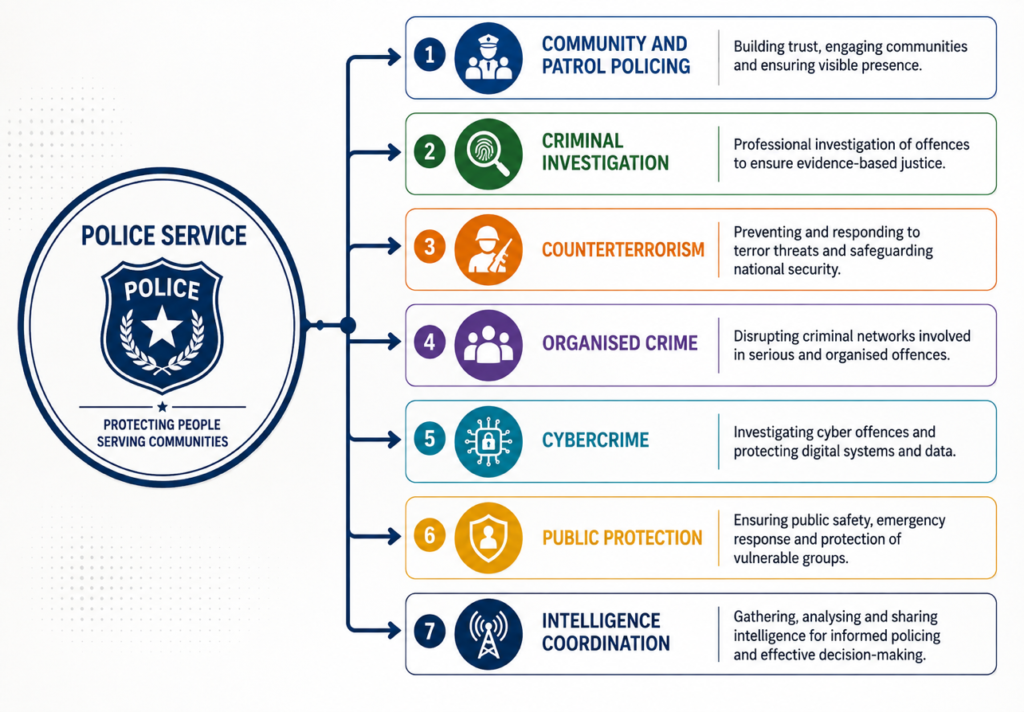
The proposal should therefore not be understood as abolition of counterterrorism capability.
It is a proposal to eliminate unnecessary parallel chains of command.
Specialisation should remain; fragmentation should not.
XXV. ONE COHERENT ANTI-CORRUPTION LAW
Pakistan should replace overlapping anti-corruption regimes with a modern Public Integrity and Anti-Corruption Act.
It should comprehensively regulate:
- bribery;
- abuse of office;
- procurement corruption;
- conflicts of interest;
- serious public fraud;
- false asset declarations;
- illicit enrichment subject to constitutional safeguards; and
- associated financial offences.
Under this model, NAB and duplicative provincial anti-corruption establishments would no longer operate as parallel investigative bureaucracies.
But consolidation must not create an all-powerful executive agency.
XXVI. FIA AS THE PRINCIPAL FEDERAL INVESTIGATION AGENCY
FIA should become the principal federal investigative agency for specifically defined matters including:
- serious public corruption;
- inter-provincial organised crime;
- designated financial crime;
- transnational crime;
- federal cybercrime;
- immigration offences; and
- associated federal offences.
Its jurisdiction must be precisely statutory.
Its Director-General should possess:
- professional qualifications;
- fixed tenure;
- operational independence;
- parliamentary accountability; and
- protection against arbitrary removal.
The President or a minister should have no lawful authority to order the registration or termination of a case against a named individual.
XXVII. ONE PROFESSIONAL PROSECUTION ARCHITECTURE
Investigation and prosecution should remain institutionally separate.
The constitutional model should be:
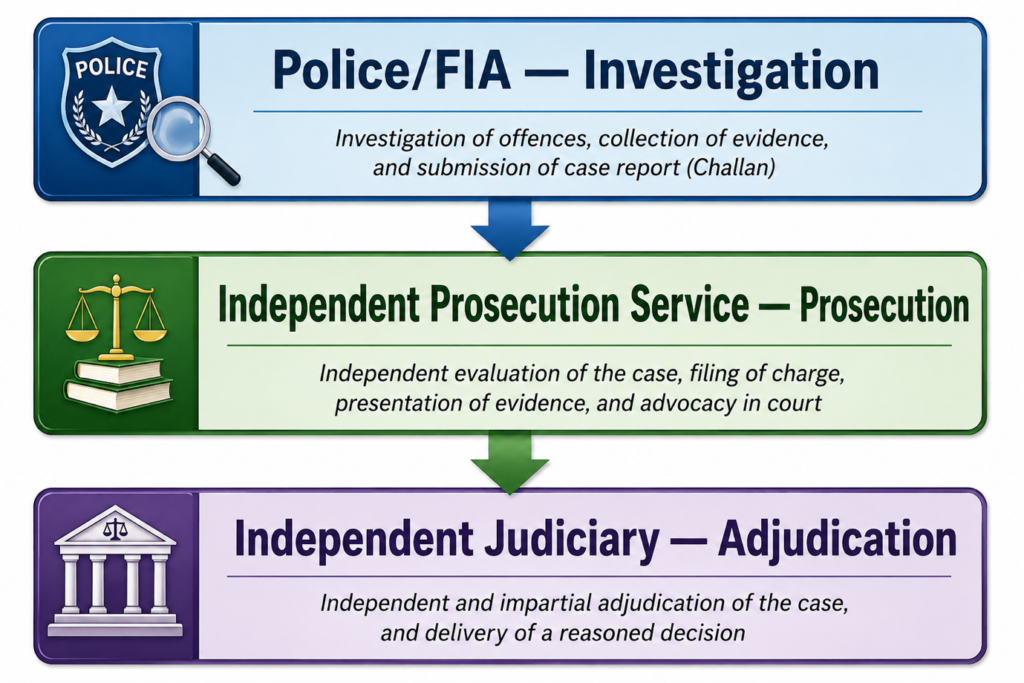
Pakistan should establish a professional prosecution service headed by a Prosecutor-General.
The Prosecutor-General should serve a fixed, preferably non-renewable term.
Career prosecutors should be recruited through open competitive procedures and trained in:
- criminal law;
- evidence;
- advocacy;
- constitutional rights;
- professional ethics;
- digital evidence;
- forensic science;
- financial crime; and
- prosecutorial judgment.
Political appointments of ordinary prosecutors should end.
XXVIII. LOCAL DISPUTE-RESOLUTION FORUMS
Local government should include access to justice.
Local Justice and Dispute Resolution Forums could deal with appropriate categories of:
- small claims;
- tenancy disputes;
- neighbourhood disputes;
- municipal disputes;
- low-value commercial matters;
- community disputes; and
- consensually resolvable family disputes.
These forums must remain subject to constitutional rights and judicial supervision.
They should supplement rather than displace the courts.
XXIX. MEDIATION, ADR AND ODR
Pakistan should formally recognise mediation, conciliation, arbitration and online dispute resolution as components of justice infrastructure.
The original paper already proposed district mediation centres, court-annexed mediation, commercial courts, digital filing and ODR.
The principle should be:
Not every dispute requires a trial; every dispute requires access to an appropriate form of justice.
XXX. HONORARY MAGISTRATES
Pakistan should consider a carefully regulated honorary magistracy for minor matters.
Honorary magistrates could deal with specified:
- municipal offences;
- minor regulatory matters;
- low-level offences; and
- appropriate community justice functions.
They should be:
- independently screened;
- properly trained;
- politically neutral;
- subject to judicial supervision; and
- governed by enforceable ethical standards.
Honorary magistracy must never become political patronage.
XXXI. A HYBRID ADVERSARIAL-INQUISITORIAL SYSTEM
Pakistan should examine whether selected inquisitorial techniques can improve the inherited adversarial process.
Fundamental adversarial protections must remain:
- presumption of innocence;
- prosecution burden;
- right to counsel;
- cross-examination;
- disclosure;
- privilege against self-incrimination; and
- independent adjudication.
But courts could exercise stronger powers of:
- case management;
- clarification;
- issue identification;
- appointment of independent experts;
- control of repetitive evidence;
- pre-trial management; and
- truth-oriented evidentiary supervision.
The objective should be neither purely adversarial nor purely inquisitorial.
It should be a rights-protective, truth-oriented hybrid.
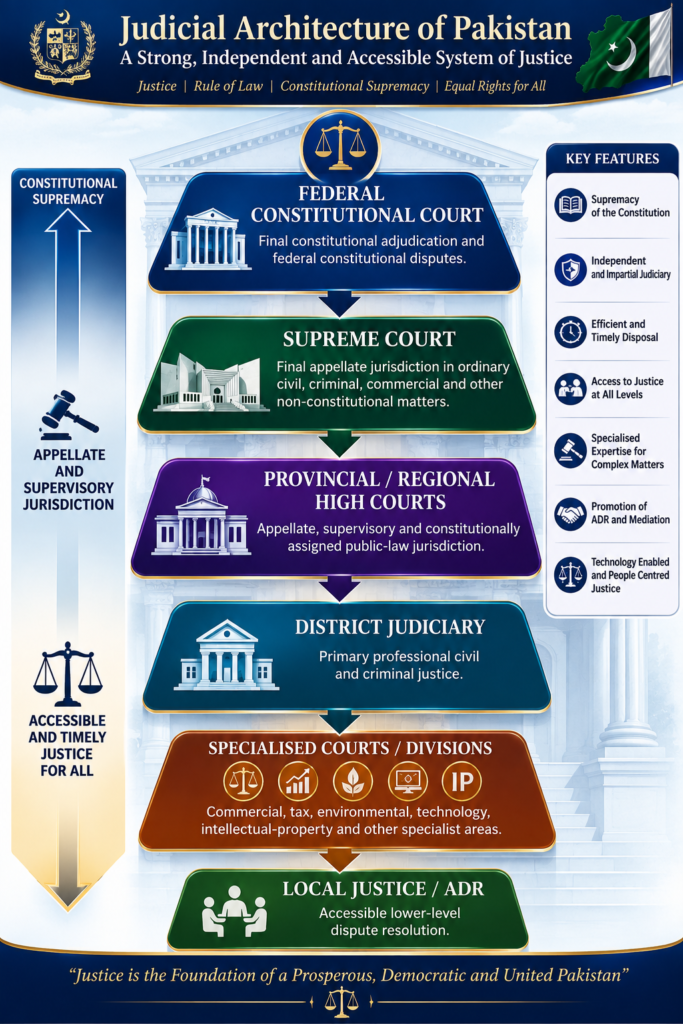
XXXII. THE NEW JUDICIAL ARCHITECTURE
Pakistan’s contemporary constitutional debate must recognise that its judicial architecture changed materially in 2025.
Any reconstructed model should evaluate the appropriate division of constitutional and ordinary appellate jurisdiction within the post-2025 framework rather than proceeding on the assumption that the earlier judicial structure remains untouched.
A coherent model could comprise:
XXXIII. SHOULD DISTRICT JUDGES BE ELECTED?
The proposal for elections of judges up to district level deserves serious examination but requires caution.
Popular election may strengthen local accountability.
It can also produce:
- politicisation;
- campaign finance dependence;
- populist judgments;
- political endorsements;
- pressure from lawyers and litigants; and
- perceived obligations to electoral constituencies.
Pakistan should therefore consider a Merit-Screened Democratic Judicial Model rather than immediately electing every district judge.
Candidates for specified senior district judicial offices could first be certified by an independent Judicial Qualifications Commission.
Any subsequent election should be:
- non-partisan;
- strictly expenditure-controlled;
- free from donations by litigants and practising lawyers;
- governed by a Judicial Election Code; and
- initially introduced through pilot programmes.
Retention elections after merit appointment may also deserve comparative examination.
XXXIV. JUDICIAL ACCOUNTABILITY
Judicial independence cannot mean absence of accountability.
A strengthened Judicial Conduct and Accountability Commission should address:
- corruption;
- conflicts of interest;
- serious misconduct;
- unexplained delay;
- abuse of office;
- persistent failure to deliver judgments; and
- ethical violations.
At the same time, judges must never be punished merely because political institutions dislike their decisions.
Performance data should include:
- case age;
- reserved judgments;
- disposal times;
- adjournment patterns; and
- case-management performance.
XXXV. ACCOUNTABILITY OF THE CIVIL SERVICES
The civil service should be politically neutral but performance accountable.
Recruitment and promotion should depend upon:
Merit + Integrity + Competence + Specialisation + Performance.
Senior officials should ordinarily enjoy minimum protected tenure to discourage political transfers.
But job security must not protect persistent incompetence, corruption or misconduct.
Strong independent Public Service Commissions are therefore indispensable.
XXXVI. DEPOLITICISING CONSTITUTIONAL APPOINTMENTS
Institutional independence ultimately depends upon who selects institutional leaders.
Pakistan should establish a National Constitutional Appointments Commission (NCAC).
It should organise merit-based appointment processes for designated independent constitutional and regulatory offices.
Its composition should itself be plural and protected from domination by the government.
It could include:
- a retired senior judge;
- government representation;
- Opposition representation;
- Senate/federating-unit representation;
- Public Service Commission representation;
- an eminent legal professional;
- a governance/public-administration expert; and
- subject specialists for particular appointments.
No political party should control the Commission.
XXXVII. THE APPOINTMENT PROCESS
For genuinely independent offices, the normal constitutional process should be:
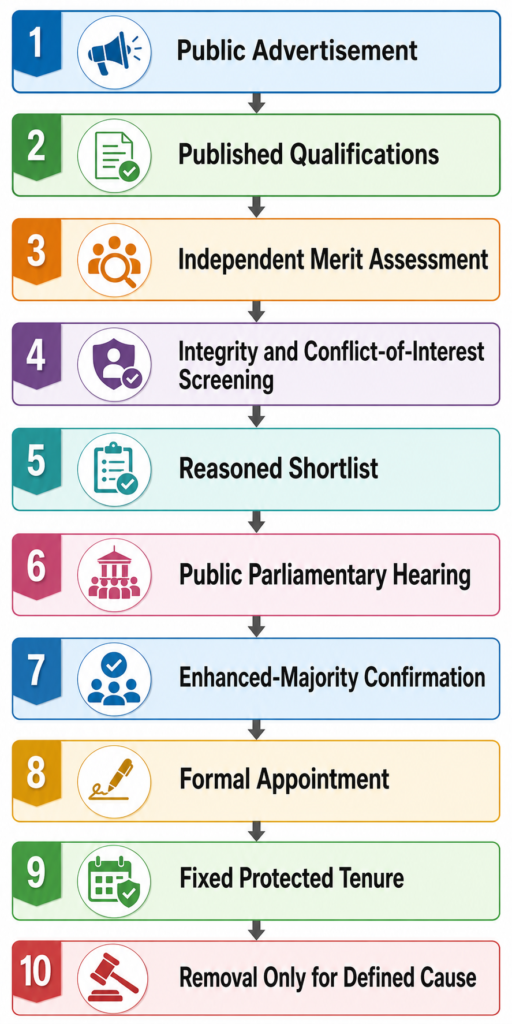
This replaces patronage with constitutional process.
XXXVIII. CHIEF ELECTION COMMISSIONER AND ECP MEMBERS
Electoral administrators must not depend upon electoral competitors.
The Chief Election Commissioner should therefore:
- be selected competitively;
- meet demanding professional and integrity criteria;
- undergo parliamentary confirmation by enhanced majority;
- serve a single non-renewable term; and
- be removable only through protected constitutional procedure.
ECP members should similarly be merit-selected.
Their terms should be staggered so one President cannot appoint the entire Commission simultaneously.
Electoral legitimacy remains the gateway to every other constitutional reform, as the original article emphasised.
XXXIX. AUDITOR-GENERAL
The Auditor-General should be an officer of constitutional accountability rather than executive convenience.
Selection should require expertise in:
- audit;
- accounting;
- public finance;
- financial governance; and
- institutional leadership.
The Auditor-General should serve one protected term.
Reports should presumptively be public.
Budgetary pressure must never become a means of controlling audit.
XL. GOVERNOR OF THE STATE BANK
The Governor of the State Bank should be selected for professional competence in:
- monetary economics;
- banking;
- financial regulation;
- macroeconomics; and
- institutional leadership.
The appointment should involve independent professional shortlisting and Senate confirmation.
The Governor’s tenure should be staggered from the President’s electoral term.
An elected government legitimately determines fiscal and economic policy.
An independent central bank should professionally administer monetary policy within law.
XLI. CHAIRMAN FBR
The Chairman FBR should be competitively selected based upon substantial expertise in:
- taxation;
- customs;
- public finance;
- economics;
- revenue law;
- digital administration; and
- organisational management.
The Chairman should enjoy fixed tenure and measurable institutional objectives.
Lawful tax enforcement should never become grounds for political removal.
XLII. ATTORNEY-GENERAL AND ADVOCATES-GENERAL
The Attorney-General occupies a different constitutional position from the CEC or Auditor-General.
An elected executive must retain some ability to choose the lawyer representing its lawful policies.
The President should therefore nominate the Attorney-General from professionally qualified persons, followed by Senate or parliamentary confirmation.
The Attorney-General’s hierarchy of duty should be:
Constitution
↓
State
↓
Lawful Government Position.
A directly elected provincial Governor could similarly nominate the Advocate-General subject to confirmation by the provincial legislature.
XLIII. PROSECUTOR-GENERAL
The Prosecutor-General requires stronger insulation from politics.
Appointment should involve:
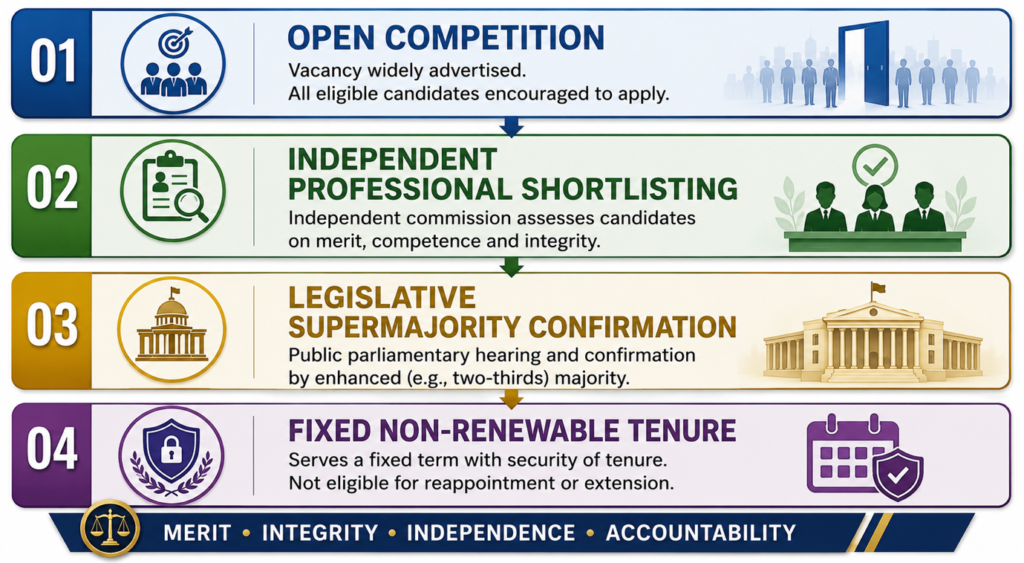
The President, Governor or minister should have no power to direct prosecution of an individual.
XLIV. HEC AND OTHER REGULATORY APPOINTMENTS
The same merit principle, appropriately adapted, should apply to:
- HEC Chairperson and members;
- PPRA leadership;
- Public Service Commissions;
- Competition Commission;
- Ombudsman institutions;
- major financial regulators; and
- other independent statutory institutions.
Different offices need different procedures.
But political loyalty should never substitute for statutory competence.
XLV. STAGGERED TERMS: PROTECTING THE STATE FROM INSTITUTIONAL CAPTURE
The terms of the:
- President;
- CEC;
- ECP members;
- Auditor-General;
- SBP Governor;
- DG FIA;
- Prosecutor-General;
- HEC Chairperson; and
- major regulators
should not expire together.
Otherwise a single presidential election could enable one political movement to capture almost the entire institutional state.
Democracy must be protected not only from unconstitutional coups but from constitutional capture.
XLVI. PRESIDENTIAL GOVERNMENT: WHY IT DESERVES CONSIDERATION
Pakistan should seriously examine whether the parliamentary system continues to provide the optimal structure for executive accountability.
A democratic presidential system can offer:
- direct executive legitimacy;
- fixed tenure;
- separation between legislature and executive;
- policy continuity;
- clearer responsibility;
- reduced coalition instability; and
- a national electoral mandate.
But presidentialism also carries the risk of personalisation and concentration of power.
Therefore, the proposal is not presidential supremacy.
It is democratic presidentialism under constitutional restraint.
XLVII. DIRECT ELECTION OF THE PRESIDENT
The President should be directly elected.
A two-round system should be considered.
If no candidate receives more than 50 per cent nationally, the two leading candidates should contest a runoff.
A candidate should additionally demonstrate meaningful electoral support across multiple federating units.
This prevents presidential legitimacy from depending entirely upon one populous region.
The President should:
- serve a fixed term;
- be limited to two terms;
- possess no arbitrary dissolution power;
- remain subject to impeachment;
- remain subject to judicial review;
- disclose assets and conflicts;
- operate under strict campaign-finance laws; and
- possess narrowly defined emergency powers.
The principle should be:
Strong enough to govern; constrained enough to remain constitutional.
XLVIII. AN INDEPENDENT BICAMERAL LEGISLATURE
The presidential system must strengthen Parliament.
The National Assembly should represent population.
The Senate should protect the federal principle.
If additional provinces are created, the Senate becomes even more important because it can balance population-based political power.
The Senate should possess meaningful authority concerning:
- federal constitutional amendments;
- independent appointments;
- inter-provincial affairs;
- major treaties affecting federating units;
- fiscal federalism; and
- legislation materially affecting provincial autonomy.
XLIX. DIRECTLY ELECTED GOVERNORS
If Pakistan adopts democratic presidentialism federally, provincial executive government should also be reconsidered.
Each province or region could directly elect its Governor.
The Governor would become the provincial chief executive rather than a ceremonial federal nominee.
The structure would therefore become:
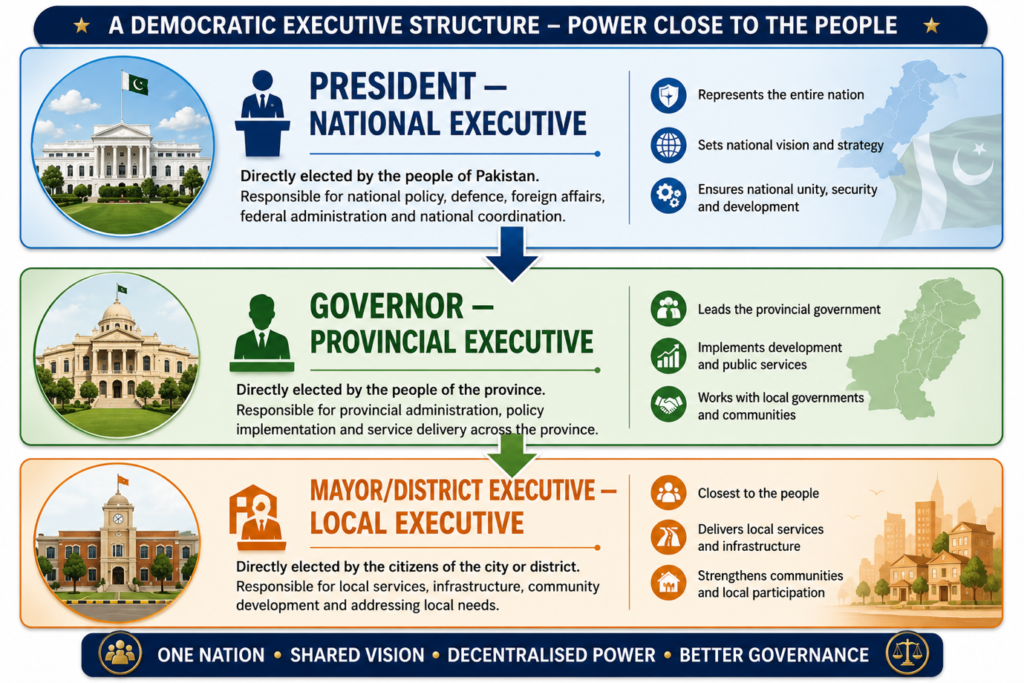
Each would possess a separate democratic mandate.
Each would have constitutionally enumerated powers.
None should possess arbitrary authority to dismiss another.
L. MORE PROVINCES: HOW MANY?
Pakistan should not begin by announcing a predetermined number.
The answer should emerge from evidence.
An independent Federal Reorganisation Commission should evaluate proposed units according to:
- population;
- geography;
- administrative accessibility;
- economic viability;
- fiscal sustainability;
- development deficits;
- infrastructure;
- water;
- natural resources;
- climate vulnerability;
- cultural and historical considerations;
- citizen preference; and
- national cohesion.
Province-making must become evidence-based constitutional design.
LI. MORE PROVINCES SHOULD NOT BECOME ETHNIC ENCLOSURES
Language, culture and history are legitimate considerations.
They should not be the sole determinants of provincial boundaries.
A province should principally be a viable governance and development unit.
The central questions should be:
Can it govern effectively?
Can citizens reach its institutions?
Can it sustain its administration?
Can it create economic opportunity?
Can it provide education and health?
Can it administer justice?
Can it manage environmental risks?
Can it sustain empowered local government?
LII. DEMOCRATIC CREATION OF NEW PROVINCES
No new province should be created by decree, executive notification, military intervention or private political bargain.
Article 239 presently provides special constitutional safeguards for alterations of provincial boundaries. The original article correctly observed that provincial restructuring is therefore constitution-building, not cartography.
The democratic process should involve:
- Independent Federal Reorganisation Commission;
- published demographic and fiscal studies;
- regional public hearings;
- economic viability assessment;
- environmental and resource assessment;
- publication of proposed boundaries;
- public objections;
- relevant Provincial Assembly approval;
- constitutionally required parliamentary approval; and
- consultative regional referendum where appropriate.
A referendum should supplement rather than circumvent constitutional requirements.
LIII. TRANSITION BEFORE CREATION
Every approved province should have a complete transition settlement before commencing operation.
It should address:
- assets;
- liabilities;
- employees;
- pensions;
- courts;
- police;
- universities;
- hospitals;
- taxation;
- public corporations;
- water;
- electricity;
- contracts;
- land records;
- infrastructure; and
- pending litigation.
New provinces should not first be created and then asked to negotiate their existence.
LIV. COMPETITIVE FEDERALISM
More provinces could introduce constructive competition.
A national governance dashboard should compare each federating unit on:
- literacy;
- learning outcomes;
- school attendance;
- healthcare;
- maternal health;
- policing;
- crime;
- judicial delay;
- unemployment;
- exports;
- investment;
- tax mobilisation;
- housing;
- water;
- sanitation;
- public transport;
- environmental quality;
- procurement transparency; and
- citizen satisfaction.
Federalism should create laboratories of better government.
LV. A ONE-YEAR CONSTITUTIONAL ROADMAP
The constitutional architecture need not take a decade merely to decide.
Implementation will require years.
But constitutional decision-making can be compressed into twelve months if genuine political consensus exists.
Months 1–2 — National Constitutional Compact
Establish:
- Constitutional Reform Commission;
- Federal Reorganisation Commission;
- electoral reform working groups; and
- specialist constitutional committees.
Publish the principal reform questions.
Months 2–3 — Electoral Integrity Package
Strengthen:
- electoral rolls;
- result transparency;
- polling-agent protections;
- campaign finance;
- election tribunals;
- result transmission; and
- administrative neutrality.
Months 3–4 — National Constitutional Consultation
Conduct hearings throughout Pakistan involving:
- provinces;
- districts;
- universities;
- bar associations;
- business;
- labour;
- civil society;
- women;
- minorities;
- young people; and
- professional organisations.
Month 5 — General Election
Conduct credible elections upon an expressly declared constitutional reform mandate.
Months 5–8 — Constitutional Convention
A constitutionally authorised Convention should prepare the new settlement.
Its committees should address:
- Presidency and Parliament
- Federalism and Provinces
- Local Government
- Judiciary
- Elections
- Fundamental Rights
- Fiscal Federalism
- Police and Criminal Justice
- Independent Institutions
- Education and Health
- Public Services
- Transitional Arrangements.
Month 8 — Publication of First Draft
Publish the complete proposed constitutional text.
Months 8–10 — Public Consultation
Translate the draft into Urdu and major regional languages.
Invite public objections and alternatives.
Month 10 — Revised Draft
Publish a revised constitutional text with reasons for major decisions.
Month 11 — Constitutional Approval
Obtain parliamentary and provincial approvals required by the existing constitutional order.
Month 12 — Democratic Ratification
Where constitutionally provided, submit the constitutional compact for national democratic ratification.
Thus:
Year One decides the constitutional architecture.
Subsequent years implement it.
LVI. IMPLEMENTATION: YEARS TWO TO FIVE
Years 1–2 after Ratification
Implement:
- independent appointment mechanisms;
- electoral institutions;
- local-government guarantees;
- fiscal arrangements;
- prosecution reform;
- FIA restructuring;
- anti-corruption consolidation;
- HEC reform;
- legal-education reform;
- curriculum reform; and
- metropolitan-government pilots.
Years 2–3
Implement:
- city policing;
- local justice forums;
- honorary magistracy pilots;
- technical education expansion;
- apprenticeship programmes;
- digital governance;
- specialised courts; and
- governance dashboards.
Years 3–5
Evaluate:
- new provinces;
- fiscal performance;
- metropolitan governance;
- policing;
- prosecution;
- education outcomes;
- judicial reform;
- employment;
- exports; and
- environmental resilience.
Poorly performing reforms should be corrected.
Constitutional reform should not become constitutionally protected failure.
LVII. RISKS AND SAFEGUARDS
A serious reform programme must acknowledge its risks.
Presidential Authoritarianism
Risk: concentration of executive authority.
Safeguards: term limits, bicameralism, judicial review, independent appointments, impeachment and strict emergency powers.
Provincial Fragmentation
Risk: territorial restructuring intensifying identity conflict.
Safeguards: multi-factor viability criteria rather than ethnicity alone.
Expensive New Bureaucracies
Risk: additional provinces increasing public expenditure.
Safeguards: lean administration, fiscal viability tests, cabinet limits, reuse of existing infrastructure and digital government.
Local Political Capture of Police
Risk: mayors controlling investigations.
Safeguards: professional police commissions, fixed tenure and operational independence.
FIA Becoming Too Powerful
Risk: concentration of coercive power.
Safeguards: precise jurisdiction, independent appointment, judicial warrants, parliamentary oversight and separate prosecution.
Politicised Judicial Elections
Risk: campaign finance and populist adjudication.
Safeguards: merit screening, non-partisan pilot schemes, expenditure restrictions and independent evaluation.
Weak New Provinces
Risk: permanent dependence upon federal transfers.
Safeguards: fiscal viability analysis and own-source revenue requirements.
LVIII. THE CONSTITUTIONAL DOCTRINE OF SUBSIDIARITY
The entire proposed system can be organised around one constitutional doctrine:
Government should exercise power at the lowest level capable of performing the function effectively, unless sovereignty, equality, national coordination or cross-boundary consequences require a higher level.
This produces:
Federal Government
Sovereignty, national integration and national standards.
Provinces/Regions
Regional coordination and development.
Metropolitan/District Government
Daily public administration and local economic development.
Municipal/Community Government
Services closest to citizens.
This is neither centralisation nor fragmentation.
It is constitutional subsidiarity.
LIX. THE PROPOSED NEW GOVERNANCE ARCHITECTURE
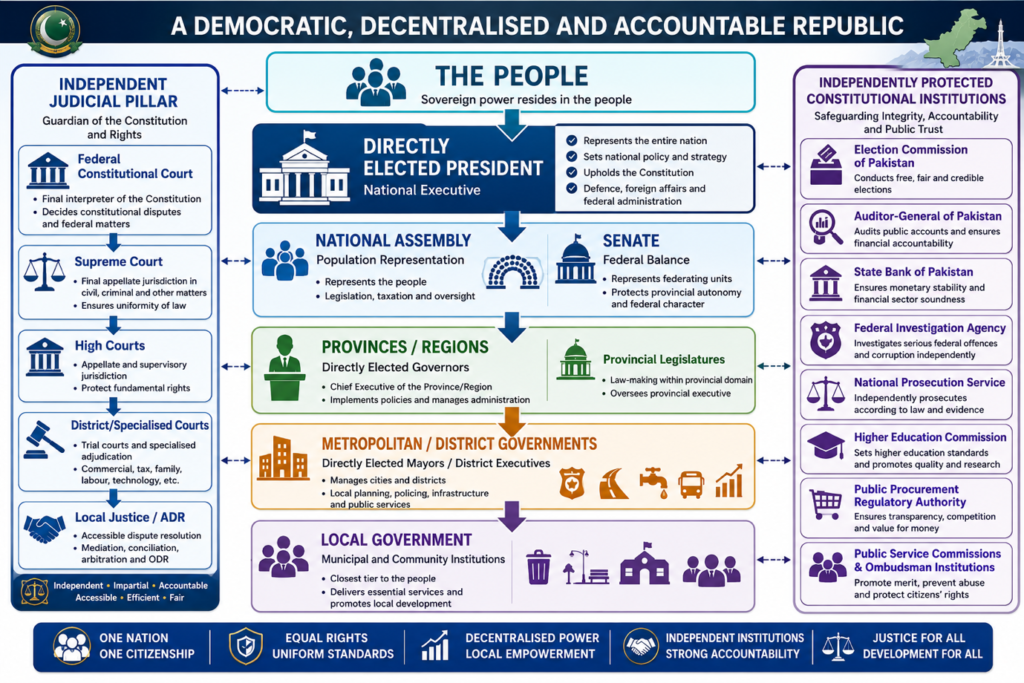
CONSTITUTIONAL INSTITUTIONS
Election Commission
Auditor-General
State Bank
FIA
Prosecution Service
HEC
PPRA
Public Service Commissions
Ombudsman Institutions
LX. THE TEN PRINCIPLES OF A NEW DEMOCRATIC GOVERNANCE COMPACT
The proposed constitutional settlement can ultimately be reduced to ten principles.
1. Democratic Legitimacy
Government must originate from credible elections.
2. Separation of Powers
No institution should possess uncontrolled authority.
3. Governable Federalism
Federating units should be administratively and fiscally viable.
4. Subsidiarity
Power should remain as close to citizens as practical.
5. Equal Citizenship
Minimum education, health and justice standards should apply nationally.
6. Independent Institutions
Election administration, audit, monetary policy, investigation and prosecution must be protected from partisan capture.
7. Local Democracy
Cities and districts should become genuine governments.
8. Accessible Justice
Courts, ADR and community justice should collectively bring justice closer to citizens.
9. Human Capital
Education must produce knowledge, skills, innovation and employability.
10. Measurable Accountability
Every institution exercising public power must disclose what it has achieved with public resources.
LXI. CONCLUSION: FROM FOUR PROVINCES TO A GOVERNABLE REPUBLIC
Pakistan’s constitutional debate should no longer be reduced to whether existing provinces should be divided.
The deeper question is whether the country’s institutional architecture remains suitable for a population exceeding a quarter of a billion people.
The demographic imbalance among the existing federating units is sufficiently large to justify an objective reconsideration of provincial structure.
But more provinces alone will not save Pakistan.
A new province without fiscal viability is another dependency.
A new provincial capital without local government is another centre of centralisation.
A directly elected President without institutional restraints is another concentration of power.
An FIA without independence is another instrument of political coercion.
An elected judge dependent upon campaign money is not necessarily more independent than an appointed judge.
A national curriculum without good teachers will not educate children.
And constitutional rights without resources will remain promises.
The reform must therefore be integrated.
Pakistan needs:
- more governable federating units
- strong constitutional local government
- national minimum standards
- fiscal equalisation
- professional public institutions
- independent investigation and prosecution
- accessible justice
- technical and skills-based education
- regional economic and export development
- environmental resilience
- credible democratic elections
- constitutional checks and balances.
The objective is not to weaken Pakistan by dividing governmental authority.
It is to strengthen Pakistan by making governmental authority manageable and accountable.
National unity does not require administrative immobility.
Indeed, a Federation may sometimes preserve national unity precisely by allowing citizens to experience effective government closer to where they live.
The constitutional question confronting Pakistan is therefore not simply:
“How many provinces should Pakistan have?”
Nor merely:
“Should Pakistan have a parliamentary or presidential system?”
The more important question is:
“What constitutional architecture can make a country of more than 250 million people democratic, governable, economically productive, socially just and institutionally accountable?”
The answer should be determined through evidence and democracy rather than emotion or elite bargaining.
Pakistan should therefore undertake a national constitutional conversation based upon:
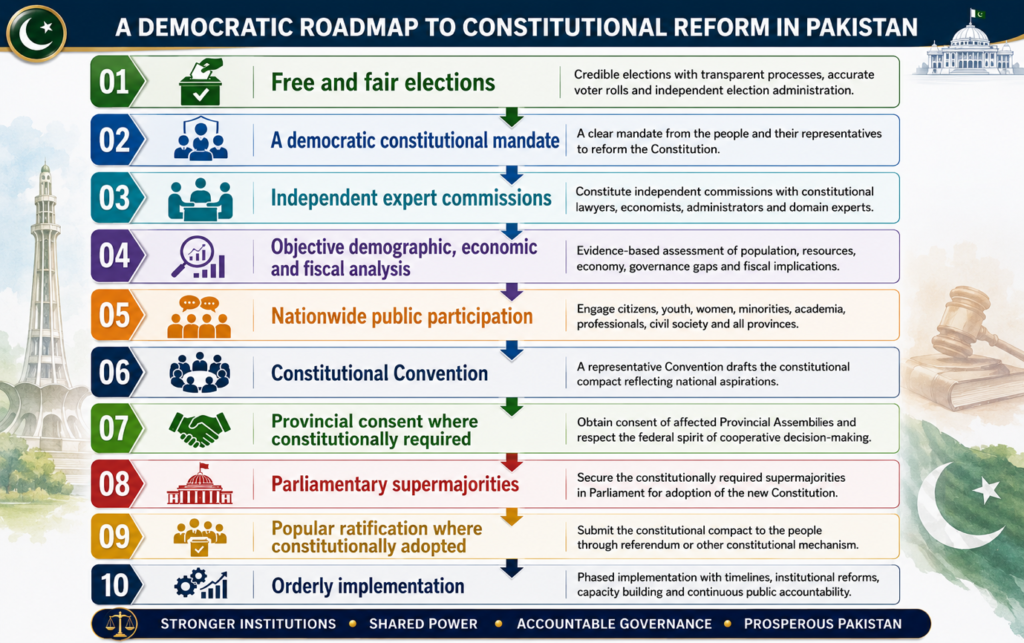
A NEW DEMOCRATIC GOVERNANCE COMPACT FOR PAKISTAN
The governing philosophy of that compact can be expressed in four propositions:
Centralise what national sovereignty requires.
Standardise what equal citizenship requires.
Regionalise what excessive scale makes unmanageable.
Localise what can be delivered better close to the citizen.
Pakistan does not need constitutional change merely for the sake of constitutional change.
It needs a constitutional order in which citizens can identify who possesses power, who has the resources, who bears responsibility and who can be held accountable when government fails.
That is the true meaning of devolution.
That is the foundation of good governance.
And that should be the purpose of constitutional reconstruction.
References and Comparative Materials
Constitutional and Pakistani Materials
- Constitution of the Islamic Republic of Pakistan 1973, particularly arts 140A, 213, 218, 238 and 239.
- Pakistan Bureau of Statistics, 7th Population and Housing Census 2023.
- Pakistan Bureau of Statistics, Labour Force Survey 2024–25.
- Government of Pakistan, Ministry of Finance, Pakistan Economic Survey.
- Election Commission of Pakistan, constitutional and institutional materials concerning the Election Commission and Chief Election Commissioner.
- Higher Education Commission Pakistan, institutional and Commission materials.
- Pakistan Bar Council, Pakistan Bar Council Legal Education Rules 2015.
- Public Procurement Regulatory Authority, federal public-procurement framework.
- Federal Board of Revenue, institutional materials concerning Inland Revenue and Customs.
- State Bank of Pakistan, statutory and institutional materials.
- Law and Justice Commission of Pakistan, judicial statistics.
Comparative and International Materials
- OECD, Vocational Education and Training Systems in Nine Countries (2025), particularly the analysis of Germany’s dual vocational system.
- OECD, The Landscape of Providers of Vocational Education and Training, Germany chapter.
- Constitution of the Republic of South Africa 1996, ch 3 (Co-operative Government) and ch 7 (Local Government).
- Constitution of the Republic of South Africa 1996, provisions concerning equitable division of national revenue among national, provincial and local government.
- World Bank, Pakistan Country Climate and Development Report and associated climate-resilience analysis.
- World Bank and partner institutions, Pakistan Floods 2022: Post-Disaster Needs Assessment, including estimates of more than US$30 billion in combined damage and economic loss.
- International IDEA, materials on constitution-building, democratic participation and constitution-making processes.
OECD, M